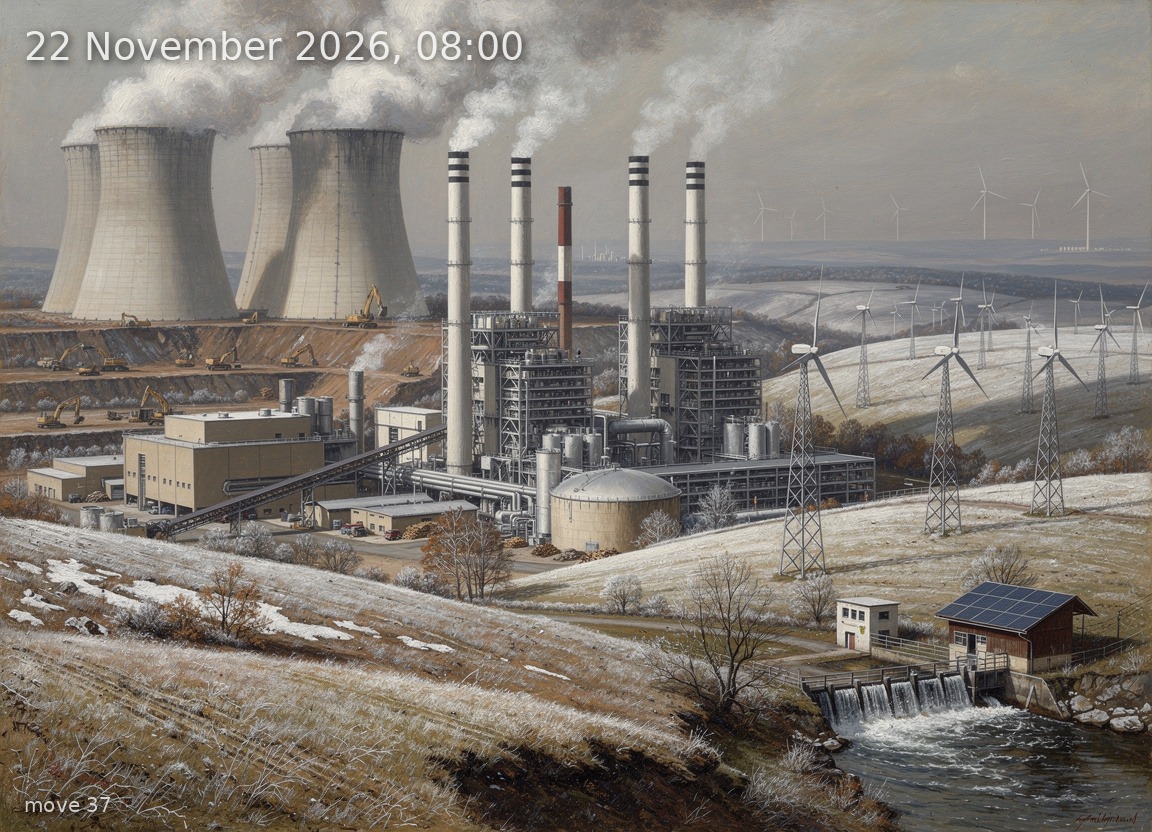
Cold November morning: gas, coal, and wind share the load as heavy cloud and high demand push prices near 195 EUR/MWh.
Generation mix
Wind onshore 21%
Wind offshore 8%
Solar 5%
Biomass 11%
Hydro 3%
Natural gas 24%
Hard coal 12%
Brown coal 16%
48%
Renewable share
11.1 GW
Wind (on + offshore)
2.1 GW
Solar
38.6 GW
Total generation
11.9 GW
Net import
194.4 EUR/MWh
Day-ahead price
1.5°C / 5 km/h
Temp / Wind speed
Open-Meteo, Kassel (51.3°N 9.5°E) · surface estimate from 100 m wind
88.0% / 0.0 W/m²
Cloud cover / Radiation
341
gCO₂/kWh
Image prompt
Natural gas 9.3 GW dominates the centre of the composition as a cluster of CCGT power plants with tall slender exhaust stacks venting white plumes; wind onshore 8.0 GW spans the right third as rows of three-blade turbines on lattice towers across rolling frost-covered hills; brown coal 6.1 GW occupies the left background as massive hyperbolic cooling towers emitting thick steam columns above an open-pit lignite mine; hard coal 4.7 GW appears as a traditional coal-fired station with rectangular boiler houses and tall chimneys to the left of centre; biomass 4.1 GW is rendered as a mid-sized industrial plant with a wood-chip storage dome and moderate stack beside bare deciduous trees; wind offshore 3.0 GW is visible on the far-right horizon as distant turbines rising from a grey sea; solar 2.1 GW appears only as dormant dark panels on a barn roof receiving no sunlight; hydro 1.1 GW is a small run-of-river weir with a powerhouse tucked into a valley in the lower right. The lighting is early-morning late-November daylight at 08:00 — flat, diffuse, cold grey-white illumination under 88% dense overcast stratus clouds with no direct sunlight and no shadows, the sky a uniform heavy pewter-grey pressing down oppressively. The landscape is late-autumn central German terrain: bare oaks and beeches, frost-whitened stubble fields, patches of old snow, temperature near freezing with visible breath-mist near ground level. The atmosphere is heavy and brooding, reflecting the high electricity price — a sense of industrial weight and cost pervading the entire scene. Rendered as a highly detailed oil painting in the tradition of 19th-century German Romantic landscape art — Caspar David Friedrich meets industrial realism — with rich impasto brushwork, atmospheric sfumato in the distant cooling tower plumes, meticulous engineering accuracy on every turbine nacelle, every lattice tower bolt, every cooling tower's concrete ribbing. Deep tonal palette of slate grey, steel blue, ochre, and muted brown. No text, no labels.