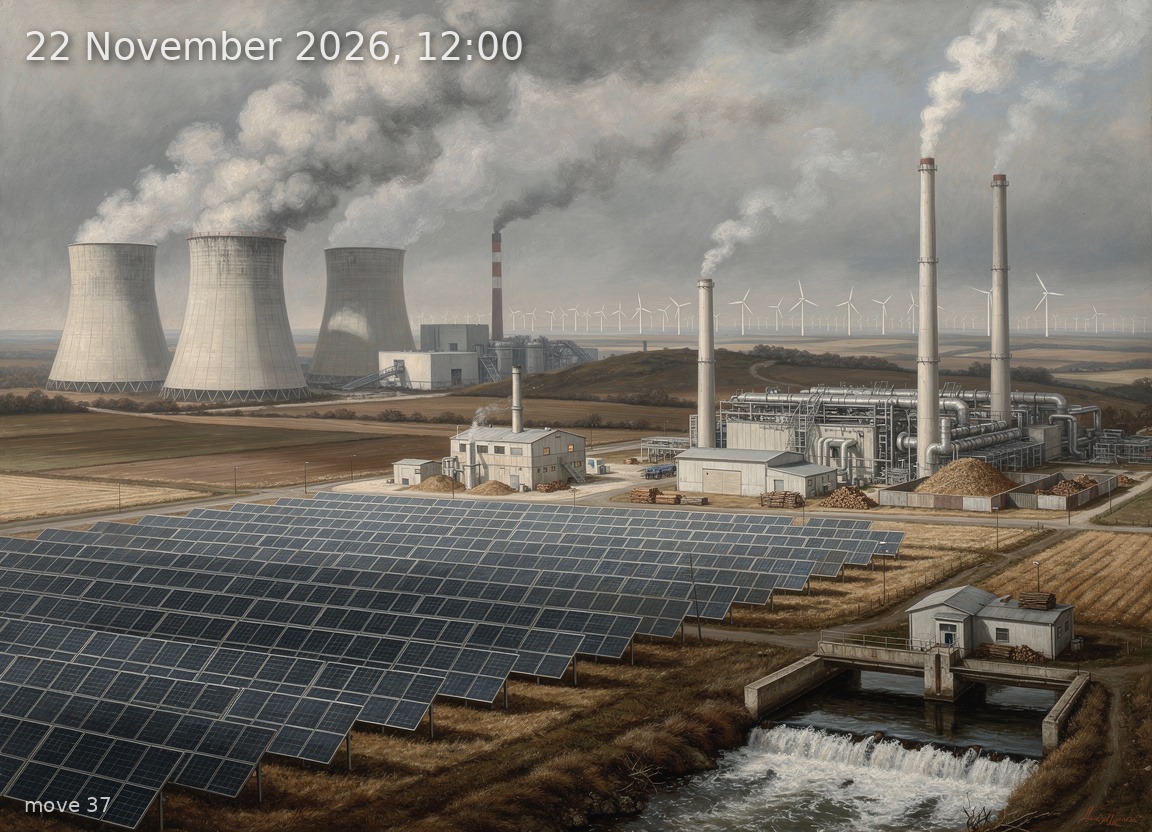
Solar leads at 12.3 GW but gas, brown coal, and 9 GW net imports fill a cold-weather supply gap.
Generation mix
Wind onshore 9%
Wind offshore 7%
Solar 26%
Biomass 10%
Hydro 2%
Natural gas 20%
Hard coal 10%
Brown coal 15%
55%
Renewable share
7.7 GW
Wind (on + offshore)
12.3 GW
Solar
46.8 GW
Total generation
9.0 GW
Net import
201.6 EUR/MWh
Day-ahead price
4.6°C / 7 km/h
Temp / Wind speed
Open-Meteo, Kassel (51.3°N 9.5°E) · surface estimate from 100 m wind
71.0% / 44.5 W/m²
Cloud cover / Radiation
298
gCO₂/kWh
Records
#1
Dead Calm
Image prompt
Solar 12.3 GW dominates the foreground as vast fields of aluminium-framed crystalline silicon photovoltaic panels stretching across flat agricultural land, catching weak diffused light; natural gas 9.4 GW fills the centre-right as a cluster of modern combined-cycle gas turbine plants with tall slender exhaust stacks emitting thin white plumes; brown coal 7.0 GW occupies the left-centre as three massive hyperbolic concrete cooling towers releasing thick billowing steam columns into the grey sky; hard coal 4.7 GW appears behind them as a smaller coal-fired station with rectangular boiler houses and a tall chimney trailing dark-tinged exhaust; biomass 4.5 GW is rendered as a mid-ground wood-chip power station with a squat smokestack and timber storage yards; wind onshore 4.3 GW appears as a line of modern three-blade turbines on low hills in the middle distance, rotors turning slowly in light wind; wind offshore 3.4 GW is suggested by a row of turbines visible on a hazy far horizon above a northern plain; hydro 1.1 GW is a small run-of-river plant with a weir beside a cold stream in the lower right corner. The scene is set at noon in late November under 71% cloud cover: a heavy, oppressive overcast sky in muted pewter and slate grey with occasional thin breaks allowing pale watery daylight through, no direct sun visible, the atmosphere thick and leaden reflecting the 201.6 EUR/MWh price. Temperature is near freezing: bare deciduous trees with skeletal branches, brown stubble fields dusted with frost, breath-like steam from every stack and tower accentuated by the 4.6°C cold. Light wind barely moves the sparse dead grasses. Rendered as a highly detailed panoramic oil painting in the tradition of 19th-century German Romantic landscape art — Caspar David Friedrich meets industrial sublime — with rich impasto brushwork, atmospheric aerial perspective fading into misty distance, sombre tonal palette of greys, browns, and cold blues, meticulous engineering detail on every turbine nacelle, every panel frame, every cooling tower's concrete ribbing, dramatic compositional depth from foreground panels to distant offshore turbines. No text, no labels.