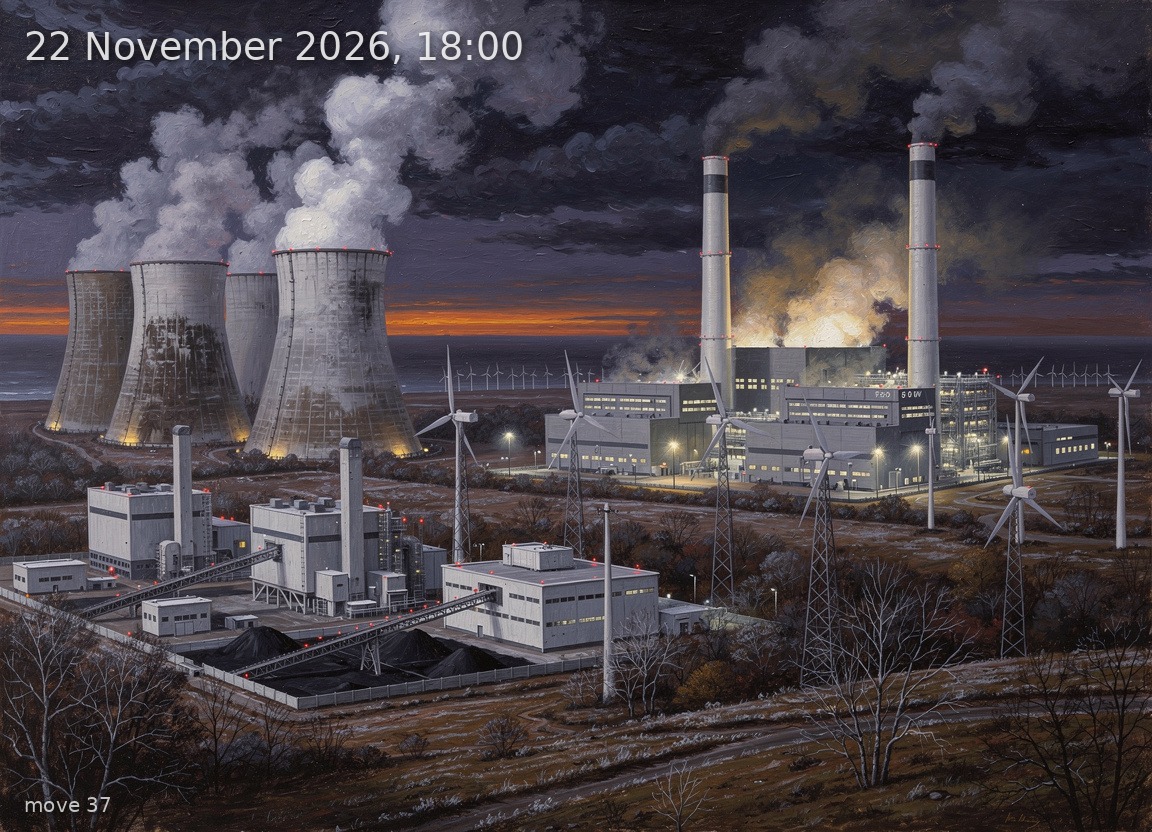
Gas, brown coal, and wind dominate evening generation as cold temperatures and zero solar drive imports and high prices.
Generation mix
Wind onshore 21%
Wind offshore 11%
Biomass 9%
Hydro 2%
Natural gas 25%
Hard coal 12%
Brown coal 20%
43%
Renewable share
15.4 GW
Wind (on + offshore)
0.0 GW
Solar
48.0 GW
Total generation
9.8 GW
Net import
230.0 EUR/MWh
Day-ahead price
4.2°C / 11 km/h
Temp / Wind speed
Open-Meteo, Kassel (51.3°N 9.5°E) · surface estimate from 100 m wind
74.0% / 0.0 W/m²
Cloud cover / Radiation
374
gCO₂/kWh
Image prompt
Natural gas 12.0 GW dominates the centre-right as a cluster of large CCGT power stations with tall single exhaust stacks venting pale combustion gases; brown coal 9.6 GW occupies the left third as massive hyperbolic cooling towers emitting thick white steam plumes from a sprawling lignite complex; hard coal 5.5 GW appears as a pair of industrial coal-fired plants with square chimneys and conveyor belts in the centre-left; wind onshore 10.1 GW stretches across the mid-ground as dozens of three-blade turbines on lattice and tubular towers, rotors turning moderately; wind offshore 5.3 GW is visible as a distant row of turbines along the far horizon; biomass 4.4 GW is rendered as a compact wood-fired CHP plant with a rounded silo and modest stack at the right edge; hydro 1.1 GW appears as a small run-of-river weir with a powerhouse tucked near a river in the foreground. Time is 18:00 in late November — full darkness has nearly arrived, with only a thin dying ember-orange glow along the lowest sliver of the western horizon, the sky above graduating rapidly through deep violet to near-black. Temperature is 4°C: bare deciduous trees, frost beginning to form on brown grass, breath-visible cold. Cloud cover at 74% obscures most stars; patches of dark cloud mass drift across the sky. The atmosphere is heavy and oppressive, conveying the economic weight of 230 EUR/MWh pricing — a brooding, dense, almost suffocating industrial twilight. Sodium-orange streetlights line a small road in the foreground, casting pools of warm light on wet asphalt. The cooling towers and gas stacks are lit from below by industrial floodlights, their steam plumes glowing amber and white against the dark sky. Wind turbines carry red aviation warning lights blinking at their nacelles. The river reflects the industrial glow. Style: highly detailed oil painting in the tradition of 19th-century German Romantic landscape painters such as Caspar David Friedrich and Carl Blechen — rich impasto brushwork, deep chiaroscuro, atmospheric perspective with industrial haze, meticulous engineering accuracy on every turbine nacelle, cooling tower ribbing, and exhaust stack detail. No text, no labels.