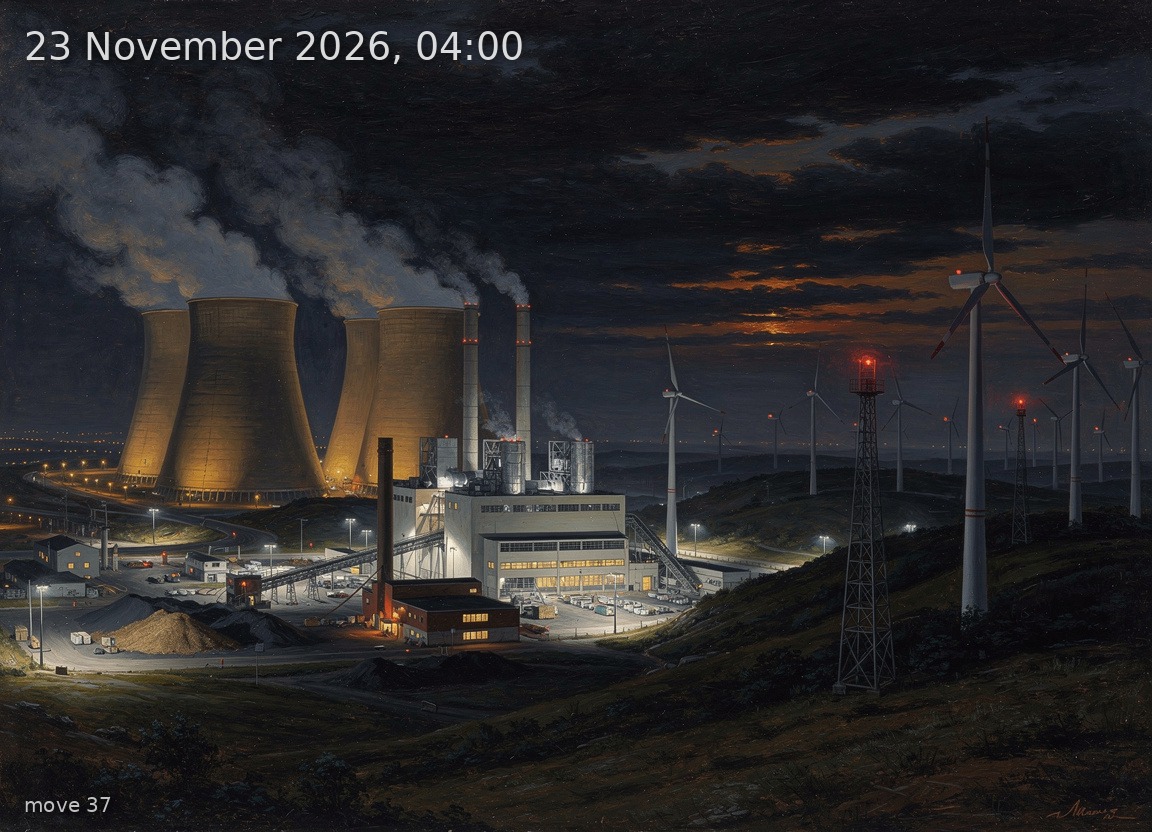
Wind leads at 17.1 GW but coal and gas provide 23.4 GW of thermal backup on a cold, dark November night.
Generation mix
Wind onshore 29%
Wind offshore 8%
Biomass 9%
Hydro 2%
Natural gas 19%
Hard coal 12%
Brown coal 20%
49%
Renewable share
17.1 GW
Wind (on + offshore)
0.0 GW
Solar
45.8 GW
Total generation
1.6 GW
Net import
182.4 EUR/MWh
Day-ahead price
1.0°C / 15 km/h
Temp / Wind speed
Open-Meteo, Kassel (51.3°N 9.5°E) · surface estimate from 100 m wind
89.0% / 0.0 W/m²
Cloud cover / Radiation
348
gCO₂/kWh
Image prompt
Brown coal 8.9 GW dominates the left quarter as a cluster of massive hyperbolic cooling towers with thick white steam plumes billowing upward into the black sky, lit from below by amber sodium lamps; natural gas 8.8 GW fills the centre-left as a row of compact CCGT power stations with tall single exhaust stacks venting thin grey plumes, their steel facades illuminated by industrial floodlights; hard coal 5.7 GW appears just right of centre as a large coal-fired station with rectangular boiler houses, conveyor belts, and stockpiles faintly visible under yellow security lights; wind onshore 13.4 GW spans the right third as dozens of tall three-blade turbines on lattice and tubular towers stretching across dark rolling hills, their red aviation warning lights blinking in unison; wind offshore 3.7 GW is suggested on the far right horizon as a distant line of turbine lights hovering above an unseen North Sea; biomass 4.1 GW appears as a modest wood-chip-fueled plant with a single chimney and a warm glow from its furnace building near the coal station; hydro 1.1 GW is a small run-of-river station nestled beside a dark river in the foreground. The sky is completely dark, deep navy-black, 89% overcast so no stars are visible, only a heavy blanket of low clouds faintly reflecting the orange industrial glow below. Temperature is 1°C: frost glistens on bare November tree branches and dead grass in the foreground, breath-like mist curls near ground level. Wind at 15 km/h causes turbine blades to show motion blur and steam plumes to drift rightward. The atmosphere is heavy and oppressive, reflecting the high 182 EUR/MWh price — a brooding, dense sky pressing down on the industrial landscape. Style: highly detailed oil painting in the tradition of 19th-century German Romantic landscape painters such as Caspar David Friedrich and Carl Blechen, with rich dark colour palette of deep blues, blacks, warm ambers and ochres, visible expressive brushwork, strong chiaroscuro from artificial lighting against total darkness, atmospheric depth with distant turbine lights fading into haze, meticulous engineering accuracy on all turbine nacelles, cooling tower geometries, and plant structures. No text, no labels.