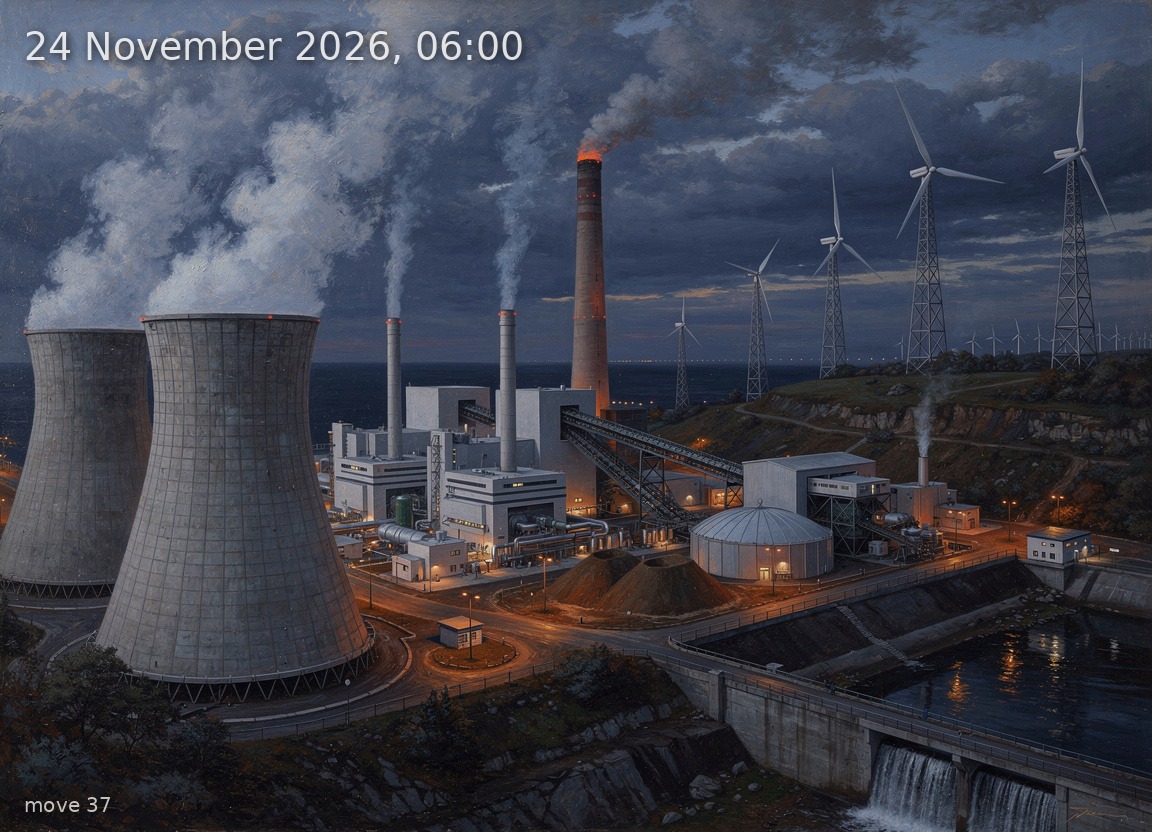
Gas and brown coal dominate a cold, dark pre-dawn grid requiring 14.9 GW net imports at high prices.
Generation mix
Wind onshore 14%
Wind offshore 2%
Biomass 9%
Hydro 3%
Natural gas 34%
Hard coal 12%
Brown coal 27%
27%
Renewable share
7.1 GW
Wind (on + offshore)
0.0 GW
Solar
45.7 GW
Total generation
14.9 GW
Net import
260.6 EUR/MWh
Day-ahead price
-2.0°C / 8 km/h
Temp / Wind speed
Open-Meteo, Kassel (51.3°N 9.5°E) · surface estimate from 100 m wind
56.0% / 0.0 W/m²
Cloud cover / Radiation
479
gCO₂/kWh
Image prompt
Brown coal 12.3 GW dominates the left third of the scene as a cluster of massive hyperbolic cooling towers with thick white steam plumes rising into the dark sky; natural gas 15.4 GW fills the centre-left as a row of compact CCGT power stations with tall single exhaust stacks emitting heat shimmer and lit by orange sodium lamps; hard coal 5.7 GW appears centre-right as a traditional coal plant with conveyor belts and a wide chimney stack glowing faintly; wind onshore 6.2 GW spans the right quarter as a scattered line of three-blade turbines on lattice towers turning slowly on a ridge; wind offshore 0.8 GW is suggested far in the background as tiny turbine silhouettes on a distant dark horizon; biomass 4.1 GW appears as a mid-sized industrial facility with a wood-chip storage dome and a single smokestack near the coal plant; hydro 1.2 GW is a small dam structure at the far right with water glinting under artificial light. Time is early pre-dawn at 06:00 in late November: the sky is deep blue-grey with the faintest pale band on the eastern horizon, no direct sunlight, no sunshine, no solar panels anywhere. Temperature is minus two degrees Celsius: frost coats bare deciduous trees and brown stubble fields, breath-like mist hangs low over the frozen ground. Cloud cover at 56% shows broken grey clouds against the deep pre-dawn sky. Wind is light at 7.8 km/h, turbine blades turning slowly. The atmosphere feels heavy, oppressive, dense — reflecting extreme electricity prices — with an amber-tinged industrial haze pooling around the power stations. Sodium streetlights cast pools of orange light along access roads. Rendered as a highly detailed oil painting in the tradition of 19th-century German Romantic landscape painters — rich, dark colour palette of indigo, umber, and ochre, visible thick brushwork, atmospheric depth and chiaroscuro contrasts, meticulous engineering accuracy on turbine nacelles, cooling tower geometries, CCGT exhaust stacks, and industrial infrastructure. The scene conveys the monumental scale of thermal generation sustaining a frozen nation before dawn. No text, no labels.