Gas and brown coal dominate as near-calm winds and cold temperatures drive high demand and 9.2 GW net imports.
Generation mix
Wind onshore 6%
Wind offshore 1%
Solar 23%
Biomass 7%
Hydro 2%
Natural gas 28%
Hard coal 10%
Brown coal 22%
40%
Renewable share
4.0 GW
Wind (on + offshore)
13.3 GW
Solar
57.5 GW
Total generation
9.2 GW
Net import
261.8 EUR/MWh
Day-ahead price
2.5°C / 3 km/h
Temp / Wind speed
Open-Meteo, Kassel (51.3°N 9.5°E) · surface estimate from 100 m wind
11.0% / 155.3 W/m²
Cloud cover / Radiation
394
gCO₂/kWh
Image prompt
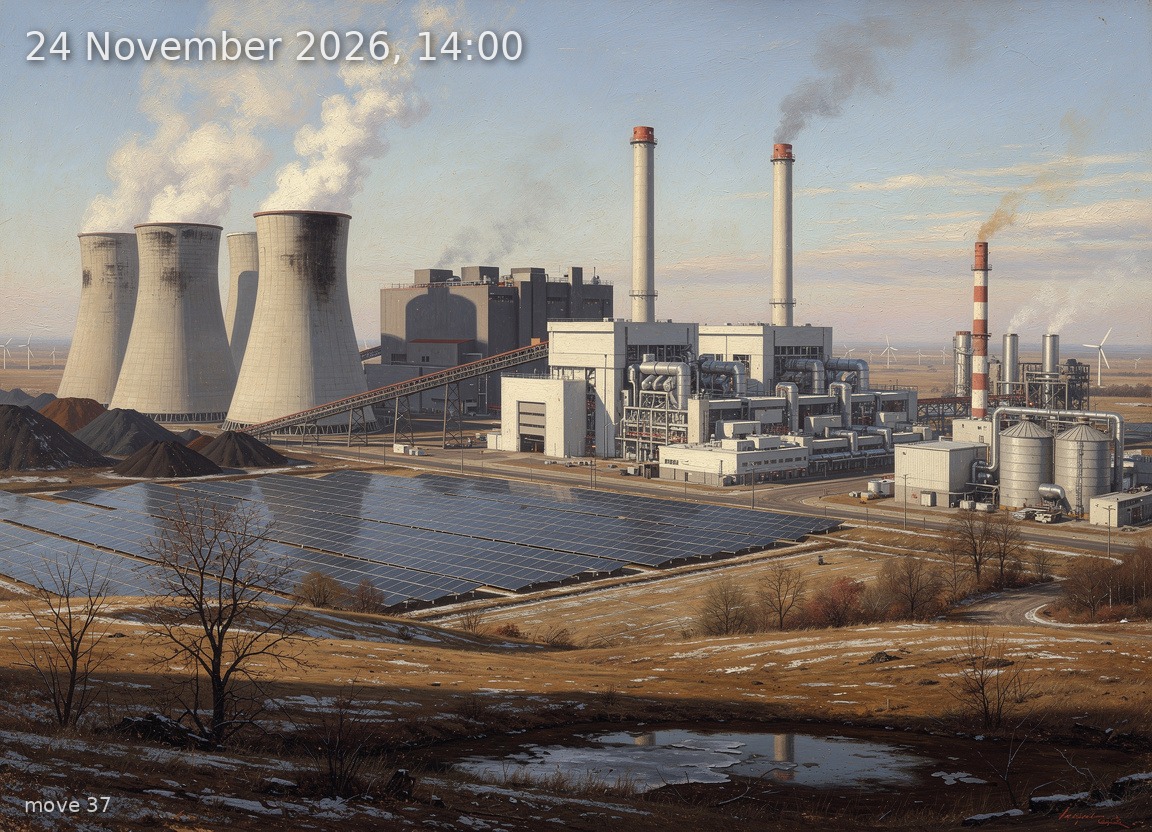
Natural gas 16.2 GW dominates the centre-right of the composition as a large complex of compact CCGT power plants with tall single exhaust stacks venting shimmering heat plumes into the cold air. Brown coal 12.6 GW occupies the left quarter as a cluster of massive hyperbolic cooling towers with thick white steam columns rising vertically in the windless atmosphere, alongside conveyor belts feeding lignite into boiler houses. Hard coal 5.8 GW appears as a secondary industrial block behind the lignite plant, with darker rectangular stacks and coal stockpiles. Solar 13.3 GW spreads across the middle ground as vast fields of aluminium-framed crystalline silicon panels glinting under low-angle winter sunshine. Biomass 4.3 GW is rendered as a mid-sized facility with rounded storage silos and a modest chimney on the right. Wind onshore 3.4 GW appears as a sparse line of three-blade turbines on a distant ridge, their rotors nearly motionless. Wind offshore 0.6 GW is a faint suggestion of two or three turbines on a far horizon. Hydro 1.3 GW is a small dam and powerhouse tucked into a valley at the far left edge. The time is 2:00 PM in late November: low-angle winter daylight with a nearly clear sky — only faint wisps of cloud — casting long shadows and cold pale-gold illumination across the landscape. The air is utterly still, no motion in tree branches or grass. The atmosphere feels heavy and oppressive despite the clear sky, with a slight industrial haze gathering at low level, reflecting the extreme electricity price. Bare deciduous trees, frost-edged brown meadows, and patches of frozen puddles convey the 2.5 °C cold. Style: highly detailed oil painting in the tradition of 19th-century German Romantic landscape painters such as Caspar David Friedrich and Carl Blechen — rich impasto brushwork, atmospheric depth with carefully graduated aerial perspective, dramatic chiaroscuro from the low winter sun, meticulous engineering detail on every turbine nacelle, cooling tower, PV panel frame, and exhaust stack. No text, no labels.