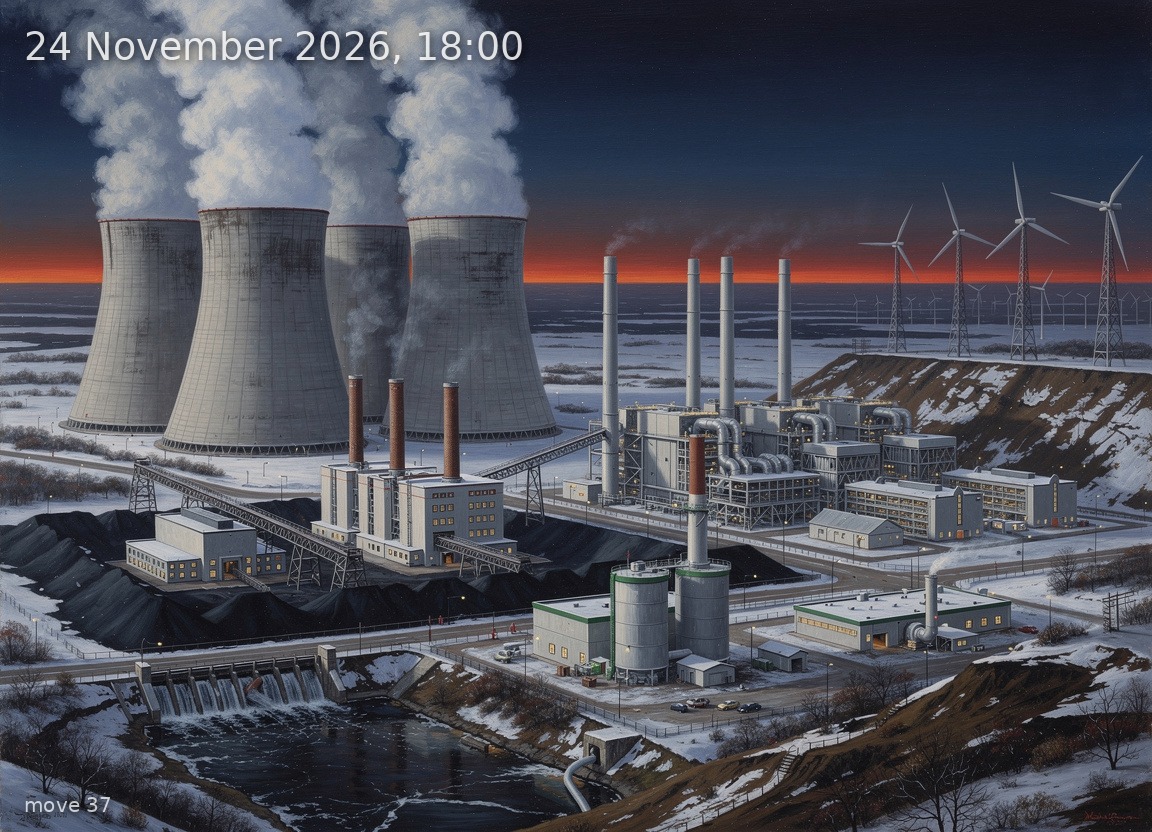
Gas and lignite dominate a cold November evening as zero solar and high demand drive prices above 300 EUR/MWh.
Generation mix
Wind onshore 19%
Wind offshore 2%
Biomass 8%
Hydro 2%
Natural gas 34%
Hard coal 11%
Brown coal 24%
31%
Renewable share
11.0 GW
Wind (on + offshore)
0.0 GW
Solar
53.4 GW
Total generation
15.5 GW
Net import
322.0 EUR/MWh
Day-ahead price
0.1°C / 6 km/h
Temp / Wind speed
Open-Meteo, Kassel (51.3°N 9.5°E) · surface estimate from 100 m wind
0.0% / 0.0 W/m²
Cloud cover / Radiation
446
gCO₂/kWh
Image prompt
Natural gas 17.9 GW dominates the centre-right as a sprawling complex of compact CCGT power plants with tall single exhaust stacks venting pale combustion plumes; brown coal 13.0 GW occupies the left quarter as massive hyperbolic cooling towers emitting thick white steam columns into the freezing air; hard coal 5.9 GW appears centre-left as a cluster of smaller conventional boiler plants with twin chimneys and conveyor gantries; wind onshore 9.9 GW is rendered as a line of large three-blade turbines on lattice towers stretching across a low ridge in the right background, blades slowly turning in light wind; wind offshore 1.2 GW appears as faint silhouettes of turbines on a distant horizon line; biomass 4.4 GW is a modest wood-chip-fired plant with a single green-trimmed stack near the centre; hydro 1.2 GW is suggested by a small dam and penstock structure in the far left middle ground. The scene is set at dusk on a freezing late-November evening: a narrow band of deep orange-red light clings to the very low western horizon, rapidly giving way to a dark indigo-to-black sky above; stars are beginning to appear; the ground is dusted with frost on bare deciduous trees and brown dormant fields; temperature near 0 °C is conveyed by visible breath-like condensation around structures and rime on metal surfaces. The sky feels heavy and oppressive despite being clear, suggesting extreme cost pressure — a faint copper-tinted haze hangs low around the industrial installations. Sodium-orange streetlights illuminate access roads between the plants. No solar panels anywhere. Highly detailed oil painting in the tradition of 19th-century German Romantic landscape painters — Caspar David Friedrich's atmospheric depth merged with industrial realism — rich, dark colour palette of burnt sienna, Prussian blue, lampblack, and raw umber; visible impasto brushwork; meticulous engineering detail on turbine nacelles, three-blade rotors, cooling tower parabolic profiles, CCGT exhaust cowlings, coal conveyors. The composition conveys the sober enormity of thermal generation keeping a freezing nation alight. No text, no labels.