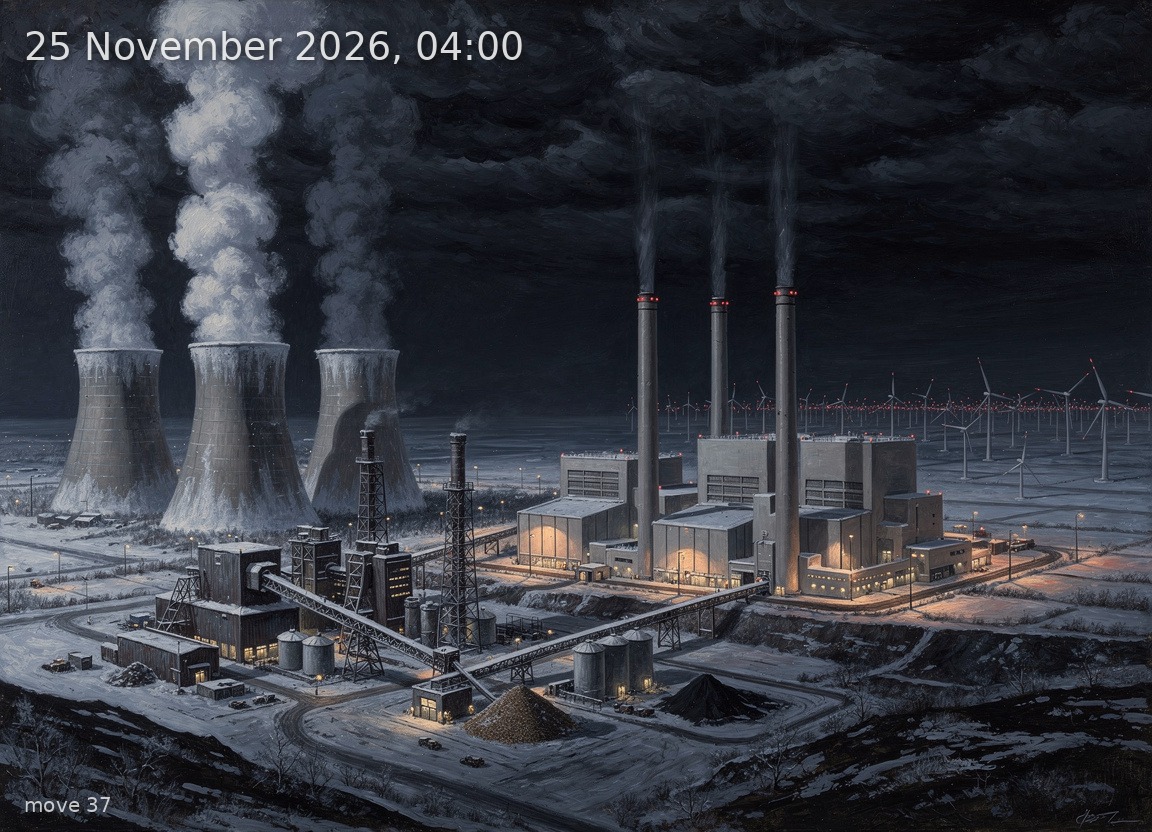
Gas, brown coal, and wind dominate overnight generation as sub-zero temperatures drive firm 51 GW demand.
Generation mix
Wind onshore 26%
Wind offshore 6%
Biomass 8%
Hydro 2%
Natural gas 28%
Hard coal 11%
Brown coal 18%
42%
Renewable share
16.4 GW
Wind (on + offshore)
0.0 GW
Solar
51.6 GW
Total generation
+0.4 GW
Net export
204.2 EUR/MWh
Day-ahead price
-5.4°C / 5 km/h
Temp / Wind speed
Open-Meteo, Kassel (51.3°N 9.5°E) · surface estimate from 100 m wind
100.0% / 0.0 W/m²
Cloud cover / Radiation
372
gCO₂/kWh
Records
#2
Ice Hour
Image prompt
Natural gas 14.4 GW dominates the centre-right as a cluster of large CCGT power plants with tall single exhaust stacks venting pale plumes into the frigid air; brown coal 9.4 GW fills the left quarter as massive hyperbolic cooling towers releasing thick white steam columns against a black sky; hard coal 5.9 GW appears as a heavy industrial complex with rectangular chimneys and conveyor structures just left of centre; wind onshore 13.3 GW spans the distant right third as dozens of three-blade turbines on lattice towers, their red aviation warning lights blinking in the darkness; wind offshore 3.1 GW is suggested on the far-right horizon as a faint row of red-lit nacelles over an invisible North Sea; biomass 4.2 GW appears as a modest wood-chip-fired plant with a low smokestack near the centre-left; hydro 1.3 GW is a small run-of-river station at the lower foreground edge near a dark frozen riverbank. Time is 04:00 — completely dark, no twilight, no sky glow, a pitch-black to deep navy sky with no stars visible through total 100% cloud cover creating a heavy, oppressive overcast ceiling. The landscape is frozen: bare deciduous trees rimmed with frost, patches of snow on the ground, breath-like mist rising from every exhaust. Temperature is minus 5°C, conveyed through ice crystals on metal surfaces and frozen puddles. The atmosphere feels heavy and expensive — thick clouds pressing down on the industrial landscape, sodium-orange streetlights casting harsh pools of amber on icy roads and rail sidings connecting the plants. Rendered as a highly detailed oil painting in the tradition of 19th-century German Romantic landscape art — rich impasto brushwork, deep chiaroscuro contrasts between the glowing industrial fires and surrounding darkness, atmospheric depth achieved through layered mist and steam. Each technology is painted with meticulous engineering accuracy: turbine nacelles with three-blade rotors, aluminium cooling tower frameworks, gas turbine exhaust diffusers, coal conveyor gantries. The scene evokes Caspar David Friedrich's sublime darkness merged with industrial grandeur. No text, no labels.