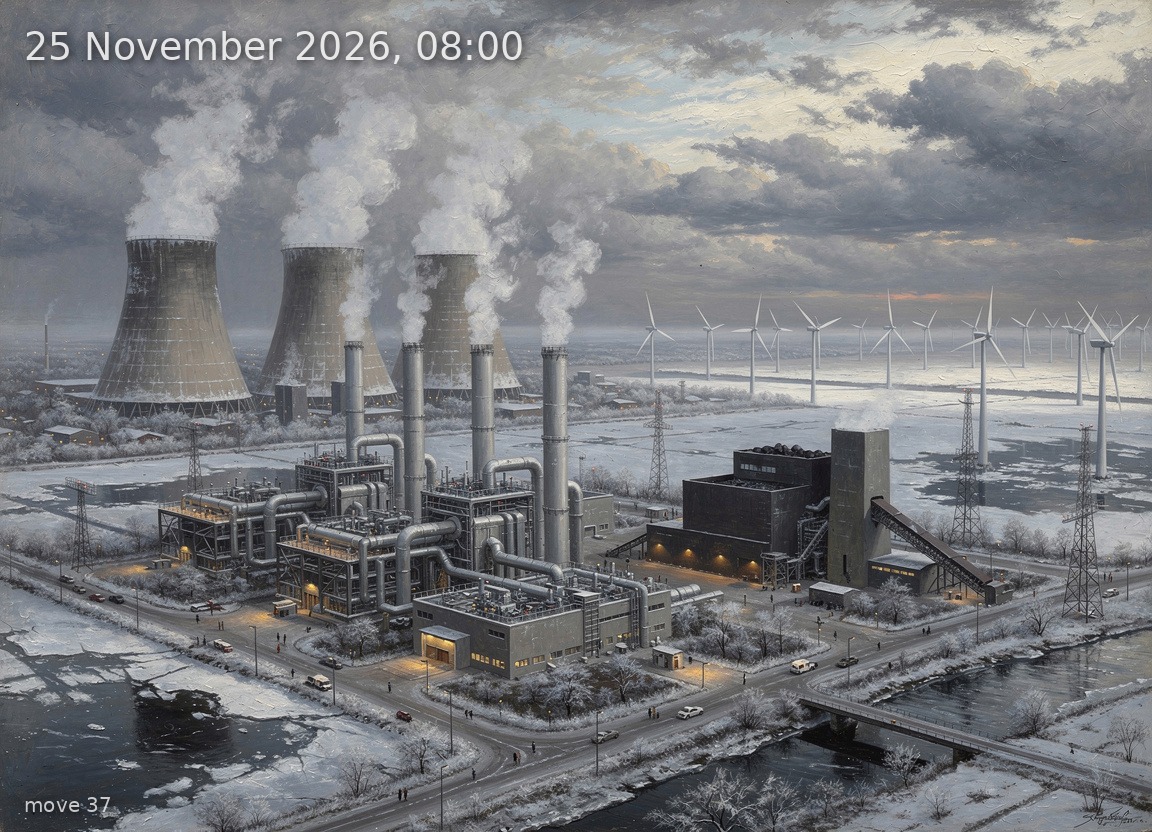
Cold snap drives 67.9 GW demand; gas, lignite, and wind shoulder generation as imports fill a 6.6 GW gap.
Generation mix
Wind onshore 28%
Wind offshore 8%
Solar 4%
Biomass 7%
Hydro 2%
Natural gas 23%
Hard coal 9%
Brown coal 19%
49%
Renewable share
21.9 GW
Wind (on + offshore)
2.6 GW
Solar
61.3 GW
Total generation
6.6 GW
Net import
292.5 EUR/MWh
Day-ahead price
-4.1°C / 8 km/h
Temp / Wind speed
Open-Meteo, Kassel (51.3°N 9.5°E) · surface estimate from 100 m wind
39.0% / 0.0 W/m²
Cloud cover / Radiation
337
gCO₂/kWh
Image prompt
Natural gas 14.2 GW dominates the centre-left as a cluster of compact CCGT power plants with tall single exhaust stacks venting white plumes into frigid air; brown coal 11.6 GW occupies the left background as massive hyperbolic cooling towers with thick steam columns rising vertically in the still cold; hard coal 5.5 GW appears as a smaller coal-fired station with conveyor belts and a single rectangular cooling tower just right of centre; wind onshore 17.0 GW spans the entire right half and distant horizon as dozens of three-blade turbines on lattice and tubular towers turning slowly in light wind; wind offshore 4.9 GW is suggested by a row of turbines on the far-right horizon above a frozen river or canal; biomass 4.2 GW appears as a modest wood-chip plant with a short smokestack and timber yard in the right foreground; hydro 1.2 GW is a small run-of-river weir with icy water visible in the lower-right corner; solar 2.6 GW is represented by a small field of frost-covered aluminium-framed crystalline PV panels in the near foreground catching only diffuse grey light, clearly generating minimally. Time is 08:00 on a late-November morning: the sun has barely risen, the sky is a cold steel-grey with roughly 39 % cloud cover breaking into pale patches, and low-angle diffuse light casts long blue shadows across a frozen landscape. Temperature is -4 °C: frost coats every surface, bare deciduous trees with icy branches, frozen puddles, breath-vapour from any figures. The atmosphere is heavy, oppressive, and brooding — reflecting extreme electricity prices — with a leaden, metallic quality to the sky. Painted in the style of a highly detailed 19th-century German Romantic oil painting — rich impasto brushwork, deep atmospheric perspective, dramatic chiaroscuro — yet with meticulous engineering accuracy in every turbine nacelle, cooling tower profile, and exhaust stack. The colour palette is dominated by cold blue-greys, slate, and iron tones with warm amber accents from sodium lights still glowing at the industrial facilities. No text, no labels.