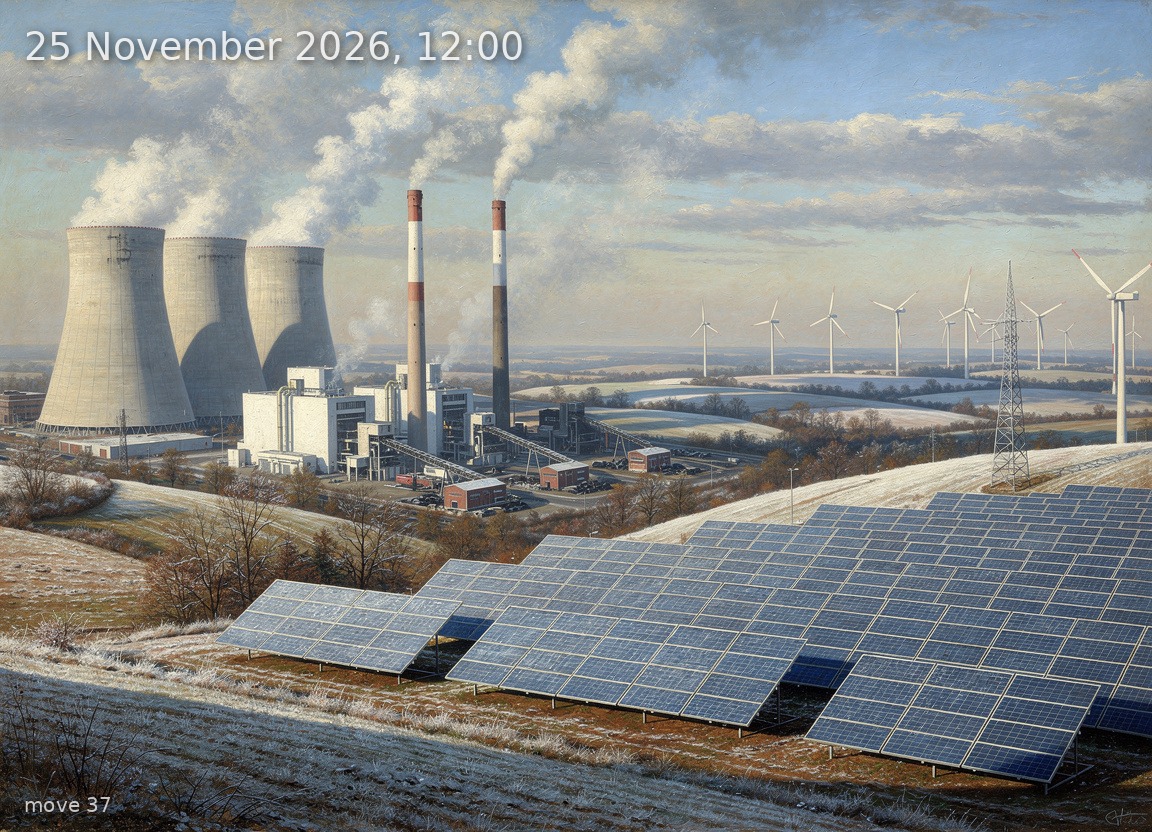
Strong midday solar and steady wind drive 55% renewable share; coal and gas hold firm, pushing 5.9 GW net exports.
Generation mix
Wind onshore 16%
Wind offshore 6%
Solar 25%
Biomass 6%
Hydro 2%
Natural gas 21%
Hard coal 8%
Brown coal 16%
55%
Renewable share
16.9 GW
Wind (on + offshore)
18.4 GW
Solar
75.1 GW
Total generation
+5.9 GW
Net export
229.1 EUR/MWh
Day-ahead price
0.5°C / 9 km/h
Temp / Wind speed
Open-Meteo, Kassel (51.3°N 9.5°E) · surface estimate from 100 m wind
37.0% / 114.8 W/m²
Cloud cover / Radiation
297
gCO₂/kWh
Image prompt
Solar 18.4 GW dominates the centre-right as vast fields of aluminium-framed crystalline silicon photovoltaic panels catching low-angle midday winter sun; natural gas 15.5 GW occupies the centre-left as a cluster of compact CCGT power stations with tall single exhaust stacks venting thin white plumes; brown coal 12.4 GW fills the far left as massive hyperbolic concrete cooling towers with billowing steam columns; wind onshore 12.1 GW spans the distant right horizon as dozens of three-blade turbines on lattice and tubular towers turning slowly; hard coal 6.0 GW appears as a pair of industrial coal plants with conveyor belts and thick rectangular chimneys near the brown coal complex; wind offshore 4.8 GW is suggested by a row of turbines visible on a hazy far-left horizon line above a distant grey sea; biomass 4.6 GW appears as a timber-clad biomass plant with a modest smokestack and stacked woodchip piles in the mid-ground; hydro 1.3 GW is a small run-of-river weir with churning white water in the lower foreground. The scene is set at noon on a late-November day in central Germany: the sun is low in the southern sky at roughly 20° elevation, casting long pale shadows across frost-dusted bare fields and leafless deciduous trees. The sky is mostly clear but with patches of grey-white cumulus clouds covering about a third of the dome, allowing bright but cool daylight to illuminate the landscape. Temperature near freezing: thin frost on grass, bare brown earth, no snow. The atmosphere feels heavy and oppressive despite the partial sunshine — a subtle yellowish-grey industrial haze hangs at mid-level, reflecting the high electricity price. Style: highly detailed oil painting in the tradition of 19th-century German Romantic landscape painters such as Caspar David Friedrich and Carl Blechen — rich saturated colour palette of cold blues, warm amber sunlight, grey industrial tones, visible impasto brushwork, dramatic atmospheric depth and chiaroscuro. Every technology rendered with meticulous engineering accuracy: turbine nacelles, rotor hubs, PV cell grids, cooling tower parabolic profiles, CCGT heat-recovery units. The composition reads as a panoramic industrial landscape masterwork. No text, no labels, no people prominent.