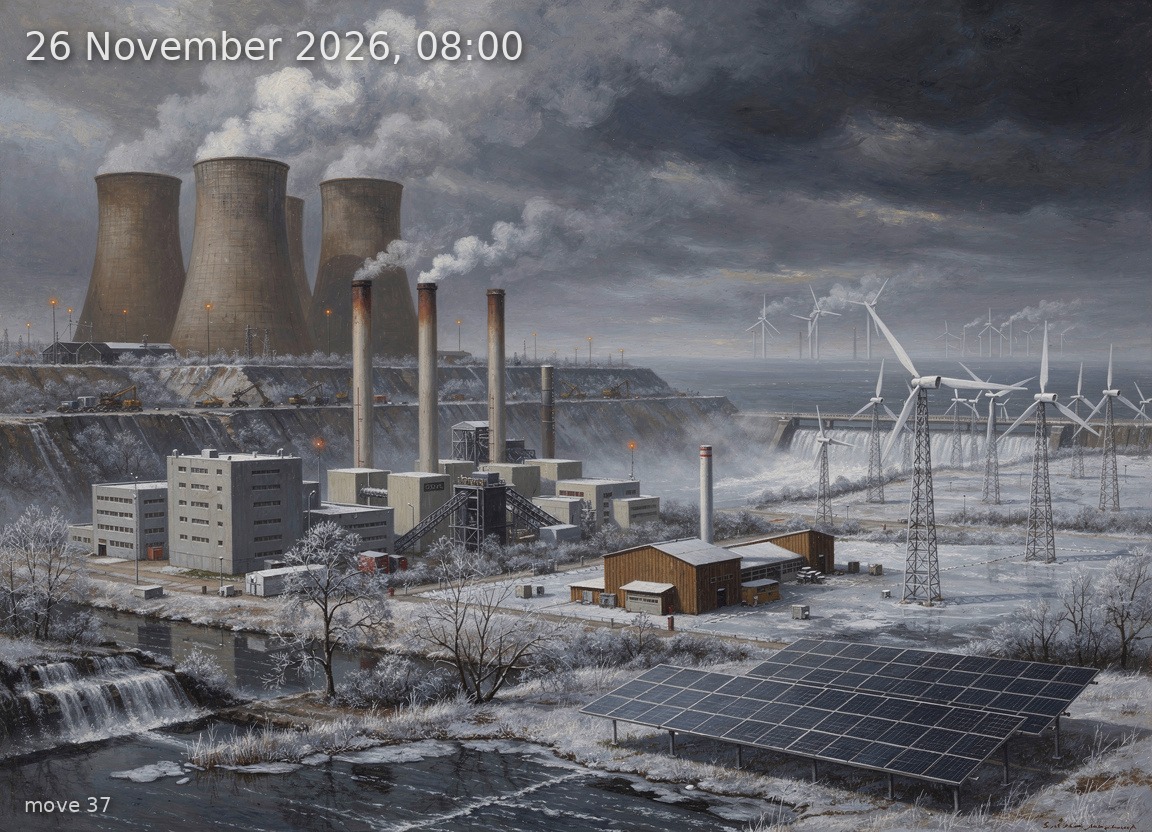
Wind, brown coal, and gas dominate generation as sub-zero cold and heavy cloud drive strong demand and high prices.
Generation mix
Wind onshore 28%
Wind offshore 9%
Solar 3%
Biomass 8%
Hydro 2%
Natural gas 21%
Hard coal 10%
Brown coal 19%
50%
Renewable share
21.4 GW
Wind (on + offshore)
1.5 GW
Solar
57.5 GW
Total generation
11.9 GW
Net import
326.2 EUR/MWh
Day-ahead price
-0.8°C / 14 km/h
Temp / Wind speed
Open-Meteo, Kassel (51.3°N 9.5°E) · surface estimate from 100 m wind
79.0% / 0.0 W/m²
Cloud cover / Radiation
336
gCO₂/kWh
Image prompt
Wind onshore 16.1 GW occupies the right third of the scene as dozens of three-blade turbines with lattice towers stretching across a frozen, frost-covered plain, blades turning steadily in moderate wind. Wind offshore 5.4 GW appears as a distant cluster of larger turbines visible through haze on the far-right horizon. Brown coal 11.0 GW dominates the left quarter as massive hyperbolic cooling towers with thick white-grey steam plumes billowing into the oppressive overcast sky, adjacent open-pit mine terraces faintly visible. Natural gas 12.3 GW fills the center-left as a row of compact CCGT power plants with tall single exhaust stacks venting thin hot plumes. Hard coal 5.6 GW appears as a smaller conventional power station with twin rectangular stacks and coal conveyors behind the gas plants. Biomass 4.4 GW is rendered as a modest wood-clad industrial facility with a single chimney emitting pale smoke, positioned in the middle ground. Hydro 1.2 GW is suggested by a small dam structure with water cascading in the far middle distance. Solar 1.5 GW is represented by a small field of aluminium-framed crystalline silicon panels in the foreground, their surfaces dull and unreflective under the dark overcast. The sky is a heavy, oppressive 79% cloud cover in layered slate-grey and leaden tones, full winter daylight at 08:00 but dim — no direct sunlight, diffuse illumination only. Temperature is below zero: frost coats every surface, bare black deciduous trees, patches of thin ice on puddles, breath-like mist near ground level. The atmosphere feels weighty and expensive, the low heavy clouds pressing down. Rendered as a highly detailed oil painting in the tradition of 19th-century German Romantic landscape painters — rich dark palette of greys, steel blues, ochres, and warm industrial oranges from stack lights; visible impasto brushwork; atmospheric aerial perspective with distant elements fading into cold haze; meticulous engineering detail on every turbine nacelle, cooling tower ribbing, and exhaust stack. No text, no labels.