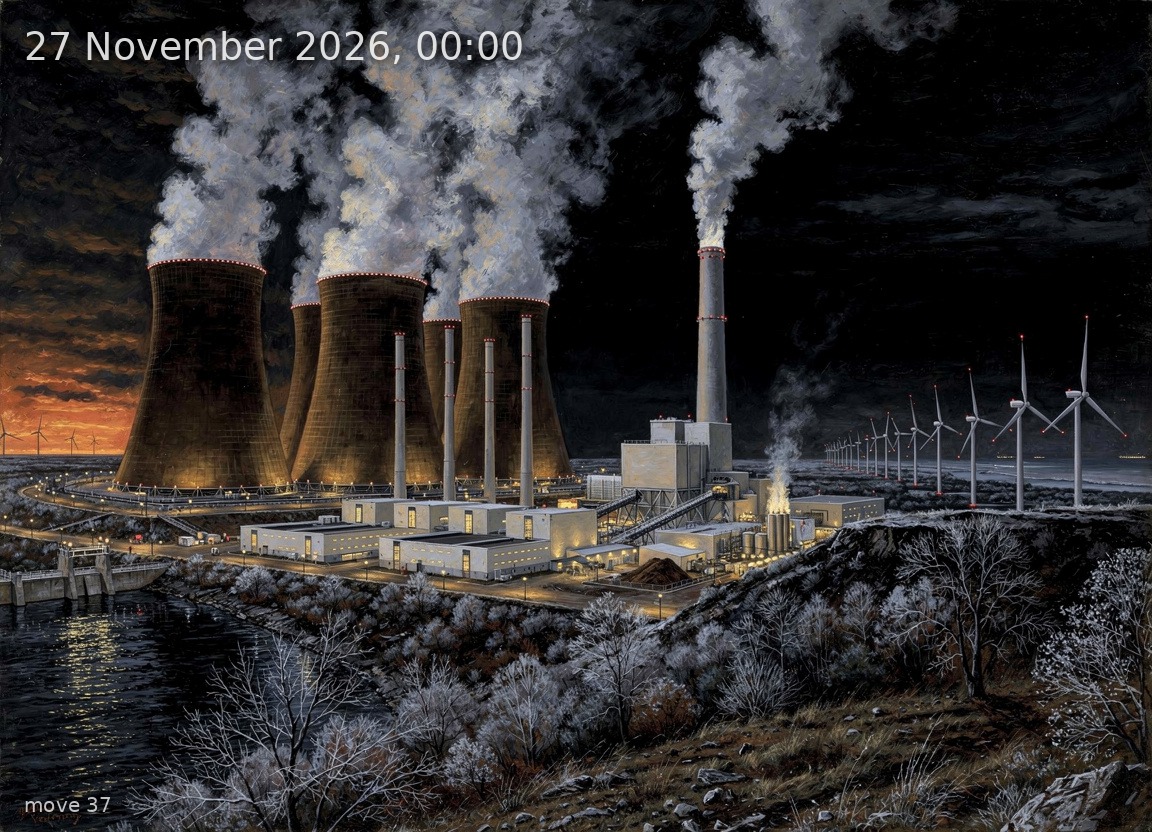
Gas, brown coal, and hard coal anchor overnight supply as sub-zero temperatures lift demand above domestic generation capacity.
Generation mix
Wind onshore 15%
Wind offshore 5%
Biomass 10%
Hydro 3%
Natural gas 32%
Hard coal 12%
Brown coal 23%
32%
Renewable share
9.5 GW
Wind (on + offshore)
0.0 GW
Solar
48.3 GW
Total generation
5.8 GW
Net import
237.5 EUR/MWh
Day-ahead price
-0.7°C / 10 km/h
Temp / Wind speed
Open-Meteo, Kassel (51.3°N 9.5°E) · surface estimate from 100 m wind
82.0% / 0.0 W/m²
Cloud cover / Radiation
441
gCO₂/kWh
Image prompt
Brown coal 11.3 GW occupies the left quarter as a cluster of massive hyperbolic cooling towers with thick white steam plumes rising into the black sky; natural gas 15.4 GW fills the centre-left as a row of modern CCGT power plants with tall slender exhaust stacks emitting heat shimmer and faint orange-lit vapour; hard coal 6.0 GW appears centre-right as a squat industrial plant with conveyor belts and a single large smokestack; wind onshore 7.2 GW stretches across the right third as a line of three-blade turbines on a dark ridge, their red aviation warning lights blinking; wind offshore 2.3 GW is suggested by distant turbines on a barely visible sea horizon at far right; biomass 4.6 GW appears as a compact wood-chip-fed plant with a modest plume near the coal facility; hydro 1.4 GW is a small concrete dam structure at the far left edge with water glinting under artificial light. The scene is set at midnight in late November central Germany: the sky is completely black with no twilight, no moon visible, heavy overcast clouds faintly lit from below by sodium-orange industrial lighting. Frost coats bare deciduous trees and dead grass in the foreground. Temperature is below zero — breath-like vapour rises from every stack and tower. The atmosphere feels heavy and oppressive, reflecting the extreme electricity price. All facilities glow with warm industrial light — sodium streetlamps, security floodlights, control-room windows. Rendered as a highly detailed oil painting in the tradition of 19th-century German Romantic landscape art — rich impasto brushwork, deep chiaroscuro contrasts between the black sky and the orange-lit industrial sprawl, atmospheric depth with steam and haze layering into the distance, meticulous engineering accuracy on turbine nacelles, lattice towers, cooling tower parabolic curves, and CCGT exhaust geometry. No text, no labels.