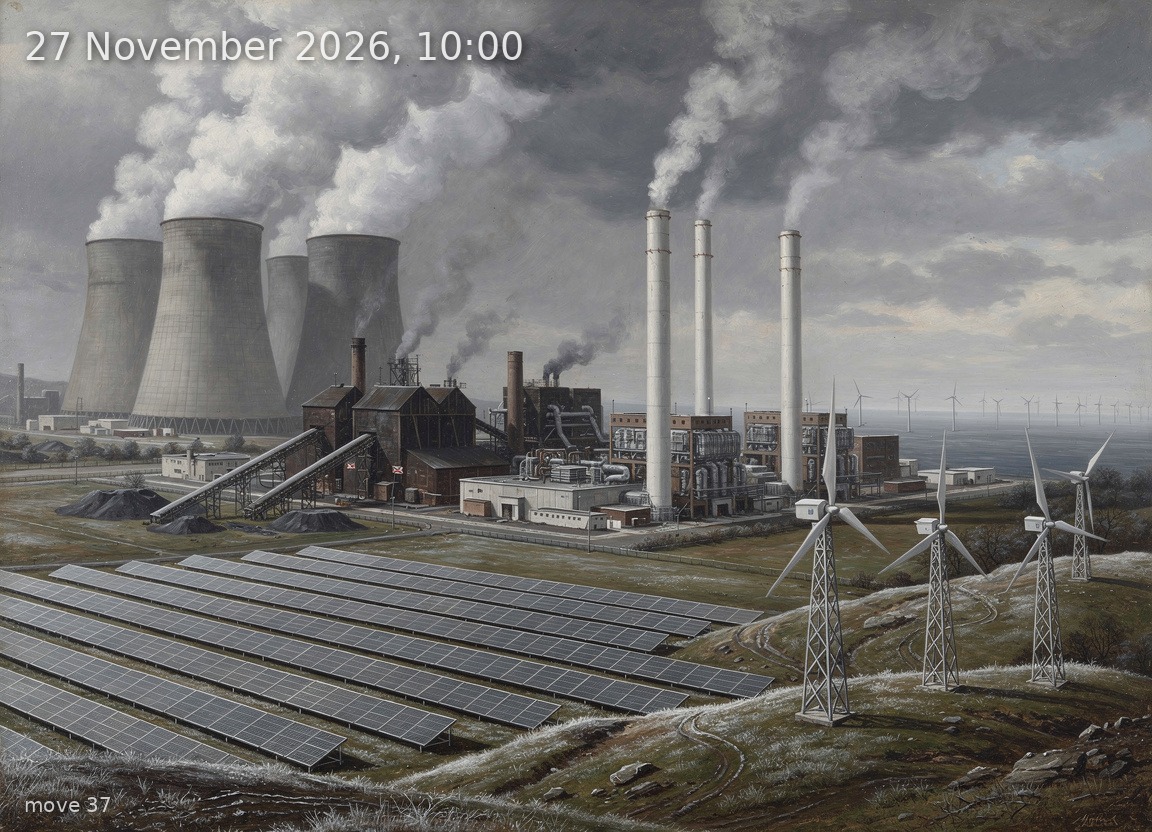
Gas, brown coal, and hard coal dominate as cold, overcast weather limits renewables and drives high demand and prices.
Generation mix
Wind onshore 8%
Wind offshore 7%
Solar 15%
Biomass 8%
Hydro 2%
Natural gas 29%
Hard coal 11%
Brown coal 20%
40%
Renewable share
8.7 GW
Wind (on + offshore)
8.8 GW
Solar
57.8 GW
Total generation
13.9 GW
Net import
345.1 EUR/MWh
Day-ahead price
-0.5°C / 10 km/h
Temp / Wind speed
Open-Meteo, Kassel (51.3°N 9.5°E) · surface estimate from 100 m wind
87.0% / 8.5 W/m²
Cloud cover / Radiation
385
gCO₂/kWh
Image prompt
Natural gas 16.7 GW dominates the centre-right as a sprawling complex of compact CCGT units with tall single exhaust stacks venting white plumes; brown coal 11.5 GW occupies the left third as massive hyperbolic cooling towers with thick steam columns rising into grey sky; hard coal 6.2 GW appears centre-left as a cluster of dark industrial boiler houses with conveyor belts and twin chimneys; solar 8.8 GW is rendered as an extensive field of aluminium-framed crystalline silicon PV panels in the mid-ground, their surfaces dull and unreflective under heavy overcast; wind onshore 4.8 GW appears as a scattered line of three-blade turbines with lattice towers on low hills at right, blades turning slowly in light wind; wind offshore 3.9 GW is visible in the far-right background as a row of turbines on a grey sea horizon; biomass 4.6 GW appears as medium-sized industrial facilities with woodchip silos and modest stacks emitting thin smoke in the right mid-ground; hydro 1.3 GW is a small dam and reservoir visible in a valley at far left. Late November morning at 10:00, full daylight but heavily overcast at 87% cloud cover, sky a uniform oppressive pewter-grey pressing down on the landscape, no direct sunlight — only flat diffuse illumination. Temperature is -0.5°C: frost covers bare deciduous trees and brown dormant fields, patches of thin ice on puddles, breath-like mist near ground level. The atmosphere feels heavy and costly, a brooding industrial panorama under a low suffocating ceiling of cloud. Rendered as a highly detailed oil painting in the tradition of 19th-century German Romantic landscape painters — rich muted earth tones, visible confident brushwork, atmospheric depth with haze softening distant cooling towers, meticulous engineering detail on every turbine nacelle, every panel frame, every conveyor mechanism. No text, no labels.