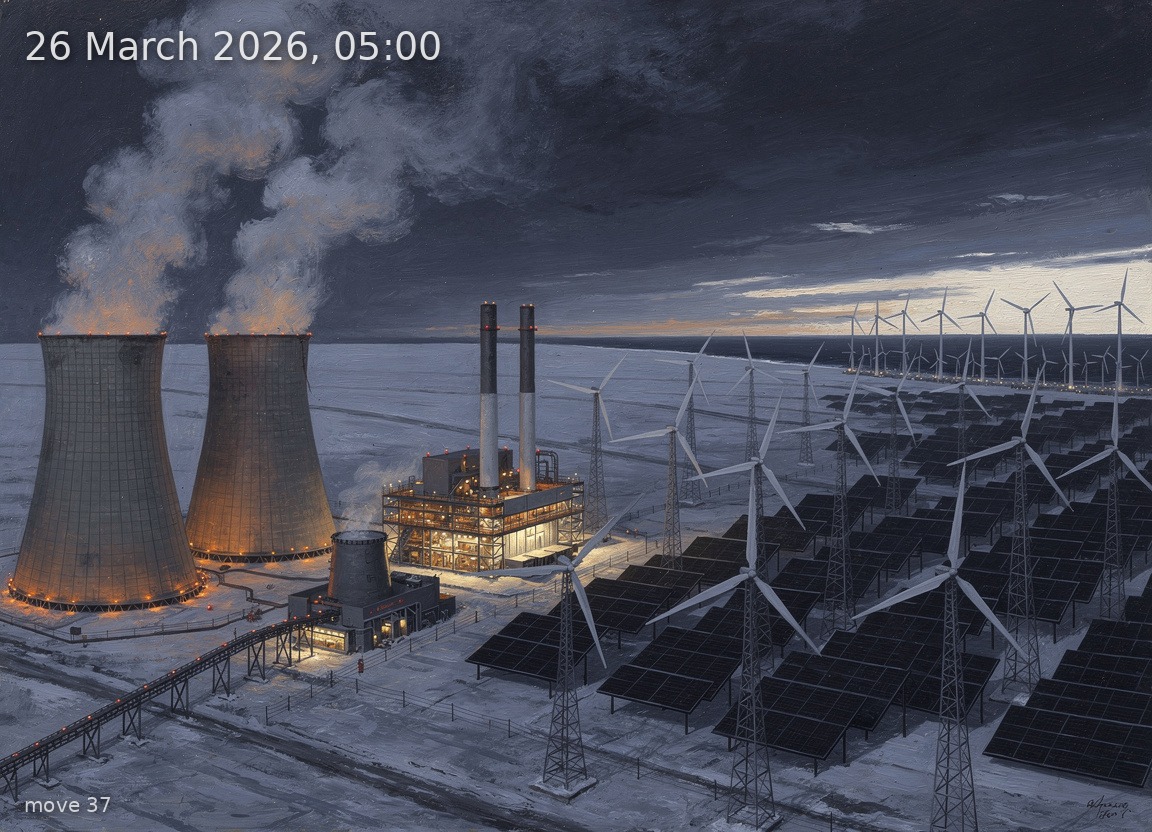
Strong onshore wind drives 74% renewables; 12.1 GW net export despite elevated day-ahead prices at pre-dawn.
Generation mix
Wind onshore 42%
Wind offshore 10%
Solar 14%
Biomass 7%
Hydro 2%
Natural gas 8%
Hard coal 6%
Brown coal 12%
74%
Renewable share
32.0 GW
Wind (on + offshore)
9.0 GW
Solar
62.2 GW
Total generation
+12.1 GW
Net export
105.3 EUR/MWh
Day-ahead price
— / —
Temp / Wind speed
Open-Meteo, Kassel (51.3°N 9.5°E) · surface estimate from 100 m wind
—% / — W/m²
Cloud cover / Radiation
181
gCO₂/kWh
Image prompt
Wind onshore 25.9 GW dominates the right two-thirds of the scene as vast ranks of three-blade turbines on lattice towers stretching across a flat frozen plain into deep pre-dawn darkness; wind offshore 6.1 GW appears on the far right horizon as a cluster of turbines rising from a barely-visible dark sea. Brown coal 7.3 GW occupies the left foreground as three massive hyperbolic cooling towers emitting thick white steam plumes lit from below by sodium-orange industrial lights. Natural gas 4.8 GW sits left of centre as a pair of compact CCGT units with tall single exhaust stacks and glowing turbine halls. Hard coal 3.9 GW appears as a smaller power station with a single cooling tower and conveyor belt structure adjacent to the brown coal complex. Solar 9.0 GW is represented as a large field of aluminium-framed crystalline silicon panels in the mid-ground, but they are dark and dormant, reflecting no sunlight — merely geometric silhouettes against the ground. Biomass 4.2 GW is rendered as a mid-sized industrial facility with a rounded silo and wood-chip storage yard, warm interior light spilling from its windows. Hydro 1.0 GW appears as a small concrete dam structure at the far left edge with modest water flow. The sky is deep blue-grey pre-dawn, the faintest pale band of light barely emerging on the eastern horizon — no direct sunlight, no warm colours in the sky. The ground is frost-covered, temperature precisely 0°C, bare late-winter trees with no leaves, dead brown grass crystallised with ice. Despite zero reported wind at ground level in central Germany, the turbines' blades show strong rotation suggesting high-altitude wind. The atmosphere is heavy and slightly oppressive — a subtle haze hangs low, evoking the elevated electricity price. Power transmission lines with steel pylons connect the sources across the landscape. Rendered as a highly detailed oil painting in the tradition of 19th-century German Romantic landscape painters — Caspar David Friedrich's atmospheric depth merged with industrial realism — rich dark blues, warm sodium oranges from industrial lighting, visible confident brushwork, chiaroscuro contrast between the glowing thermal plants and the dark wind-farm horizon. Meticulous engineering detail on every turbine nacelle, cooling tower ribbing, and panel frame. No text, no labels.