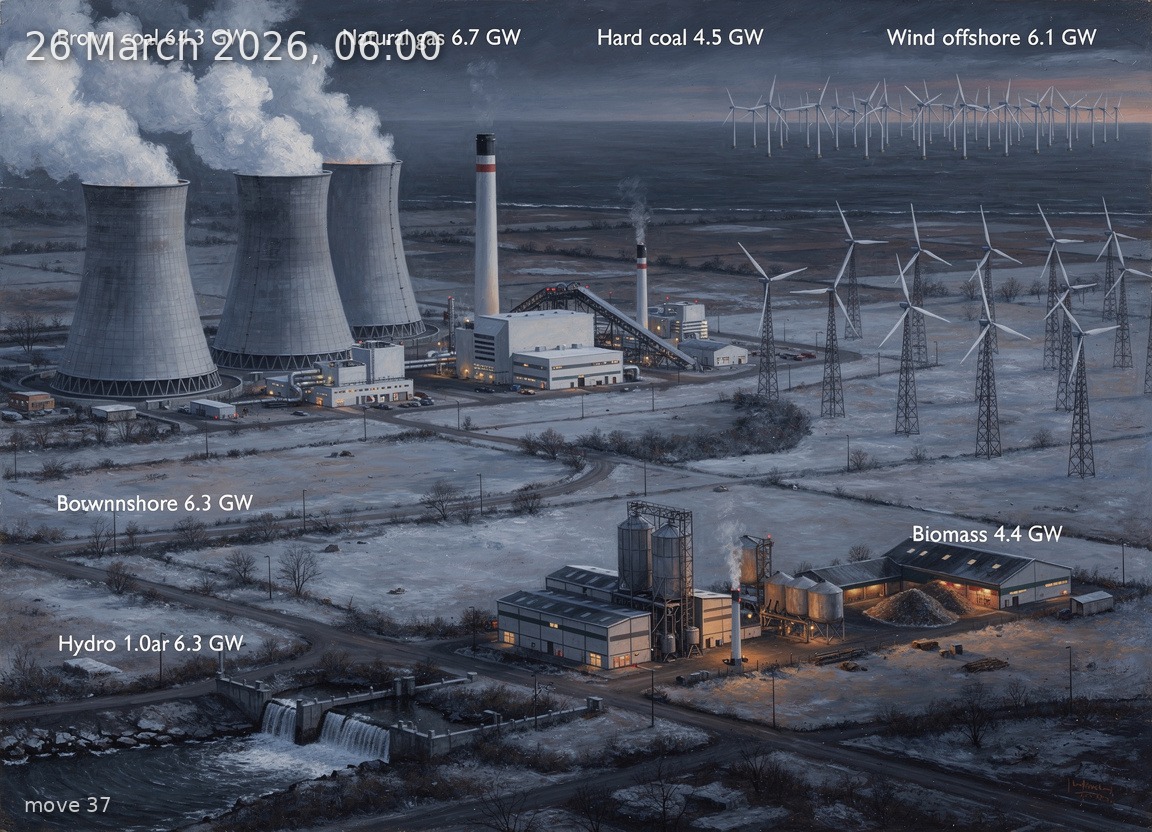
Wind provides 30.4 GW at pre-dawn; thermal plants firm the balance as freezing temperatures lift demand to 55.9 GW.
Generation mix
Wind onshore 45%
Wind offshore 11%
Solar 1%
Biomass 8%
Hydro 2%
Natural gas 12%
Hard coal 8%
Brown coal 12%
68%
Renewable share
30.4 GW
Wind (on + offshore)
0.8 GW
Solar
54.1 GW
Total generation
1.9 GW
Net import
120.3 EUR/MWh
Day-ahead price
— / —
Temp / Wind speed
Open-Meteo, Kassel (51.3°N 9.5°E) · surface estimate from 100 m wind
—% / — W/m²
Cloud cover / Radiation
218
gCO₂/kWh
Image prompt
Wind onshore 24.3 GW dominates the right two-thirds of the canvas as vast ranks of three-blade turbines on lattice towers stretching across a frozen, flat North German plain, rotors spinning hard; wind offshore 6.1 GW appears in the far-right background as a cluster of larger turbines rising from a dark steel-grey sea at the horizon. Brown coal 6.3 GW occupies the left foreground as a massive lignite power station with four hyperbolic cooling towers emitting heavy white steam plumes that drift across the scene. Natural gas 6.7 GW sits centre-left as two compact CCGT blocks with tall single exhaust stacks releasing thin transparent heat shimmer. Hard coal 4.5 GW appears behind the gas plant as a smaller conventional station with a single large chimney and coal conveyor belt. Biomass 4.4 GW is rendered as a mid-ground industrial wood-chip facility with a modest stack and warm amber glow from its furnace. Hydro 1.0 GW appears as a small concrete run-of-river weir in the left middle distance with faint white water. Solar 0.8 GW is virtually absent—no panels visible, no sunshine. Time is 06:00 in late March: the sky is deep blue-grey pre-dawn, with the faintest steel-blue luminescence along the eastern horizon but no direct sunlight; the landscape is lit primarily by sodium-orange industrial lights on the power stations and the amber glow of biomass furnaces. Temperature is 0 °C: frost coats the flat fields, thin ice edges puddles, bare deciduous trees stand skeletal, and breath-like mist curls around the cooling towers. The atmosphere feels heavy and oppressive—a leaden, brooding sky pressing down, reflecting the 120.3 EUR/MWh price tension. Style: highly detailed oil painting in the tradition of Caspar David Friedrich and Carl Blechen—rich dark blues, warm industrial oranges, visible impasto brushwork, dramatic chiaroscuro between the glowing plants and the cold dark landscape, atmospheric depth with haze and layered distance. Meticulous engineering detail on turbine nacelles, cooling tower parabolic curves, conveyor structures, and exhaust stacks. No text, no labels.