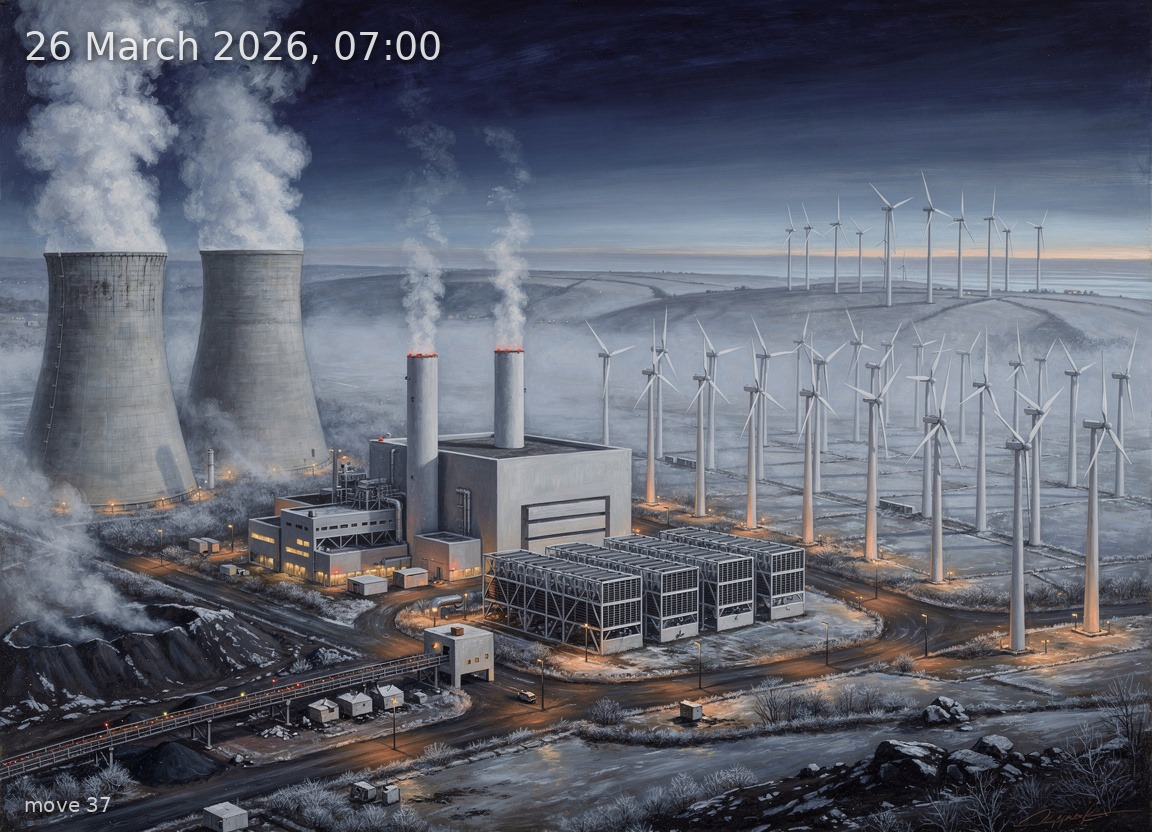
Strong wind generation meets morning demand as gas and coal provide thermal support under cold, clear pre-dawn skies.
Generation mix
Wind onshore 40%
Wind offshore 10%
Solar 8%
Biomass 8%
Hydro 2%
Natural gas 14%
Hard coal 8%
Brown coal 10%
67%
Renewable share
30.1 GW
Wind (on + offshore)
4.8 GW
Solar
60.2 GW
Total generation
0.2 GW
Net import
137.3 EUR/MWh
Day-ahead price
— / —
Temp / Wind speed
Open-Meteo, Kassel (51.3°N 9.5°E) · surface estimate from 100 m wind
—% / — W/m²
Cloud cover / Radiation
216
gCO₂/kWh
Image prompt
Wind onshore 24.0 GW dominates the right two-fifths of the scene as dense ranks of three-blade turbines with white tubular towers and aerodynamic nacelles stretching across frozen fields toward the horizon; wind offshore 6.0 GW appears in the far-right background as a cluster of taller turbines rising from a grey sea glimpsed through a gap in the terrain; natural gas 8.6 GW occupies the centre-left as a compact CCGT power station with twin exhaust stacks emitting pale plumes and rectangular air-cooled condensers; brown coal 6.3 GW fills the far left as two massive hyperbolic cooling towers with thick white steam columns and a conveyor belt carrying dark lignite; hard coal 4.8 GW sits just left of centre as a smaller coal plant with a single tall chimney and coal stockpile; solar 4.8 GW is shown as a field of aluminium-framed crystalline silicon panels in the low foreground catching the faintest grey-blue pre-dawn light; biomass 4.6 GW appears as a mid-ground wood-chip-fed plant with a modest smokestack and timber storage; hydro 1.0 GW is a small run-of-river weir with a powerhouse near a frozen stream in the lower-left corner. TIME AND LIGHT: early dawn at 07:00 in late March — the sky transitions from deep navy-blue at the zenith to a pale steel-blue band at the eastern horizon, no direct sunlight yet, all structures lit by diffuse pre-dawn glow and scattered sodium-orange industrial lighting on the power stations. WEATHER: freezing 0°C temperature, frost coating bare branches and brown stubble fields, patches of ice on puddles, perfectly clear sky with zero clouds — yet the atmosphere feels heavy and oppressive reflecting high electricity prices, rendered through a thick, cold haze hanging low over the industrial structures. Bare deciduous trees and dormant winter vegetation. Highly detailed oil painting in the tradition of 19th-century German Romantic landscape painters — Caspar David Friedrich's atmospheric depth merged with meticulous industrial realism — rich colour palette of deep indigo, steel grey, warm sodium orange, and cold white steam, visible confident brushwork, chiaroscuro contrast between glowing facilities and the dark pre-dawn landscape. No text, no labels.