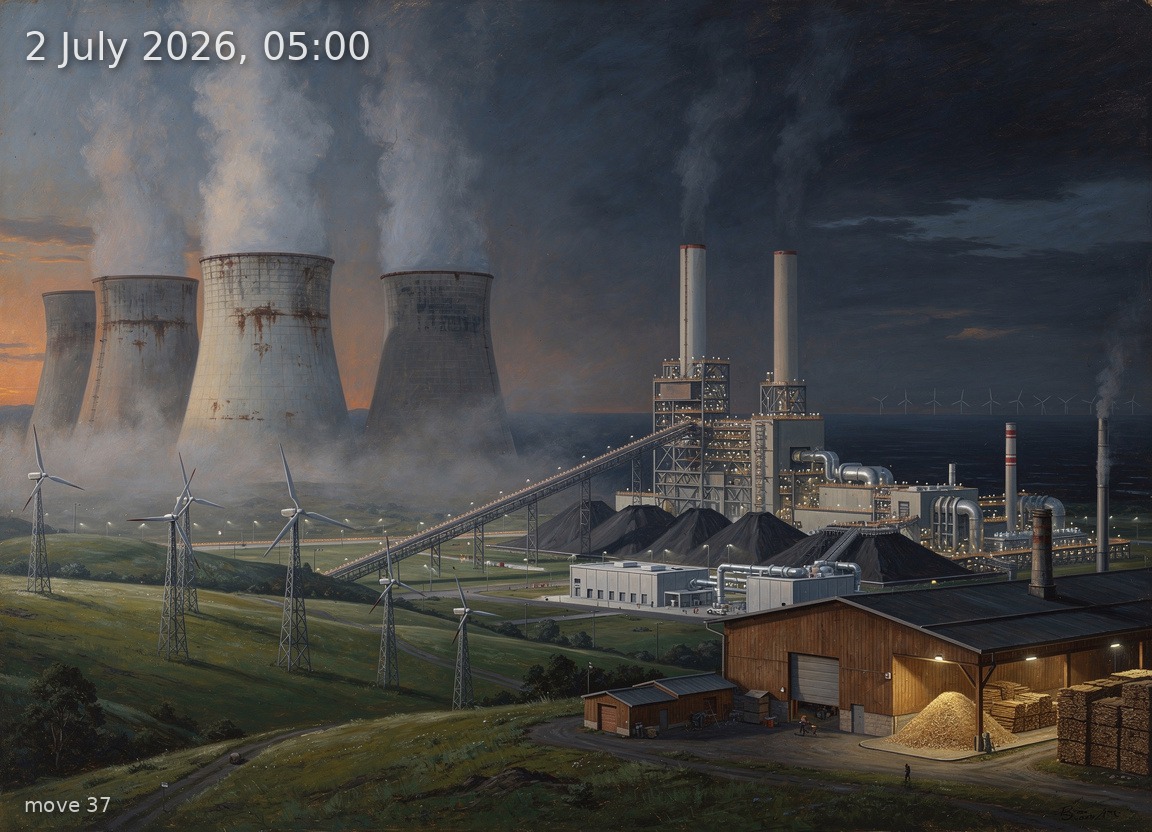
Brown coal and wind dominate pre-dawn generation as large net imports cover a 15.6 GW domestic shortfall.
Generation mix
Wind onshore 15%
Wind offshore 15%
Solar 2%
Biomass 12%
Hydro 7%
Natural gas 12%
Hard coal 12%
Brown coal 25%
51%
Renewable share
9.4 GW
Wind (on + offshore)
0.7 GW
Solar
30.9 GW
Total generation
15.5 GW
Net import
114.5 EUR/MWh
Day-ahead price
11.7°C / 8 km/h
Temp / Wind speed
Open-Meteo, Kassel (51.3°N 9.5°E) · surface estimate from 100 m wind
0.0% / 0.0 W/m²
Cloud cover / Radiation
354
gCO₂/kWh
Image prompt
Brown coal 7.7 GW dominates the left third of the scene as a cluster of massive hyperbolic cooling towers with thick white-grey steam plumes rising into the sky; wind onshore 4.7 GW appears as a line of three-blade turbines with lattice towers on rolling green hills in the centre-left middle ground, blades turning slowly; wind offshore 4.7 GW is suggested by distant turbines on a dark North Sea horizon at far right; hard coal 3.8 GW occupies the centre-right as a large power station with tall rectangular stacks and conveyor belts feeding coal bunkers; natural gas 3.7 GW appears as two compact CCGT units with slim single exhaust stacks emitting thin heat shimmer beside the coal plant; biomass 3.7 GW is rendered as a timber-clad industrial facility with a modest smokestack and stacked woodchip piles in the right foreground; hydro 2.0 GW is depicted as a concrete dam with spillway visible in a valley in the distant background; solar 0.7 GW appears as a tiny cluster of aluminium-framed crystalline silicon panels on a field in the near foreground, completely dark and inactive. The time is 05:00 in early July — the sky is deep blue-grey pre-dawn with the faintest pale luminescence at the eastern horizon, no direct sunlight, most of the sky still very dark; the landscape is lit primarily by sodium-orange industrial lighting from the power stations and cool blue-white LED floodlights on the turbine service roads. The atmosphere is heavy and oppressive despite the clear sky, reflecting the high electricity price — a low haze clings to the ground between the cooling towers. Vegetation is lush midsummer green, grasses slightly dew-laden. Temperature is cool at 11.7°C, conveyed by mist pooling in low areas. Style: highly detailed oil painting in the tradition of 19th-century German Romantic landscape painters — Caspar David Friedrich's atmospheric depth combined with Adolph Menzel's industrial precision — rich layered colour, visible confident brushwork, dramatic chiaroscuro between the glowing industrial facilities and the dark pre-dawn sky. Meticulous engineering accuracy on every turbine nacelle, cooling tower shell, and CCGT exhaust stack. No text, no labels.