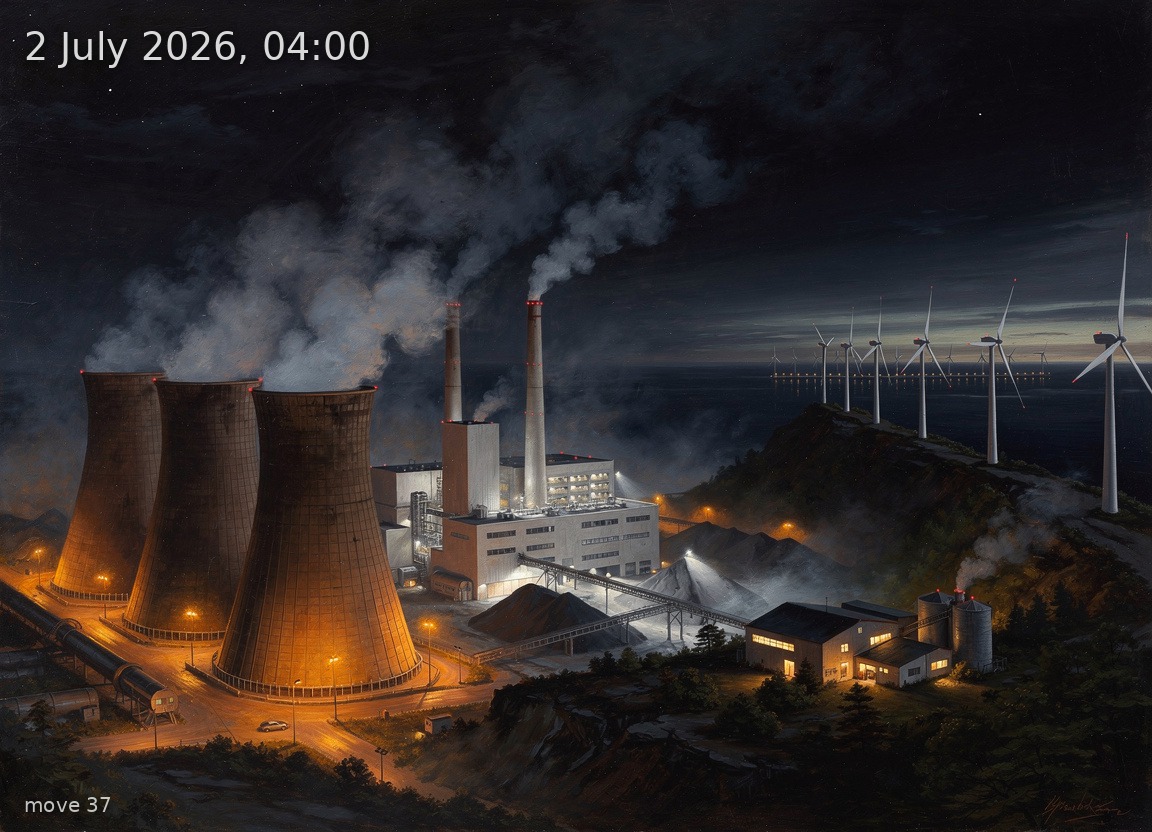
Brown coal and imports dominate a 4 AM grid with modest wind and no solar generation.
Generation mix
Wind onshore 12%
Wind offshore 13%
Solar 0%
Biomass 13%
Hydro 7%
Natural gas 14%
Hard coal 13%
Brown coal 28%
44%
Renewable share
7.2 GW
Wind (on + offshore)
0.0 GW
Solar
29.0 GW
Total generation
15.0 GW
Net import
114.1 EUR/MWh
Day-ahead price
12.0°C / 6 km/h
Temp / Wind speed
Open-Meteo, Kassel (51.3°N 9.5°E) · surface estimate from 100 m wind
0.0% / 0.0 W/m²
Cloud cover / Radiation
398
gCO₂/kWh
Image prompt
Brown coal 8.1 GW dominates the left third of the scene as a cluster of massive hyperbolic cooling towers with heavy white-grey steam plumes rising into black sky; natural gas 4.2 GW appears centre-left as a pair of compact CCGT plants with tall single exhaust stacks emitting thin hot exhaust, lit by sodium-orange floodlights; hard coal 3.8 GW sits in the centre as a large conventional power station with square chimneys and conveyor gantries, coal piles faintly visible under industrial spotlights; biomass 3.7 GW appears centre-right as a smaller industrial facility with a rounded silo and modest stack, warm interior light glowing from windows; wind onshore 3.4 GW is rendered as a row of three-blade turbines on a dark ridge to the right, red aviation warning lights blinking on nacelles; wind offshore 3.8 GW appears in the far right background as a line of taller offshore turbines silhouetted against a deep navy-black sea horizon, each with a tiny red beacon; hydro 2.1 GW is shown as a concrete dam structure nestled in a dark valley in the far background with faint white water at its base. The sky is completely dark—deep black to navy, no twilight, no glow on the horizon—a true 4 AM midsummer night with stars barely visible through industrial haze. The atmosphere is heavy and oppressive, reflecting a high electricity price: low humid haze drifts across the scene, steam and exhaust merge overhead into a brooding canopy. Temperature is mild at 12°C; summer vegetation—dark leafy trees and tall grass—frames the foreground, barely visible in sodium lamplight. A few lit windows in distant houses suggest a sleeping countryside. Style: highly detailed oil painting in the tradition of 19th-century German Romantic landscape painters such as Caspar David Friedrich and Carl Blechen—rich dark palette of indigo, umber, ochre, and warm orange from artificial light, visible confident brushwork, dramatic chiaroscuro, atmospheric depth with layered fog and steam, meticulous engineering detail on every turbine nacelle, cooling tower ribbing, and exhaust stack. No text, no labels.