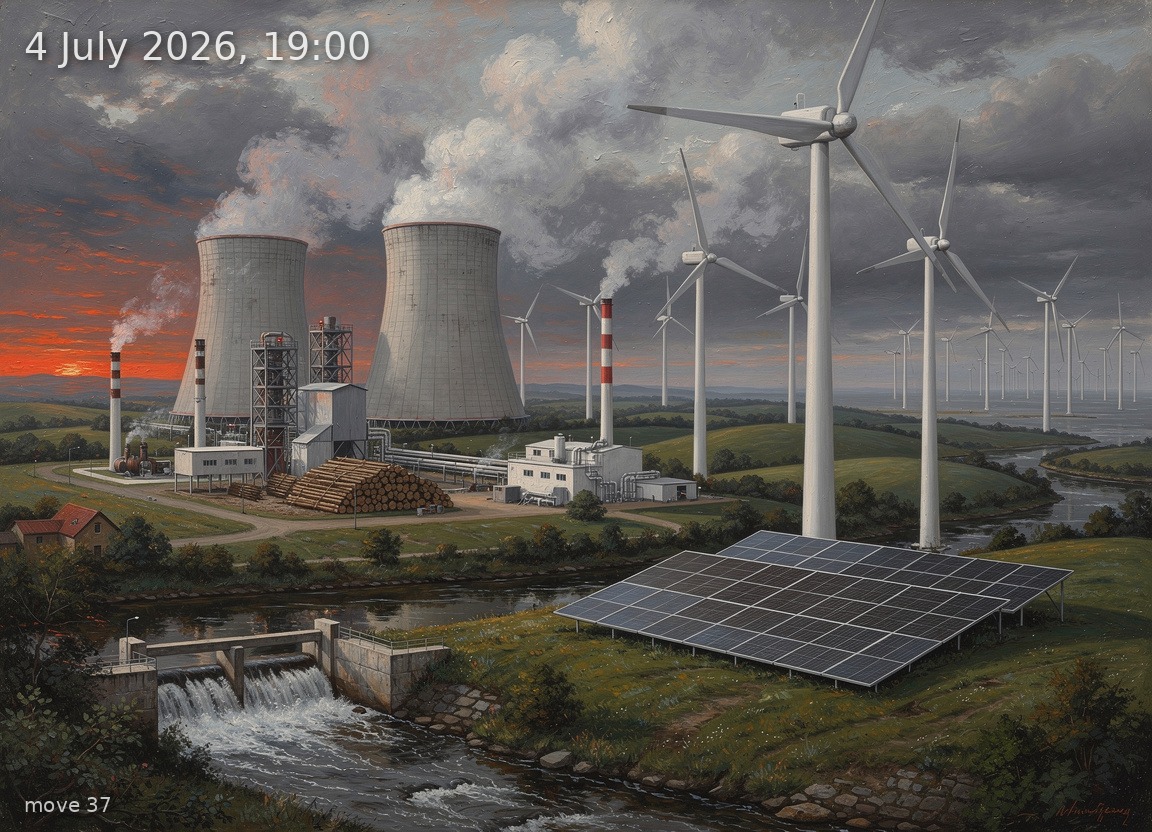
Strong wind dominates as solar fades at dusk; 8.9 GW net imports cover remaining demand at elevated prices.
Generation mix
Wind onshore 45%
Wind offshore 13%
Solar 18%
Biomass 10%
Hydro 4%
Natural gas 5%
Hard coal 1%
Brown coal 5%
89%
Renewable share
23.7 GW
Wind (on + offshore)
7.4 GW
Solar
41.3 GW
Total generation
8.9 GW
Net import
107.2 EUR/MWh
Day-ahead price
23.3°C / 16 km/h
Temp / Wind speed
Open-Meteo, Kassel (51.3°N 9.5°E) · surface estimate from 100 m wind
91.0% / 10.0 W/m²
Cloud cover / Radiation
74
gCO₂/kWh
Image prompt
Wind onshore 18.4 GW dominates the right two-thirds of the scene as dozens of three-blade turbines with white tubular towers and detailed nacelles stretching across rolling green summer hills into the hazy distance; wind offshore 5.3 GW appears as a cluster of larger turbines visible on a grey sea horizon at far right. Solar 7.4 GW occupies a modest field of aluminium-framed crystalline silicon panels in the centre-right foreground, their surfaces dull and unreflective under thick overcast. Biomass 4.2 GW is rendered as a mid-sized industrial plant with a timber yard and a single smoking stack in the centre-left. Brown coal 2.2 GW appears as a pair of hyperbolic cooling towers with heavy white-grey steam plumes rising on the left. Natural gas 2.0 GW sits as a compact CCGT facility with a single tall exhaust stack and visible heat shimmer just left of centre. Hydro 1.5 GW is a small concrete dam with water spilling over a weir in the lower left foreground near a river. Hard coal 0.4 GW is a single small smokestack barely visible behind the lignite towers, nearly dormant. The sky is a dusk scene at 19:00 in July — a rapidly fading orange-red glow hugging the lower horizon on the left, the upper sky darkening to deep slate-blue and grey, with 91% cloud cover rendering thick, oppressive layered clouds that press down heavily, conveying the tension of high electricity prices. The air feels warm at 23°C; lush midsummer foliage — full deciduous canopies, wildflowers, tall grasses — sways moderately in 16 km/h winds. No direct sunshine whatsoever; diffuse grey-amber light only. Rendered as a highly detailed oil painting in the tradition of 19th-century German Romantic landscape painters such as Caspar David Friedrich and Carl Blechen — rich impasto brushwork, dramatic atmospheric depth, luminous cloud formations, meticulous engineering detail on every turbine nacelle, every cooling tower rib, every PV cell grid line. The mood is sublime and weighty, an industrial pastoral at the edge of night. No text, no labels.