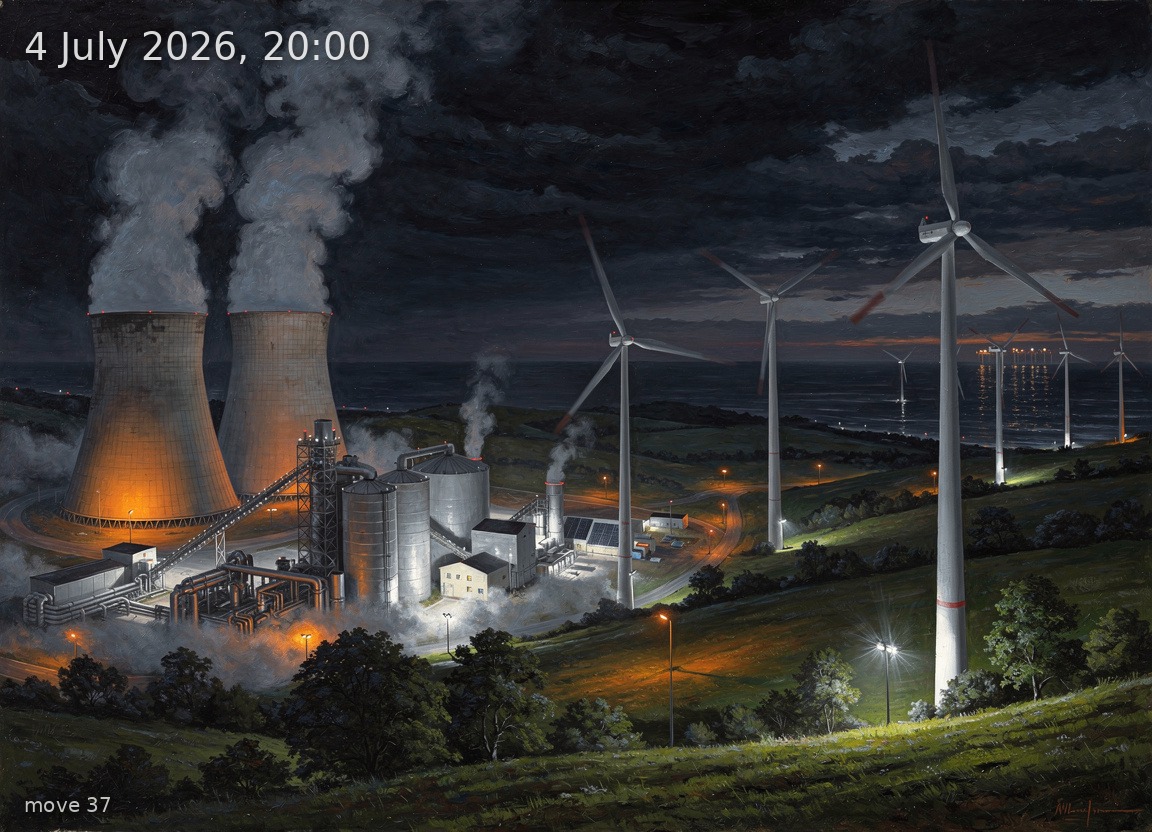
Wind leads at 22.6 GW but 12 GW net imports are needed as solar fades under overcast evening skies.
Generation mix
Wind onshore 46%
Wind offshore 14%
Solar 6%
Biomass 11%
Hydro 4%
Natural gas 8%
Hard coal 1%
Brown coal 8%
82%
Renewable share
22.6 GW
Wind (on + offshore)
2.2 GW
Solar
37.3 GW
Total generation
12.0 GW
Net import
125.6 EUR/MWh
Day-ahead price
22.5°C / 14 km/h
Temp / Wind speed
Open-Meteo, Kassel (51.3°N 9.5°E) · surface estimate from 100 m wind
96.0% / 14.0 W/m²
Cloud cover / Radiation
120
gCO₂/kWh
Image prompt
Wind onshore 17.3 GW dominates the right two-thirds of the scene as dozens of tall three-blade turbines with white tubular towers and detailed nacelles stretching across rolling green summer hills into the distance; wind offshore 5.3 GW appears as a cluster of larger turbines visible on the far-right horizon above a faintly glinting sea; biomass 4.3 GW occupies the centre-left as a mid-sized industrial plant with wood-chip storage silos, conveyor belts, and a single stack emitting pale steam; brown coal 3.1 GW sits at the far left as a pair of hyperbolic cooling towers with thick white steam plumes rising into the dark sky, lit from below by sodium-orange industrial lighting; natural gas 3.1 GW appears just left of centre as a compact CCGT facility with a tall slender exhaust stack and a smaller heat-recovery unit, its metallic surfaces gleaming under floodlights; solar 2.2 GW is represented only as a small dark field of aluminium-framed crystalline silicon panels in the lower foreground, completely unlit and inactive, reflecting no sunlight; hydro 1.4 GW is a small concrete dam structure visible in a valley at centre-right with white water cascading; hard coal 0.5 GW is a single small smokestack barely visible behind the brown coal towers. TIME OF DAY: 20:00 in July, full night darkness — the sky is deep navy-black, no twilight, no sunset glow, no sky colour gradient, only a dense 96% overcast ceiling of invisible clouds faintly backlit by city light pollution far on the horizon. All facilities are illuminated solely by artificial light: sodium-orange streetlamps, white LED floodlights on industrial structures, and glowing control-room windows. Summer vegetation is lush — tall green grass, full deciduous trees with dense canopies — but visible only where artificial light reaches. The atmosphere feels heavy and oppressive, reflecting the high electricity price: humid summer air, haze around the cooling tower plumes, a claustrophobic low cloud ceiling pressing down. The wind turbine blades show moderate rotational blur suggesting steady 13.5 km/h winds. Style: highly detailed oil painting in the tradition of 19th-century German Romantic landscape painters such as Caspar David Friedrich and Carl Blechen — rich impasto brushwork, dramatic chiaroscuro between the artificial lights and surrounding darkness, atmospheric depth with layers of industrial haze, meticulous engineering accuracy on every turbine nacelle, cooling tower curve, and panel frame. The composition evokes the sublime tension between nature and industry. No text, no labels, no human figures.