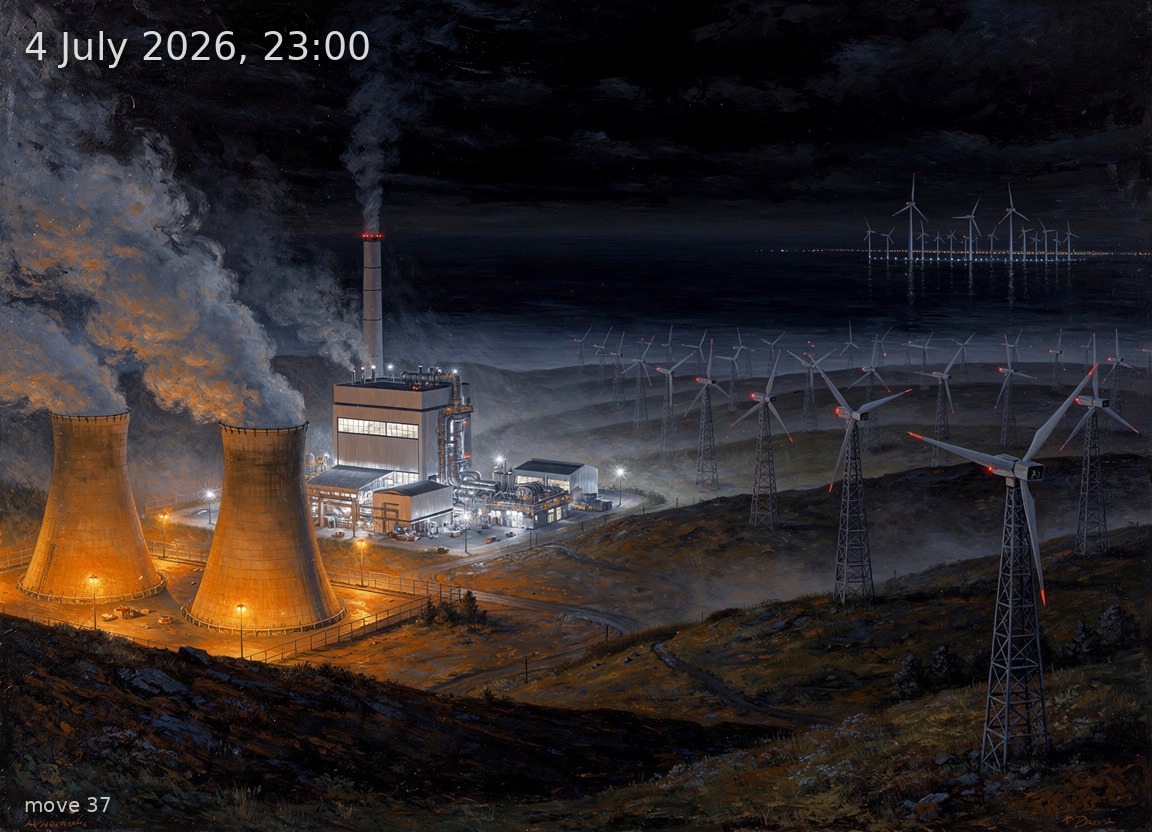
Strong overnight wind generation at 21.7 GW still leaves an 8.0 GW import need, keeping prices elevated at 118.6 EUR/MWh.
Generation mix
Wind onshore 45%
Wind offshore 17%
Biomass 12%
Hydro 4%
Natural gas 10%
Hard coal 3%
Brown coal 9%
78%
Renewable share
21.8 GW
Wind (on + offshore)
0.0 GW
Solar
35.5 GW
Total generation
8.0 GW
Net import
118.6 EUR/MWh
Day-ahead price
19.9°C / 14 km/h
Temp / Wind speed
Open-Meteo, Kassel (51.3°N 9.5°E) · surface estimate from 100 m wind
100.0% / 0.0 W/m²
Cloud cover / Radiation
148
gCO₂/kWh
Image prompt
Wind onshore 15.8 GW dominates the right two-thirds of the scene as vast ranks of three-blade turbines on lattice towers stretching across rolling hills into the darkness, their red aviation warning lights blinking in unison; wind offshore 5.9 GW appears in the far-right background as a ghostly cluster of tall turbines rising from a barely visible dark sea horizon, marked by faint navigation lights; brown coal 3.3 GW occupies the left foreground as two massive hyperbolic cooling towers emitting pale steam plumes lit from below by sodium-orange industrial lamps; natural gas 3.7 GW sits centre-left as a compact combined-cycle gas turbine plant with a single tall exhaust stack releasing a thin heat shimmer, its turbine hall illuminated by white floodlights; hard coal 1.0 GW appears as a smaller coal-fired station beside the brown coal plant, a single square stack with modest emissions; biomass 4.3 GW is rendered as a mid-sized industrial facility with a domed digester and wood-chip silo glowing warmly behind chain-link fencing, centre-right among the turbines; hydro 1.4 GW appears as a small concrete dam and powerhouse nestled in a wooded valley on the far left, with water glinting under a single floodlight. The sky is completely black and starless under total cloud cover, heavy and oppressive, pressing down on the landscape to reflect the high electricity price. The season is midsummer: lush dark-green deciduous foliage on trees, warm air at nearly 20°C suggested by open windows in distant village houses with warm-lit interiors. A moderate breeze animates the turbine blades and stirs tree canopies. No sunlight, no twilight — only artificial illumination: orange sodium streetlights trace a country road, industrial floodlights pick out steel structures, and the red blink of turbine lights pulses rhythmically. Highly detailed oil painting in the tradition of 19th-century German Romantic landscape painters — rich deep colour palette of indigo, umber, burnt orange, and charcoal; visible impasto brushwork; atmospheric depth with misty industrial haze; meticulous technical accuracy on every turbine nacelle, cooling tower curvature, and exhaust stack detail. The composition evokes Caspar David Friedrich's sense of sublime scale but applied to an industrial nocturne. No text, no labels.