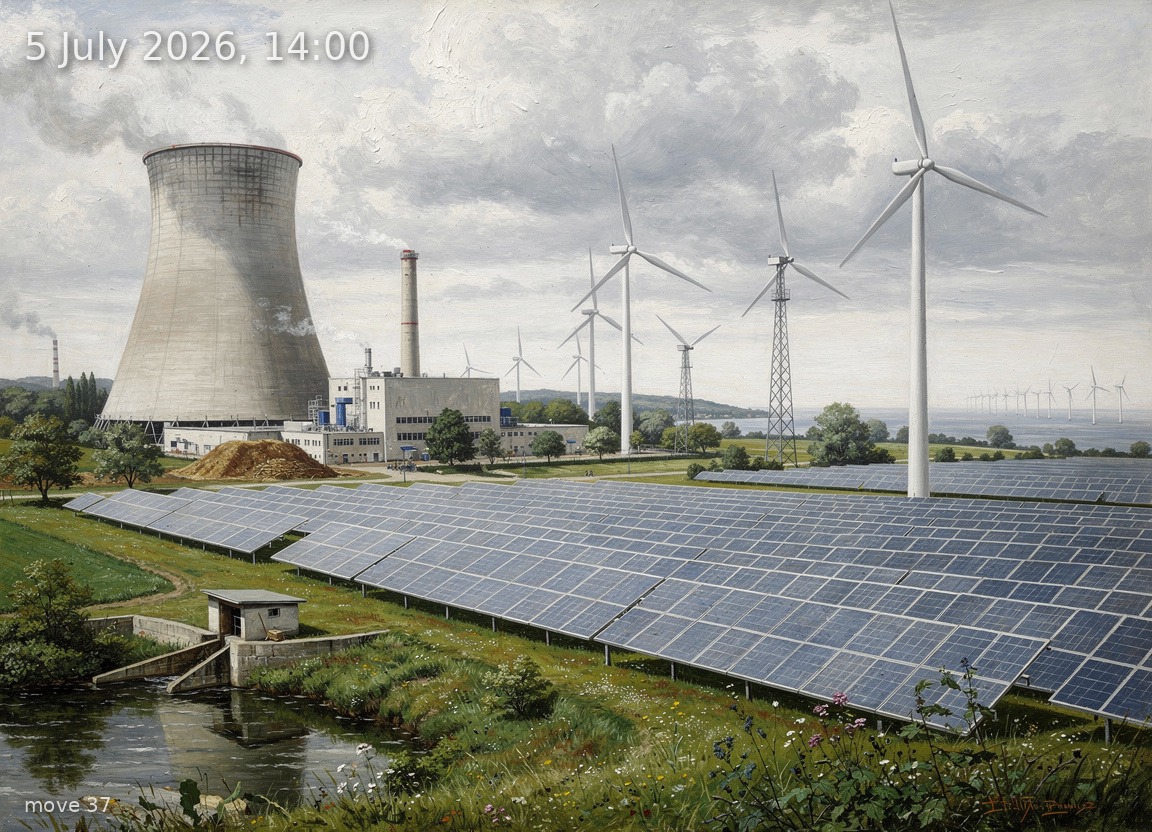
Solar and onshore wind dominate at 94% renewable share, driving 12.3 GW net export and negative prices.
Generation mix
Wind onshore 31%
Wind offshore 3%
Solar 52%
Biomass 6%
Hydro 2%
Natural gas 2%
Hard coal 0%
Brown coal 3%
94%
Renewable share
21.1 GW
Wind (on + offshore)
31.5 GW
Solar
61.2 GW
Total generation
+12.3 GW
Net export
-1.2 EUR/MWh
Day-ahead price
20.3°C / 15 km/h
Temp / Wind speed
Open-Meteo, Kassel (51.3°N 9.5°E) · surface estimate from 100 m wind
100.0% / 55.0 W/m²
Cloud cover / Radiation
40
gCO₂/kWh
Image prompt
Solar 31.5 GW dominates the foreground and middle distance as vast fields of aluminium-framed crystalline silicon PV panels stretching across gently rolling farmland, their blue-grey surfaces reflecting a uniformly overcast white-grey sky; onshore wind 19.2 GW fills the mid-ground and right two-thirds of the composition as dozens of tall three-blade turbines on lattice and tubular towers, blades visibly mid-rotation in moderate wind; offshore wind 1.9 GW appears as a distant cluster of turbines on the far-right horizon emerging from atmospheric haze; biomass 3.6 GW is rendered as a modest wood-chip power station with a square industrial chimney emitting a thin wisp of steam, situated in the left mid-ground; hydro 1.4 GW appears as a small concrete run-of-river weir and powerhouse beside a green-banked river in the left foreground; natural gas 1.4 GW is a compact single CCGT unit with a tall slender exhaust stack and minimal heat shimmer, positioned behind the biomass plant; brown coal 1.9 GW sits on the far left as a single hyperbolic cooling tower with a faint lazy steam plume, its massive concrete form dwarfed by the renewable infrastructure surrounding it; hard coal 0.2 GW is a barely visible small smokestack behind the cooling tower, nearly idle. The sky is fully overcast—a smooth dome of luminous pearl-grey clouds at 14:00 summer daylight, bright but entirely diffuse with no sun disc visible, no shadows on the ground. The landscape is lush July green: tall grasses, wildflowers, deciduous trees in full leaf. The temperature is mild at 20°C. The atmosphere is calm and open, reflecting the slightly negative electricity price—no oppressive mood, just a quiet, almost meditative stillness over an industrious landscape producing far more energy than it needs. Painted in the style of a highly detailed 19th-century German Romantic oil painting—rich impasto brushwork, atmospheric aerial perspective, Caspar David Friedrich's sense of sublime scale applied to modern energy infrastructure, with meticulous engineering accuracy on every turbine nacelle, every PV cell grid line, every cooling tower's hyperbolic curve. No text, no labels.