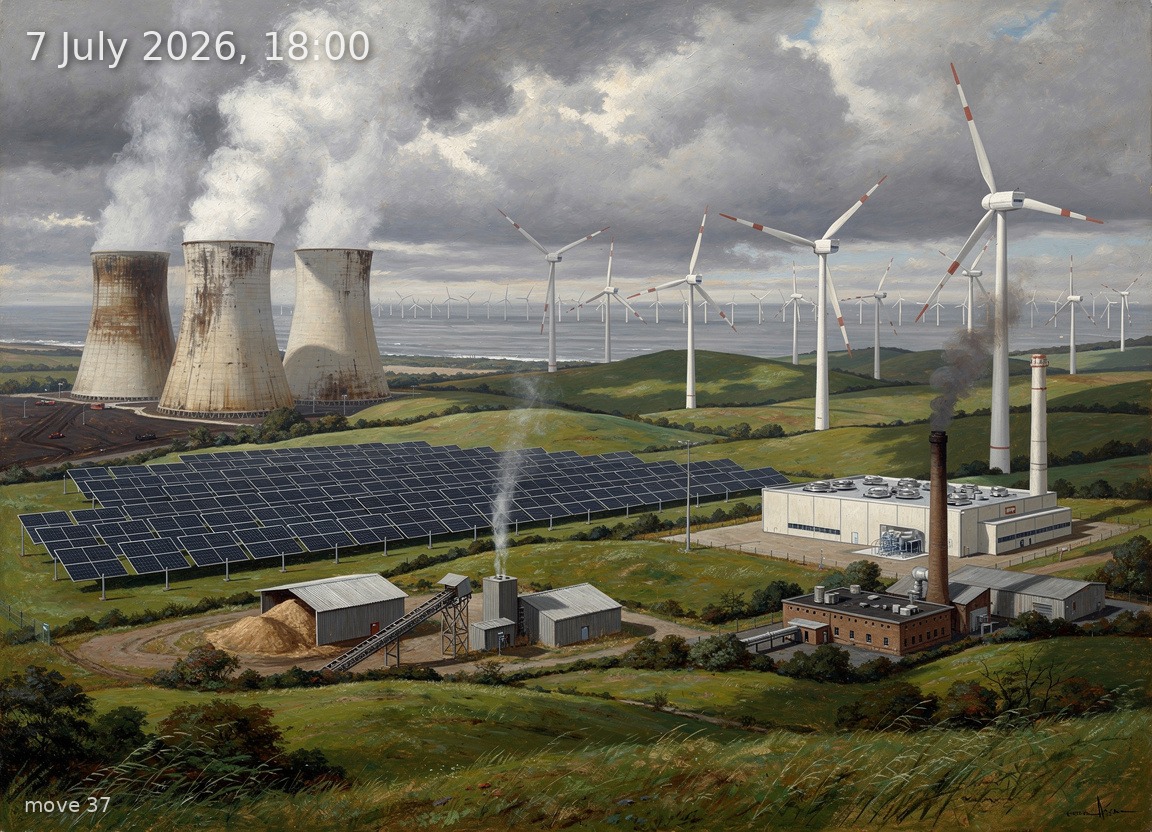
Strong onshore wind (39.3 GW) under full overcast drives 10.7 GW net exports despite persistent brown coal baseload.
Generation mix
Wind onshore 56%
Wind offshore 7%
Solar 17%
Biomass 5%
Hydro 2%
Natural gas 3%
Hard coal 2%
Brown coal 7%
88%
Renewable share
44.3 GW
Wind (on + offshore)
12.1 GW
Solar
70.0 GW
Total generation
+10.7 GW
Net export
60.7 EUR/MWh
Day-ahead price
25.6°C / 28 km/h
Temp / Wind speed
Open-Meteo, Kassel (51.3°N 9.5°E) · surface estimate from 100 m wind
100.0% / 12.0 W/m²
Cloud cover / Radiation
88
gCO₂/kWh
Image prompt
Wind onshore 39.3 GW dominates the scene as vast ranks of three-blade turbines with white tubular towers and detailed nacelles stretching across rolling green hills from centre to far right, their blades visibly in vigorous motion; solar 12.1 GW appears as a mid-ground field of aluminium-framed crystalline silicon panels on the centre-left, their surfaces reflecting only diffuse grey light, no direct sun; brown coal 5.0 GW occupies the far left as a cluster of massive hyperbolic concrete cooling towers emitting thick white steam plumes rising into the overcast; wind offshore 5.0 GW is visible on the distant horizon as a line of larger turbines standing in a faintly visible grey sea; biomass 3.8 GW appears as a modest industrial facility with a wood-chip conveyor and a single stack with thin pale exhaust near the coal plant; natural gas 2.4 GW is rendered as a compact CCGT plant with a single tall exhaust stack and low rectangular turbine hall just beside the cooling towers; hard coal 1.2 GW is a smaller power station with a single square chimney releasing a thin dark plume; hydro 1.3 GW is a small dam and penstock structure nestled in a valley at far right. The sky is entirely overcast with a heavy, continuous layer of stratocumulus clouds in shades of pewter and slate grey, but the lower western horizon glows with fading amber and burnt-orange dusk light at 18:00 — early evening in July — casting warm tones across the undersides of clouds and gilding the turbine blades. The landscape is lush midsummer green, tall grass bending in the strong wind, deciduous trees in full leaf swaying noticeably. The atmosphere is slightly heavy and warm, suggesting 25°C humidity under the cloud blanket. Highly detailed oil painting in the tradition of 19th-century German Romantic landscape painters — rich, layered colour with visible impasto brushwork, atmospheric aerial perspective creating depth across the expansive industrial-pastoral scene, meticulous engineering accuracy in every turbine nacelle, every cooling tower's parabolic curve, every panel's aluminium frame. No text, no labels.