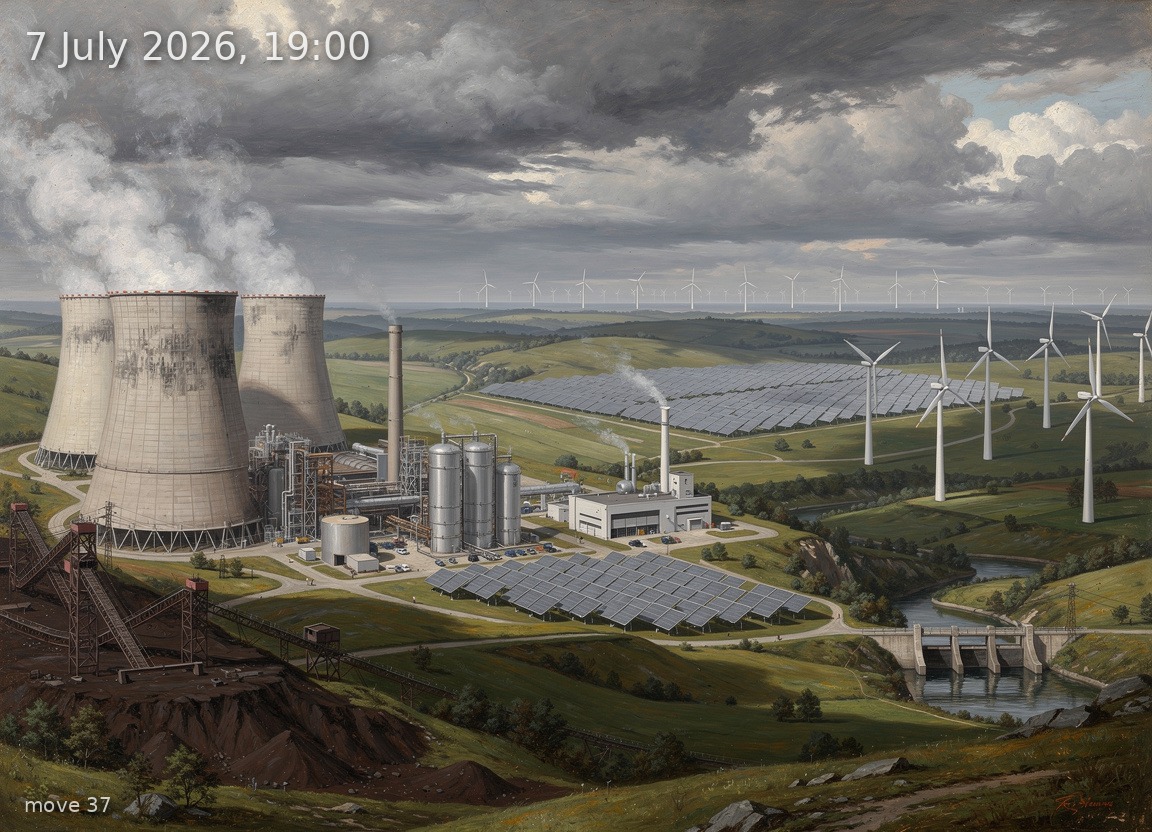
Strong onshore wind at 39.2 GW drives 83.8% renewable share and 6.8 GW net exports under full overcast.
Generation mix
Wind onshore 59%
Wind offshore 7%
Solar 9%
Biomass 6%
Hydro 2%
Natural gas 4%
Hard coal 3%
Brown coal 9%
84%
Renewable share
44.1 GW
Wind (on + offshore)
6.0 GW
Solar
66.2 GW
Total generation
+6.8 GW
Net export
86.2 EUR/MWh
Day-ahead price
24.1°C / 22 km/h
Temp / Wind speed
Open-Meteo, Kassel (51.3°N 9.5°E) · surface estimate from 100 m wind
100.0% / 0.0 W/m²
Cloud cover / Radiation
116
gCO₂/kWh
Image prompt
Wind onshore 39.2 GW dominates the scene as vast ranks of three-blade wind turbines with white tubular towers and detailed nacelles stretching across rolling green hills from the centre to the far right, their blades visibly spinning in strong wind; brown coal 6.1 GW occupies the left foreground as a cluster of massive hyperbolic cooling towers emitting thick white steam plumes, with conveyor belts of dark lignite visible at their base; solar 6.0 GW appears as extensive fields of aluminium-framed crystalline silicon panels on gentle slopes in the centre-left middle ground, their surfaces dull and reflective-grey under overcast sky, producing no glint; wind offshore 5.0 GW is suggested on the distant horizon as a line of turbines rising from a faintly visible grey sea; biomass 4.0 GW shows as a modest industrial facility with cylindrical digesters and a single smokestack with thin exhaust in the left-centre middle ground; natural gas 2.9 GW is rendered as a compact CCGT plant with a sleek exhaust stack and modest vapour trail near the cooling towers; hard coal 1.7 GW appears as a smaller conventional power station with a rectangular boiler house and single stack behind the gas plant; hydro 1.3 GW is depicted as a small dam with a reservoir glinting faintly in the background valley. The sky is entirely overcast with heavy, layered stratocumulus clouds in dark grey and slate tones, no blue visible, creating a dense oppressive atmosphere reflecting the high 86.2 EUR/MWh price. The time is 19:00 in July — late dusk — with a faint warm orange-red glow along the lowest horizon line fading into darkening pewter and deep blue-grey sky above; the landscape is lit by the last ambient twilight, sodium-orange streetlights beginning to glow along roads. Lush midsummer vegetation, full deciduous trees in deep green, tall grass swaying strongly in the 21.6 km/h wind. Highly detailed oil painting in the tradition of 19th-century German Romantic landscape painters — Caspar David Friedrich's atmospheric depth combined with meticulous industrial-age accuracy — rich impasto brushwork, warm and cool tonal contrasts, dramatic scale showing the coexistence of ancient fossil infrastructure and modern renewables across a sweeping panoramic German lowland landscape. No text, no labels.