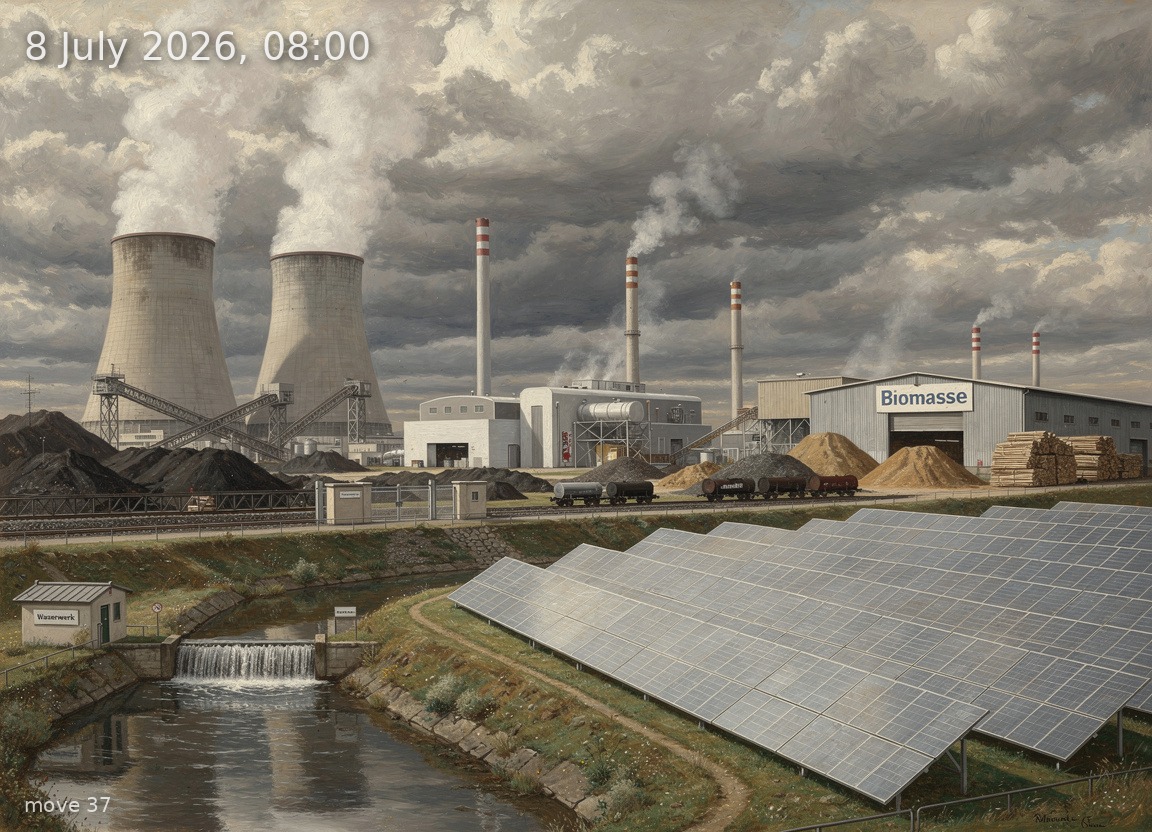
Wind and diffuse solar dominate under full overcast, with brown coal and net imports bridging a 3.8 GW gap.
Generation mix
Wind onshore 30%
Wind offshore 7%
Solar 31%
Biomass 7%
Hydro 2%
Natural gas 6%
Hard coal 5%
Brown coal 11%
77%
Renewable share
20.8 GW
Wind (on + offshore)
17.4 GW
Solar
56.4 GW
Total generation
3.8 GW
Net import
125.8 EUR/MWh
Day-ahead price
17.1°C / 12 km/h
Temp / Wind speed
Open-Meteo, Kassel (51.3°N 9.5°E) · surface estimate from 100 m wind
98.0% / 1.0 W/m²
Cloud cover / Radiation
161
gCO₂/kWh
Image prompt
Wind onshore 16.8 GW dominates the right half of the canvas as dozens of three-blade turbines on lattice and tubular towers stretching across rolling green hills into atmospheric haze; wind offshore 4.0 GW appears in the distant far right as a cluster of turbines rising from a grey North Sea horizon. Solar 17.4 GW fills the centre-right foreground as vast fields of aluminium-framed crystalline silicon PV panels reflecting only the flat white-grey of the overcast sky, no sunlight glinting, their surfaces muted. Brown coal 6.2 GW occupies the left portion as three massive hyperbolic cooling towers emitting thick columns of white-grey steam that merge into the heavy cloud ceiling, with conveyor belts and lignite stockpiles visible at their base. Biomass 4.2 GW sits in the centre-left as a cluster of industrial wood-chip facilities with squat chimneys and stored timber. Natural gas 3.5 GW appears as two compact CCGT units with single tall exhaust stacks and visible heat shimmer. Hard coal 3.1 GW shows as a smaller coal-fired station with a pair of striped stacks and coal bunkers beside rail sidings. Hydro 1.2 GW is a small run-of-river weir with turbine house in the lower-left foreground beside a calm river. The sky is 98% overcast: a uniform, heavy, oppressive ceiling of layered stratus clouds in tones of pewter, slate, and dull cream, pressing low over the landscape, consistent with a 125.80 EUR/MWh price atmosphere of tension and weight. Lighting is full daytime at 08:00 Berlin time—diffuse, shadowless, cool morning light filtering through dense cloud. Vegetation is lush mid-summer green, grass damp, wildflowers dotting meadow edges. Style: highly detailed oil painting in the tradition of Caspar David Friedrich and Carl Blechen—rich impasto brushwork, atmospheric aerial perspective with mist softening distant turbines, dramatic Romantic composition contrasting industrial might with natural landscape, meticulous engineering accuracy on every nacelle, panel frame, and cooling tower curve. No text, no labels.