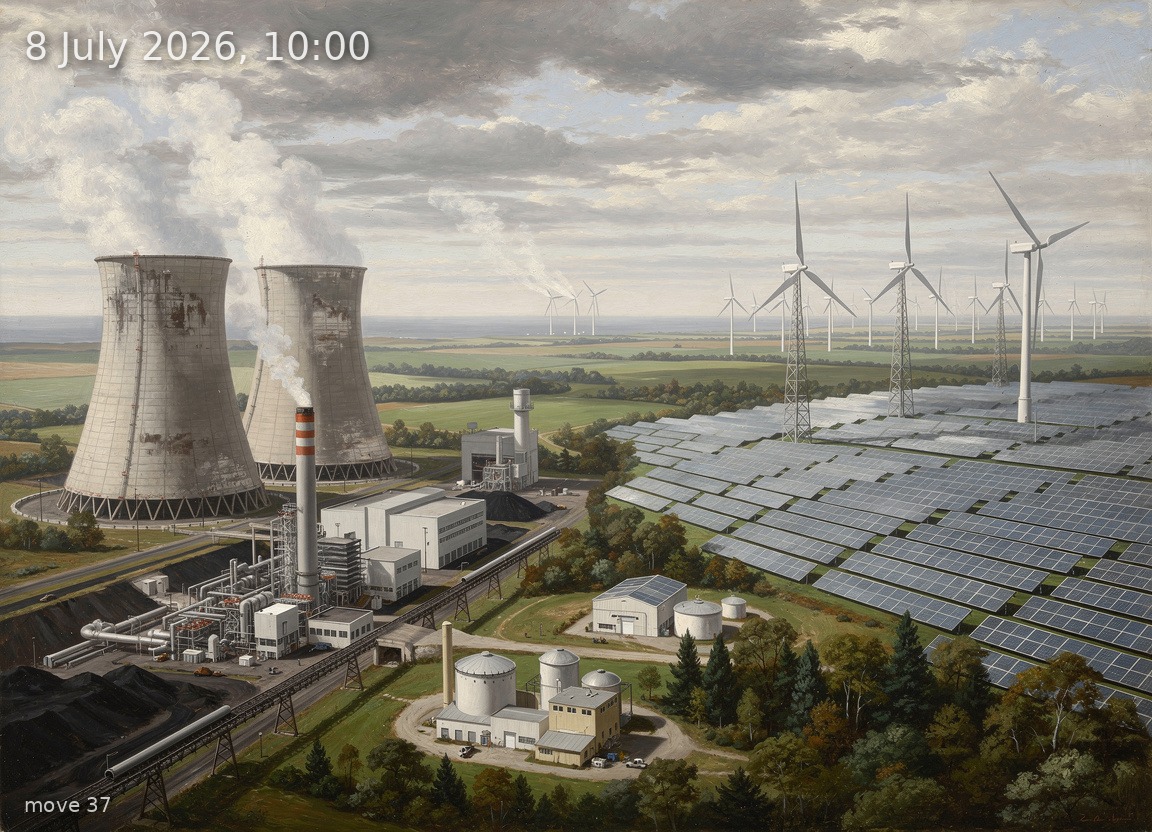
Overcast solar (31.8 GW) and wind (20.2 GW) dominate at 82% renewables, with 7.7 GW net export and persistent lignite.
Generation mix
Wind onshore 25%
Wind offshore 4%
Solar 46%
Biomass 6%
Hydro 2%
Natural gas 5%
Hard coal 4%
Brown coal 9%
82%
Renewable share
20.2 GW
Wind (on + offshore)
31.8 GW
Solar
69.4 GW
Total generation
+7.7 GW
Net export
79.6 EUR/MWh
Day-ahead price
17.2°C / 13 km/h
Temp / Wind speed
Open-Meteo, Kassel (51.3°N 9.5°E) · surface estimate from 100 m wind
100.0% / 5.0 W/m²
Cloud cover / Radiation
126
gCO₂/kWh
Image prompt
Solar 31.8 GW dominates the right half of the canvas as vast rolling fields of aluminium-framed crystalline silicon PV panels stretching to the horizon under flat, diffuse white-grey light — no direct sun, no shadows, panels reflecting a pearlescent overcast sky. Wind onshore 17.1 GW fills the centre-right as dozens of tall three-blade turbines on lattice and tubular towers, rotors turning at moderate speed in a gentle breeze, receding in atmospheric perspective across green summer farmland. Wind offshore 3.1 GW appears as a cluster of larger turbines on the distant horizon above a sliver of grey North Sea. Brown coal 6.0 GW occupies the left foreground as a pair of massive hyperbolic cooling towers with thick white steam plumes spreading horizontally, flanked by conveyor belts of dark lignite and an industrial complex of boiler houses. Natural gas 3.5 GW sits centre-left as a compact modern CCGT plant with a single tall exhaust stack emitting a thin heat shimmer. Hard coal 2.8 GW appears behind it as a traditional power station with a rectangular chimney and coal stockyard. Biomass 3.9 GW is rendered as a medium-sized facility with rounded silos and a modest stack amid woodland edge. Hydro 1.2 GW is a small dam and penstock visible in a valley fold at far left. The sky is entirely overcast — a uniform, heavy, layered blanket of stratus cloud in tones of warm grey and muted white, pressing down with an oppressive, close atmosphere reflecting the 79.6 EUR/MWh price. Full July daytime brightness (10:00) but completely diffuse, no blue sky, no sun disc. The landscape is lush midsummer green — tall grasses, wheat fields, deciduous trees in full dark-green leaf — at 17°C, cool for July, with a faintly damp, humid feeling. Painted in the style of a highly detailed 19th-century German Romantic oil painting — rich impasto brushwork, deep atmospheric perspective, Caspar David Friedrich's sense of scale but applied to industrial infrastructure, meticulous engineering accuracy on every nacelle, panel frame, and cooling tower. No text, no labels.