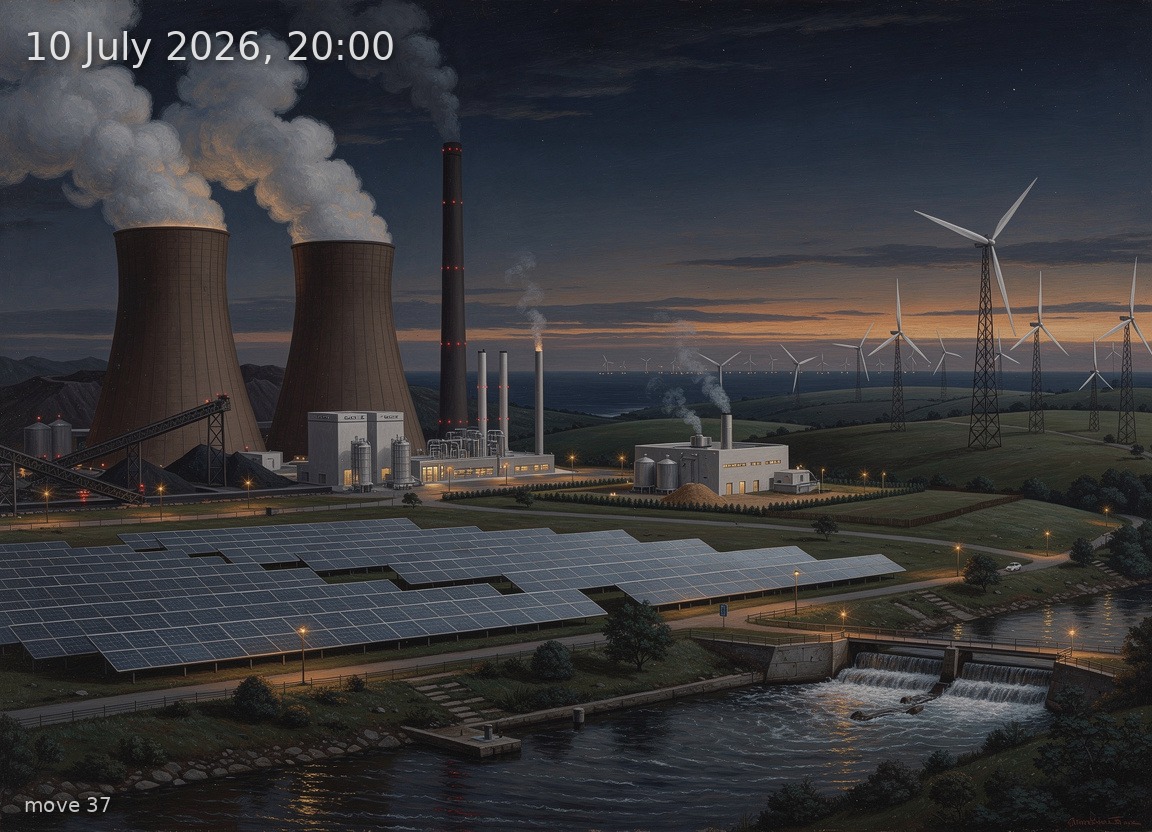
Brown coal leads at 8.1 GW as evening demand of 54 GW forces 21.7 GW of net imports at high prices.
Generation mix
Wind onshore 21%
Wind offshore 1%
Solar 9%
Biomass 12%
Hydro 4%
Natural gas 18%
Hard coal 11%
Brown coal 25%
46%
Renewable share
7.0 GW
Wind (on + offshore)
2.8 GW
Solar
32.3 GW
Total generation
21.8 GW
Net import
186.7 EUR/MWh
Day-ahead price
24.3°C / 13 km/h
Temp / Wind speed
Open-Meteo, Kassel (51.3°N 9.5°E) · surface estimate from 100 m wind
0.0% / 152.0 W/m²
Cloud cover / Radiation
374
gCO₂/kWh
Image prompt
Brown coal 8.1 GW dominates the left third of the scene as a massive lignite power station complex with three hyperbolic cooling towers emitting thick white steam plumes into the evening sky; onshore wind 6.6 GW fills the centre-right background as a long line of three-blade turbines on lattice towers across rolling green hills, blades turning slowly in moderate wind; natural gas 5.7 GW appears centre-left as two compact CCGT units with tall single exhaust stacks venting hot gases; biomass 4.0 GW is rendered as a mid-ground wood-chip-fed power plant with a squat rectangular boiler building and a modest chimney releasing pale smoke; hard coal 3.6 GW sits beside the lignite station as a conventional coal plant with conveyor belts and a single large smokestack; solar 2.8 GW is visible as a field of aluminium-framed crystalline silicon panels in the foreground, their surfaces reflecting the last amber remnants of twilight; hydro 1.2 GW appears as a small run-of-river dam with a weir in the lower right corner; offshore wind 0.3 GW is barely hinted at as tiny distant turbines on the far horizon. The sky is deep navy-blue darkening to black at the zenith, the last thin band of warm amber-orange glow just touching the western horizon line; it is 20:00 in July, effectively dusk transitioning to night, artificial sodium streetlights casting orange pools on roads winding between facilities. The warm 24°C summer air is rendered through lush green deciduous trees in full leaf, tall grasses, and a faint heat shimmer near the coal plant stacks. The atmosphere feels heavy and oppressive, reflecting the 186.7 EUR/MWh price—hazy industrial murk, dense steam, and a brooding quality to the darkening sky. High-voltage transmission pylons recede toward the eastern horizon, symbolising import flows. Style: highly detailed oil painting in the tradition of 19th-century German Romantic landscape painting—rich saturated colour, visible confident brushwork, dramatic chiaroscuro between artificial light and gathering darkness, atmospheric depth with layered planes from foreground panels to distant turbines, meticulous engineering detail on every technology, the grandeur and melancholy of Caspar David Friedrich applied to an industrial energy landscape. No text, no labels.