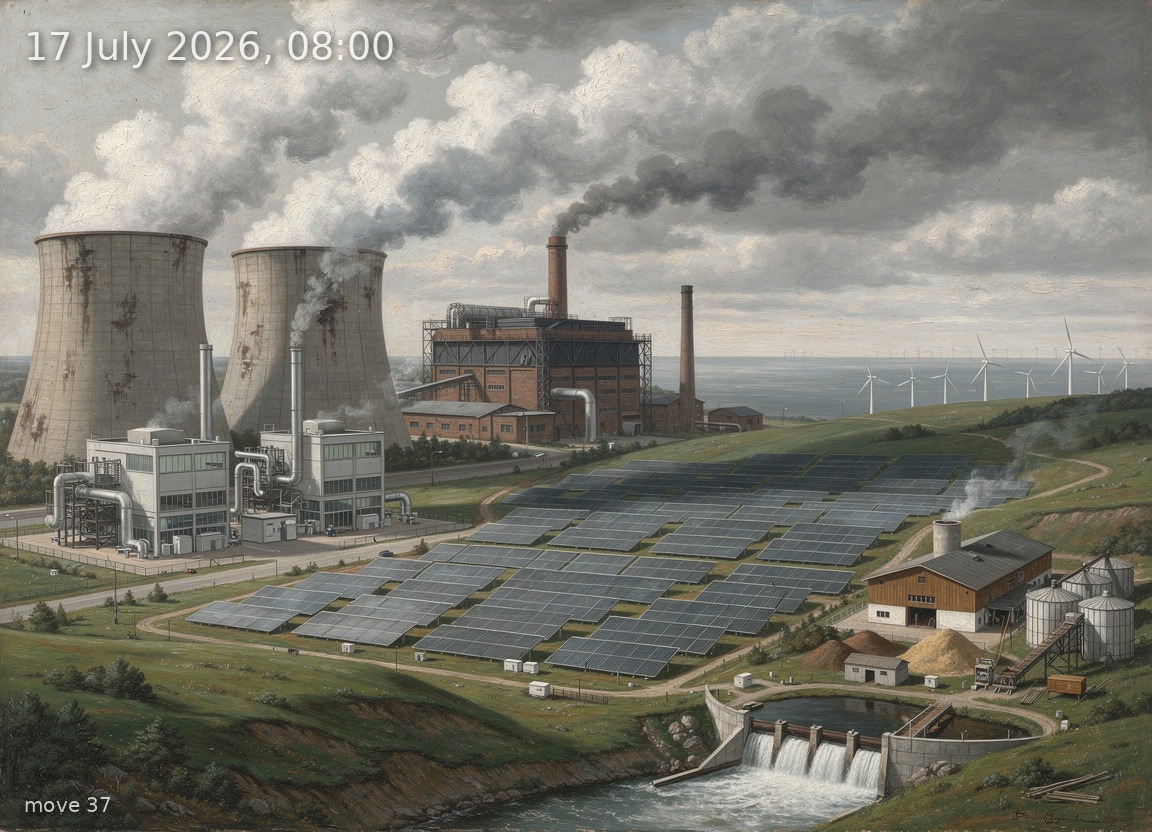
Cloudy skies limit solar to 17 GW; brown coal and large net imports fill a 61.6 GW demand at high prices.
Generation mix
Wind onshore 6%
Wind offshore 1%
Solar 38%
Biomass 9%
Hydro 3%
Natural gas 12%
Hard coal 9%
Brown coal 24%
56%
Renewable share
2.9 GW
Wind (on + offshore)
17.1 GW
Solar
45.3 GW
Total generation
16.3 GW
Net import
157.1 EUR/MWh
Day-ahead price
19.0°C / 9 km/h
Temp / Wind speed
Open-Meteo, Kassel (51.3°N 9.5°E) · surface estimate from 100 m wind
76.0% / 67.0 W/m²
Cloud cover / Radiation
317
gCO₂/kWh
Image prompt
Brown coal 10.8 GW dominates the left third of the scene as a cluster of massive hyperbolic cooling towers with thick white-grey steam plumes rising into overcast sky; solar 17.1 GW fills the centre-right as vast fields of aluminium-framed crystalline silicon PV panels stretching across gentle green summer hills, their surfaces reflecting diffuse grey-white light; natural gas 5.2 GW appears centre-left as two compact CCGT power stations with slim exhaust stacks emitting thin heat haze; hard coal 3.9 GW sits behind the lignite complex as a rectangular boiler house with a single tall chimney trailing dark smoke; biomass 4.0 GW is rendered as a timber-clad industrial plant with a short stack and woodchip storage silos at the far right; wind onshore 2.7 GW appears as a sparse row of three-blade turbines on a distant ridge, rotors turning slowly in light breeze; hydro 1.4 GW is a small concrete dam with spillway in the right foreground valley; wind offshore 0.2 GW is barely visible as tiny turbine silhouettes on the far horizon. Time is 08:00 on a July morning: full daylight but heavily diffused by 76% cloud cover, the sky a layered blanket of pearl-grey and slate cumulus with only scattered brighter patches where the sun tries to break through, casting soft even light with no sharp shadows. The atmosphere feels heavy and oppressive, reflecting the 157 EUR/MWh price — humid summer air pressing down. Vegetation is lush mid-summer green, meadows and deciduous trees in full leaf at 19°C. High-voltage transmission pylons and cables cross the middle distance, symbolising the heavy import flows. Painted in the style of a highly detailed 19th-century German Romantic oil painting — rich, layered colour, visible impasto brushwork, atmospheric depth and haze, meticulous engineering detail on every turbine nacelle, every cooling tower rib, every PV panel frame — a grand industrial landscape rendered as a masterwork. No text, no labels.