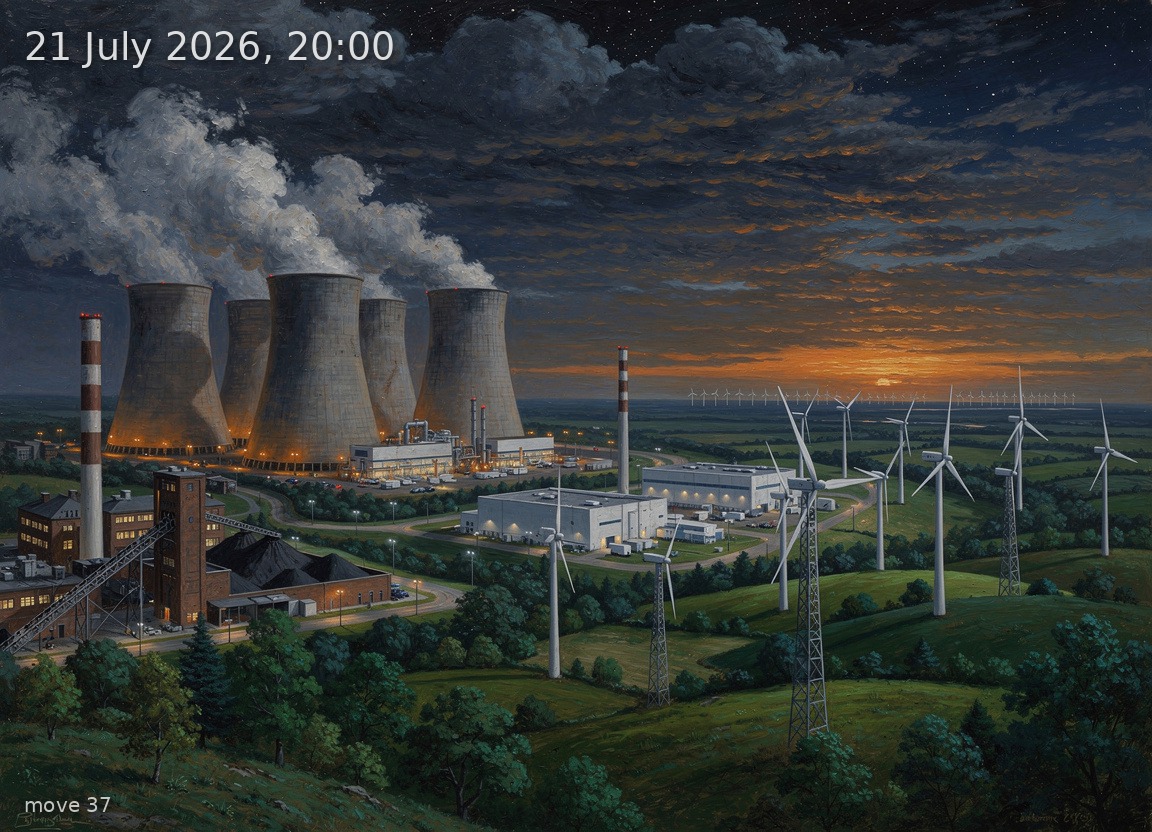
Brown coal, wind, and gas anchor a 37 GW supply against 56 GW demand, requiring large net imports at elevated prices.
Generation mix
Wind onshore 24%
Wind offshore 8%
Solar 6%
Biomass 11%
Hydro 3%
Natural gas 13%
Hard coal 12%
Brown coal 24%
52%
Renewable share
11.8 GW
Wind (on + offshore)
2.1 GW
Solar
37.0 GW
Total generation
19.2 GW
Net import
172.0 EUR/MWh
Day-ahead price
21.2°C / 9 km/h
Temp / Wind speed
Open-Meteo, Kassel (51.3°N 9.5°E) · surface estimate from 100 m wind
73.0% / 138.0 W/m²
Cloud cover / Radiation
343
gCO₂/kWh
Image prompt
Brown coal 8.7 GW dominates the left third of the scene as a cluster of massive hyperbolic cooling towers rising against a darkening sky, thick white-grey steam plumes drifting eastward, lit from below by orange sodium lamps of the power station complex; wind onshore 8.9 GW spans the centre-right as dozens of three-blade turbines on lattice and tubular towers across rolling green summer hills, blades turning slowly in light wind; natural gas 4.7 GW appears centre-left as two compact CCGT plants with slender exhaust stacks emitting thin heat shimmer, illuminated by industrial floodlights; hard coal 4.3 GW sits adjacent to the lignite plant as a smaller coal-fired station with a single tall rectangular chimney and conveyor belts feeding coal bunkers; biomass 4.2 GW is rendered as a mid-ground wood-chip-fed CHP facility with a modest smokestack and stacked timber logs beside it; wind offshore 2.9 GW appears as a distant row of turbines along the far horizon line; solar 2.1 GW is a small field of crystalline silicon PV panels in the mid-ground, panels dark and reflectionless in the fading light; hydro 1.2 GW is a small dam and powerhouse nestled in a wooded valley at far right. Time of day is 20:00 in July — the sky is deep twilight transitioning to night, a narrow band of fading amber-orange light clings to the western horizon, the upper sky is deep indigo shading to near-black overhead, first stars barely visible; the landscape is lush summer green with full-leafed deciduous trees. The atmosphere is heavy, humid, and oppressive with 73% cloud cover — low stratus clouds glow faintly orange from industrial light pollution beneath. Highly detailed oil painting in the tradition of 19th-century German Romantic landscape painters — rich, saturated colour palette, visible impasto brushwork, Caspar David Friedrich-style atmospheric depth and scale, but with meticulous engineering accuracy on every turbine nacelle, cooling tower hyperbolic curve, PV panel aluminium frame, and gas turbine exhaust stack. No text, no labels.