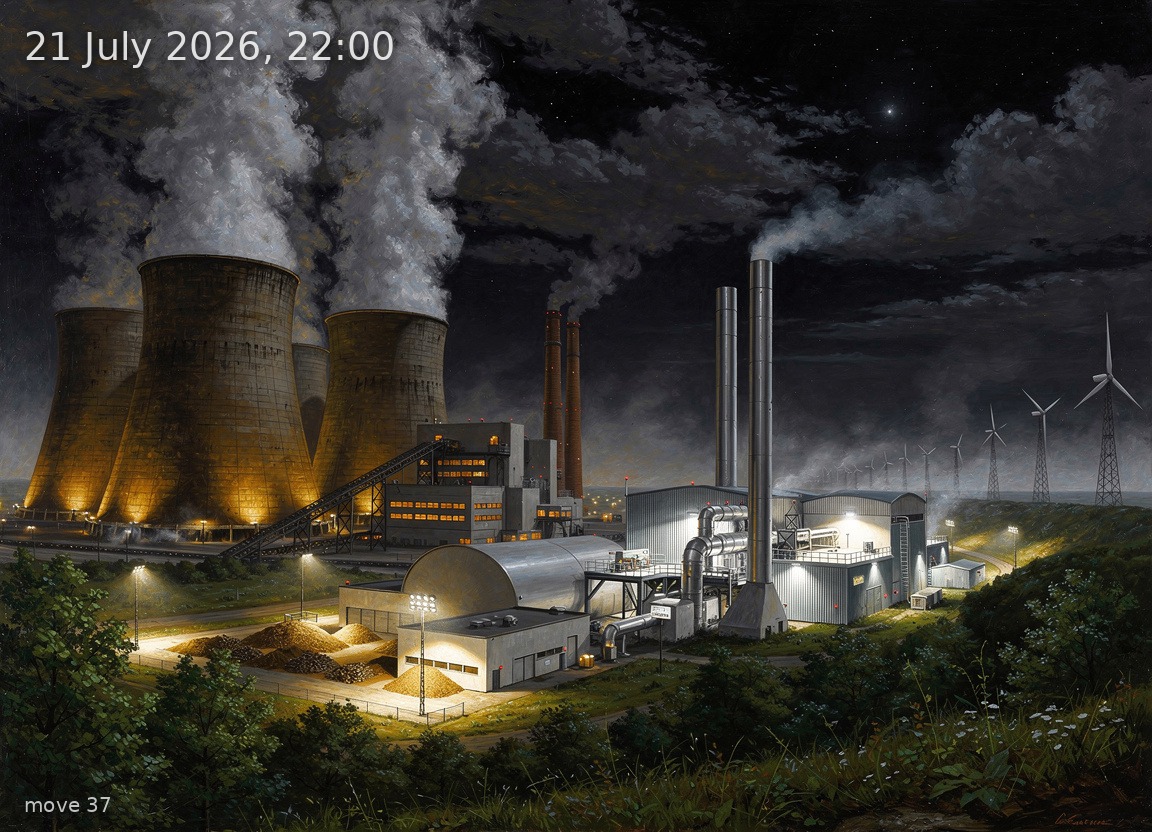
Brown coal and wind lead a 35.3 GW supply against 51.3 GW demand, requiring 16 GW net imports at elevated prices.
Generation mix
Wind onshore 24%
Wind offshore 9%
Biomass 12%
Hydro 3%
Natural gas 14%
Hard coal 12%
Brown coal 25%
49%
Renewable share
11.7 GW
Wind (on + offshore)
0.0 GW
Solar
35.3 GW
Total generation
16.0 GW
Net import
168.3 EUR/MWh
Day-ahead price
18.2°C / 8 km/h
Temp / Wind speed
Open-Meteo, Kassel (51.3°N 9.5°E) · surface estimate from 100 m wind
59.0% / 1.0 W/m²
Cloud cover / Radiation
367
gCO₂/kWh
Image prompt
Brown coal 8.9 GW dominates the left third of the scene as a cluster of massive hyperbolic cooling towers with thick white-grey steam plumes rising into the dark sky, their bases glowing amber from sodium lights; wind onshore 8.5 GW spans the right third as a long receding line of three-blade turbines on lattice towers along a ridge, red aviation warning lights blinking on nacelles, blades turning gently in moderate wind; natural gas 4.9 GW appears centre-right as two compact CCGT plants with tall slender exhaust stacks emitting thin heat shimmer, lit by industrial floodlights; hard coal 4.4 GW sits centre-left as a large power station with twin brick chimneys and a visible coal conveyor system, windows glowing orange; biomass 4.3 GW occupies the near centre as a mid-sized plant with a rounded silo and wood-chip storage yard under halogen lamps; wind offshore 3.2 GW is suggested in the far-right background as distant turbines barely visible above a dark horizon line with faint red lights; hydro 1.2 GW appears as a small dam structure in the lower foreground with water glinting under floodlights. The sky is completely dark, deep navy-black, no twilight, no sunset glow — a full summer night at 22:00 in July. Stars are largely hidden by 59% cloud cover rendered as grey-charcoal masses drifting across the upper canvas. The atmosphere feels heavy and oppressive, reflecting the high electricity price — humid summer air traps the steam and industrial haze close to the ground. Green summer vegetation — deciduous trees in full leaf, tall grass — is faintly visible in the foreground lit by spill light from the plants. The entire scene is rendered as a highly detailed oil painting in the tradition of 19th-century German Romantic landscape painters such as Caspar David Friedrich, with rich dark palette, visible impasto brushwork, dramatic chiaroscuro between the artificial lights and the black sky, atmospheric depth with haze layers receding toward the horizon. Every technology is painted with meticulous engineering accuracy: turbine nacelles with correct proportions, three-blade rotors, aluminium-framed infrastructure, lignite hyperbolic cooling tower geometry with reinforced concrete texture, CCGT stainless steel exhaust stacks. No text, no labels.