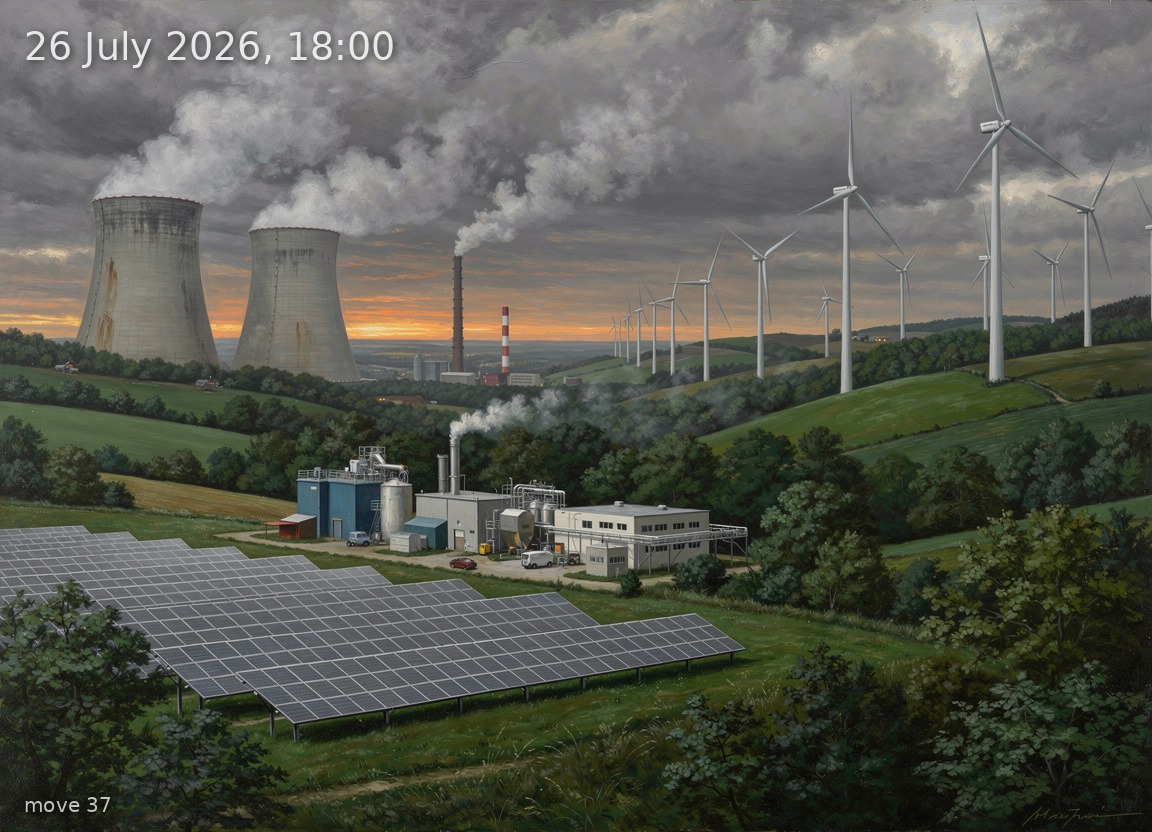
Strong onshore wind and diffuse solar lead at 88% renewables, but 6.6 GW net imports cover the consumption gap.
Generation mix
Wind onshore 44%
Wind offshore 4%
Solar 28%
Biomass 9%
Hydro 3%
Natural gas 4%
Hard coal 1%
Brown coal 7%
88%
Renewable share
19.9 GW
Wind (on + offshore)
11.8 GW
Solar
41.6 GW
Total generation
6.6 GW
Net import
109.2 EUR/MWh
Day-ahead price
23.6°C / 17 km/h
Temp / Wind speed
Open-Meteo, Kassel (51.3°N 9.5°E) · surface estimate from 100 m wind
100.0% / 12.0 W/m²
Cloud cover / Radiation
84
gCO₂/kWh
Image prompt
Wind onshore 18.4 GW dominates the right two-thirds of the scene as dozens of tall three-blade turbines with white tubular towers and detailed nacelles, rotors spinning briskly in moderate wind, stretching across rolling green summer hills into atmospheric depth. Solar 11.8 GW occupies the centre-left foreground as vast fields of aluminium-framed crystalline silicon photovoltaic panels reflecting only dull grey light under the overcast sky. Biomass 3.9 GW appears as a mid-ground cluster of industrial biomass plants with rectangular boiler buildings and modest chimneys emitting thin white exhaust. Brown coal 2.9 GW sits in the left background as two large hyperbolic concrete cooling towers with heavy white-grey steam plumes merging into the clouds. Natural gas 1.5 GW is rendered as a compact CCGT facility with a single tall exhaust stack and visible heat shimmer, positioned behind the solar field. Wind offshore 1.5 GW is barely visible on the far-right horizon as a few distant turbines standing in a sliver of grey sea. Hydro 1.1 GW appears as a small concrete dam with cascading water in a valley in the far left middle ground. Hard coal 0.5 GW is a single small smokestack near the brown coal plant. The sky is completely overcast with a thick, heavy, oppressive blanket of stratiform cloud — no blue sky visible — rendered in tones of slate grey and warm pewter. The time is 18:00 in late July dusk: the sun is still above the horizon but fully hidden, giving a flat diffuse light with a subtle warm orange-amber glow along the lowest sliver of the western horizon where the cloud layer thins slightly. Lush green summer vegetation — tall grass, mature deciduous trees in full leaf — covers the landscape at 23.6°C warmth. The atmosphere feels heavy, humid, and oppressive, reflecting the high electricity price. Highly detailed oil painting in the tradition of 19th-century German Romantic landscape painters such as Caspar David Friedrich and Carl Blechen — rich layered colour, visible confident brushwork, strong atmospheric perspective and chiaroscuro depth — but with meticulous modern engineering accuracy in every turbine nacelle, PV cell grid pattern, cooling tower curvature, and exhaust plume. No text, no labels.