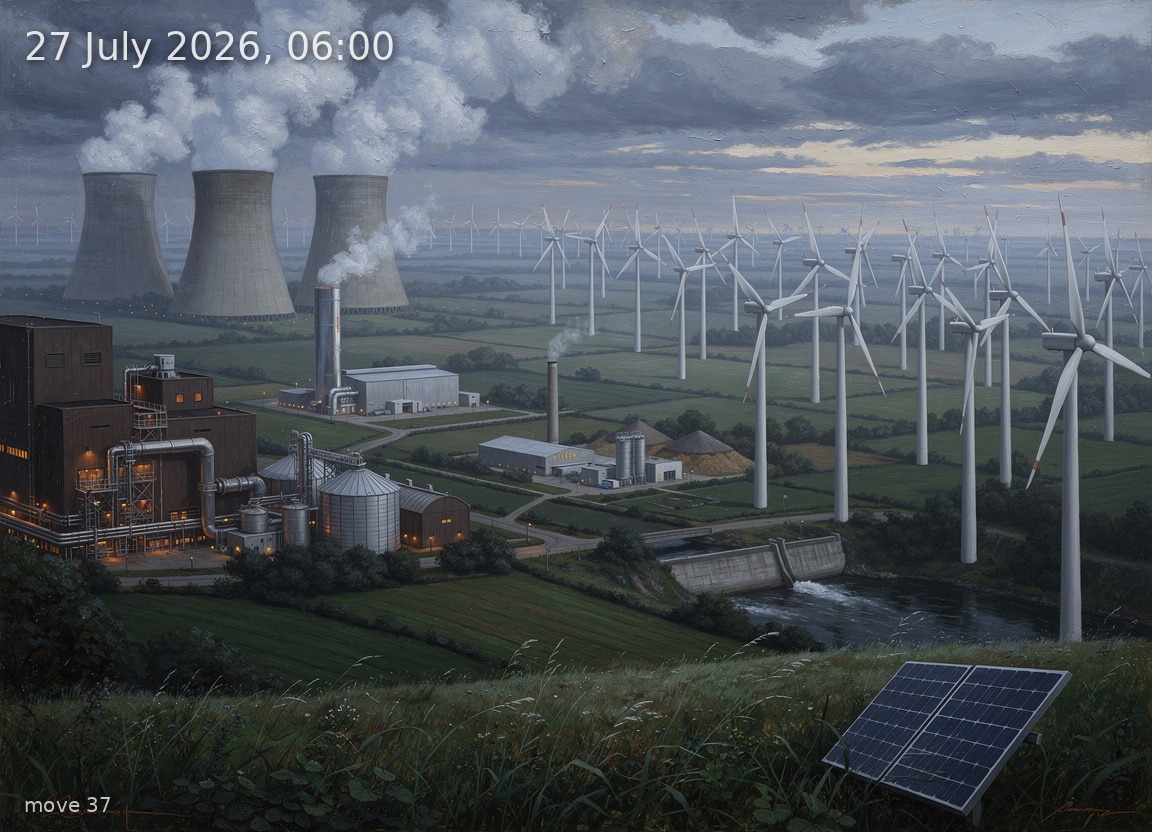
Strong onshore wind leads generation at dawn while brown coal and net imports cover the 5.5 GW shortfall.
Generation mix
Wind onshore 51%
Wind offshore 11%
Solar 4%
Biomass 8%
Hydro 2%
Natural gas 6%
Hard coal 4%
Brown coal 14%
76%
Renewable share
28.7 GW
Wind (on + offshore)
1.8 GW
Solar
46.7 GW
Total generation
5.5 GW
Net import
117.6 EUR/MWh
Day-ahead price
16.4°C / 12 km/h
Temp / Wind speed
Open-Meteo, Kassel (51.3°N 9.5°E) · surface estimate from 100 m wind
77.0% / 0.0 W/m²
Cloud cover / Radiation
175
gCO₂/kWh
Image prompt
Wind onshore 23.8 GW dominates the scene as vast ranks of three-blade turbines with white tubular towers and detailed nacelles stretching across rolling green farmland, occupying over half the canvas from centre to right; wind offshore 5.0 GW appears as a cluster of larger turbines on the distant horizon line, partially obscured by morning haze over the North Sea; brown coal 6.4 GW occupies the left foreground as a massive lignite power station with three hyperbolic concrete cooling towers emitting thick white-grey steam plumes rising into heavy clouds; biomass 3.9 GW is rendered as a mid-ground industrial plant with a tall rectangular stack and adjacent wood-chip storage silos; natural gas 2.8 GW appears as a compact CCGT facility with a single polished exhaust stack and a smaller rectangular cooling unit, positioned between the coal plant and the turbines; hard coal 2.1 GW is a smaller conventional power station with a single cylindrical chimney releasing a thin grey plume, set behind the gas plant; hydro 1.0 GW is suggested by a modest concrete dam and spillway along a river in the middle distance; solar 1.8 GW is a small array of aluminium-framed crystalline silicon panels in a meadow near the foreground, their surfaces dull and unreflective under the overcast sky. The sky is deep blue-grey pre-dawn light at 06:00, no direct sun visible, only a faint pale brightening along the eastern horizon behind layered stratocumulus clouds at 77% cover; the atmosphere feels heavy and oppressive reflecting the high 117.6 EUR/MWh price. Temperature 16.4°C in late July — lush green deciduous trees in full summer leaf, dew on grass. Wind at 11.8 km/h animates the turbine blades in gentle rotation and bends tall grasses. Style: highly detailed oil painting in the tradition of Caspar David Friedrich and Carl Blechen — rich colour palette of slate blues, mossy greens, warm industrial oranges from sodium lamps still glowing on the coal plant, visible impasto brushwork, deep atmospheric perspective with layered mist, meticulous engineering detail on all infrastructure. No text, no labels.