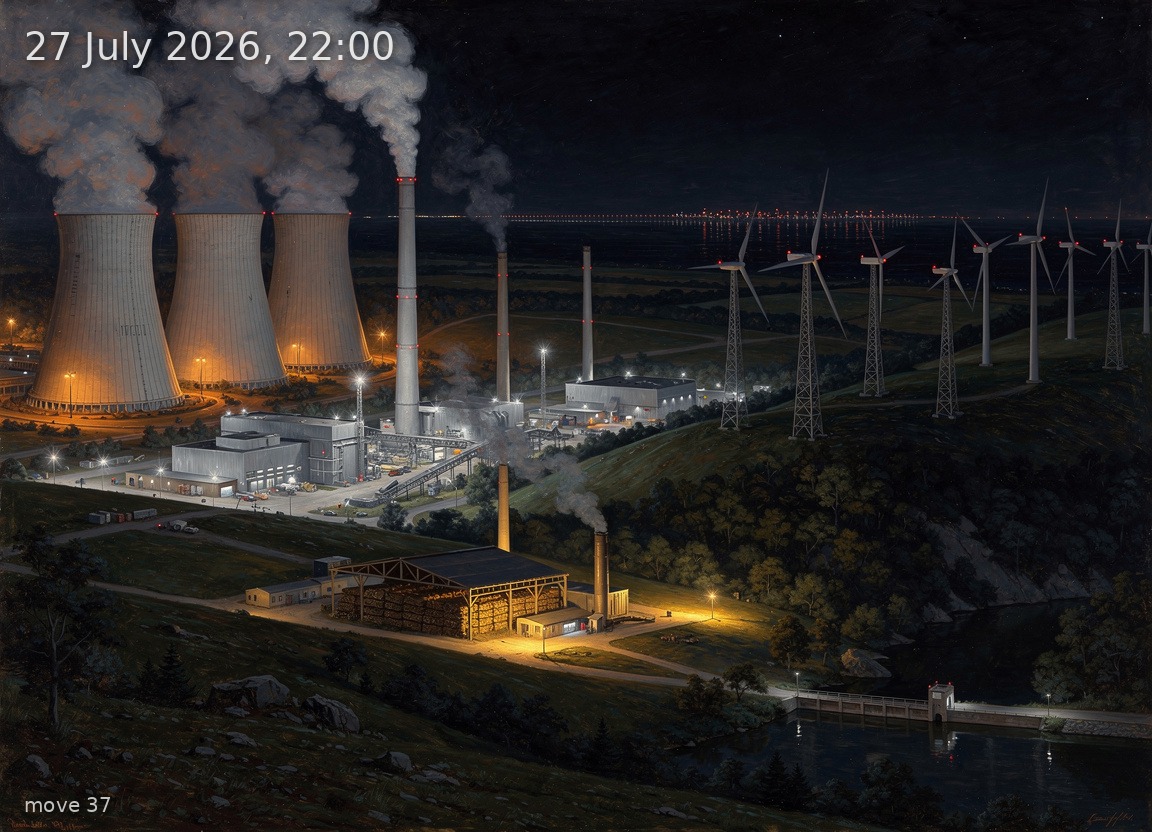
Wind leads at 14.1 GW but 14 GW of net imports are needed as coal and gas fill a high-demand summer night.
Generation mix
Wind onshore 29%
Wind offshore 9%
Biomass 12%
Hydro 3%
Natural gas 13%
Hard coal 11%
Brown coal 24%
52%
Renewable share
14.1 GW
Wind (on + offshore)
0.0 GW
Solar
37.1 GW
Total generation
14.0 GW
Net import
171.1 EUR/MWh
Day-ahead price
17.8°C / 11 km/h
Temp / Wind speed
Open-Meteo, Kassel (51.3°N 9.5°E) · surface estimate from 100 m wind
2.0% / 0.0 W/m²
Cloud cover / Radiation
340
gCO₂/kWh
Image prompt
Brown coal 8.8 GW dominates the left quarter of the scene as a cluster of massive hyperbolic cooling towers with thick white steam plumes rising into the night sky, lit from below by orange sodium lamps; natural gas 4.8 GW appears left-of-centre as two compact CCGT power blocks with tall slender exhaust stacks emitting thin heat shimmer, illuminated by industrial floodlights; hard coal 4.1 GW sits centre-left as a large conventional power station with rectangular boiler houses and a single fat chimney trailing grey smoke; biomass 4.3 GW appears at centre as a mid-sized plant with a timber-framed fuel storage hall and a modest stack, warmly lit; wind onshore 10.8 GW fills the right half of the composition as dozens of three-blade turbines on lattice and tubular steel towers stretching across rolling hills into the distance, red aviation warning lights blinking on nacelles; wind offshore 3.3 GW is visible in the far right background as a line of turbines standing in a dark sea on the horizon, their lights reflected on calm water; hydro 1.0 GW appears as a small dam and powerhouse nestled in a wooded valley at far right. The sky is completely dark, deep navy-black, nearly cloudless with brilliant stars visible overhead and a faint Milky Way — cloud cover only 2%. The atmosphere feels heavy and oppressive despite the clear sky, conveying the tension of high electricity prices — a subtle amber-brown industrial haze clings low to the horizon around the thermal plants. Summer vegetation is lush and green where lit — deciduous trees in full leaf, tall grass — but mostly rendered as dark silhouettes. Moderate wind animates the turbine blades and rustles tree canopies. No sunlight, no solar panels, no twilight glow. Highly detailed oil painting in the tradition of 19th-century German Romantic landscape painters such as Caspar David Friedrich and Carl Blechen — rich impasto brushwork, dramatic chiaroscuro between the glowing industrial facilities and the surrounding darkness, atmospheric depth with layers of haze, masterful rendering of artificial light against natural night. Meticulous engineering detail on every technology: three-blade rotors with correct nacelle proportions, aluminium-clad CCGT units, reinforced-concrete cooling towers with visible ribbing. No text, no labels.