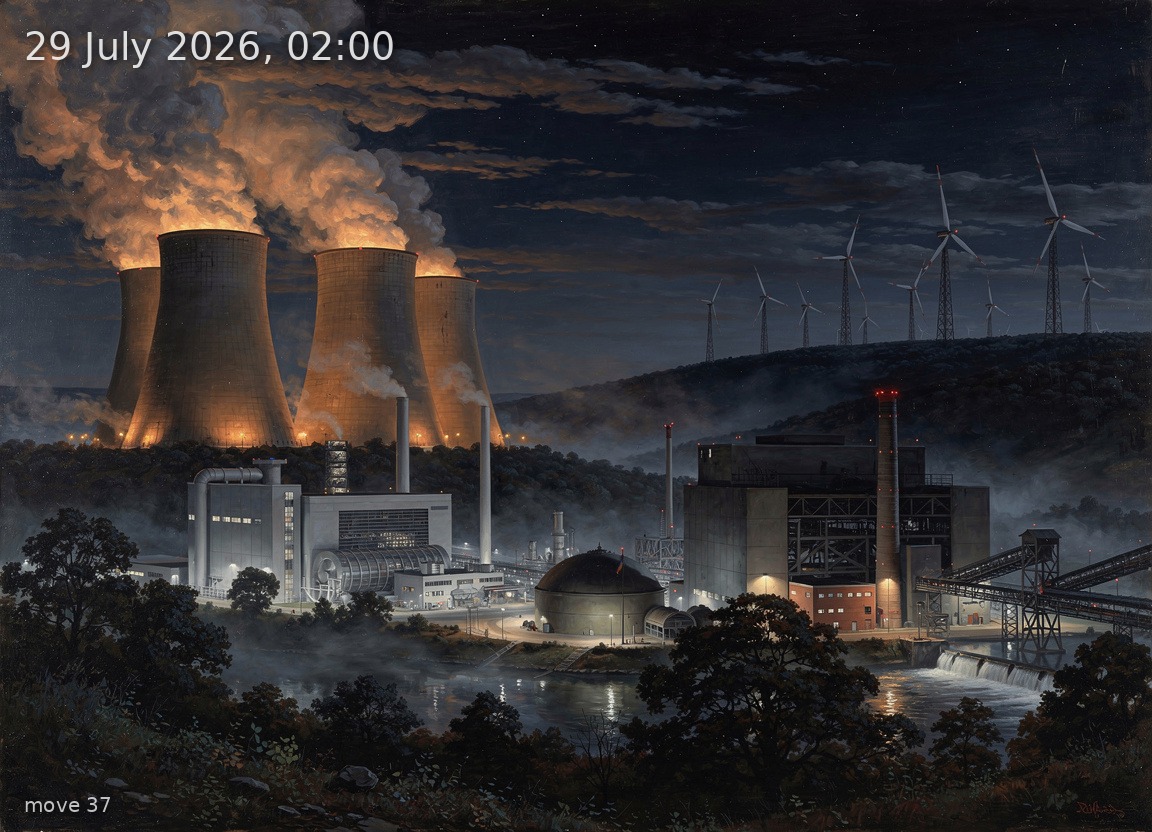
Brown coal, onshore wind, gas, and hard coal anchor overnight supply as Germany imports 5.3 GW.
Generation mix
Wind onshore 26%
Wind offshore 6%
Biomass 11%
Hydro 3%
Natural gas 16%
Hard coal 14%
Brown coal 25%
45%
Renewable share
11.6 GW
Wind (on + offshore)
0.0 GW
Solar
36.5 GW
Total generation
5.3 GW
Net import
137.2 EUR/MWh
Day-ahead price
14.5°C / 2 km/h
Temp / Wind speed
Open-Meteo, Kassel (51.3°N 9.5°E) · surface estimate from 100 m wind
45.0% / 0.0 W/m²
Cloud cover / Radiation
388
gCO₂/kWh
Image prompt
Brown coal 9.1 GW dominates the left third of the scene as three massive hyperbolic cooling towers with thick steam plumes lit from below by orange sodium lamps; onshore wind 9.5 GW spans the right third as dozens of tall three-blade turbines on lattice towers along a dark ridgeline, blades turning slowly; natural gas 5.8 GW appears centre-left as a pair of compact CCGT plants with slender exhaust stacks venting pale heat shimmer; hard coal 5.2 GW sits centre-right as a large block power station with a single tall smokestack and conveyor infrastructure; biomass 3.9 GW is rendered as a smaller industrial plant with a rounded biomass dome and short chimney near the middle ground; hydro 1.0 GW appears as a small dam structure with illuminated spillway in the far background valley. Time is 02:00 at night: the sky is completely black to deep navy, no twilight, no sky glow, stars partly obscured by 45% cloud cover drifting in thin layers. The air is still — virtually no wind at ground level despite the turbines catching higher-altitude breezes. Summer vegetation: dark deciduous trees with full canopies barely visible. The atmosphere feels heavy and oppressive, reflecting the high electricity price — a brooding, weighty industrial darkness. Artificial light dominates: sodium-orange streetlights along an access road, blue-white security floodlights on plant perimeters, red aircraft warning lights on turbine nacelles and smokestacks blinking. Cooling tower steam catches and scatters the orange industrial glow. Temperature is mild at 14.5°C — no frost, soft humid air. No solar panels anywhere. Style: highly detailed oil painting in the tradition of 19th-century German Romantic landscape painters — rich, dark palette of indigo, burnt sienna, and lamp black with visible impasto brushwork, dramatic chiaroscuro from artificial light sources, atmospheric depth created by layered industrial haze. Each technology rendered with meticulous engineering accuracy: three-blade rotor profiles, hyperbolic concrete shell geometry, CCGT gas turbine exhaust cowlings. The scene evokes Caspar David Friedrich's sublime darkness transposed onto a modern industrial Rhineland panorama. No text, no labels.