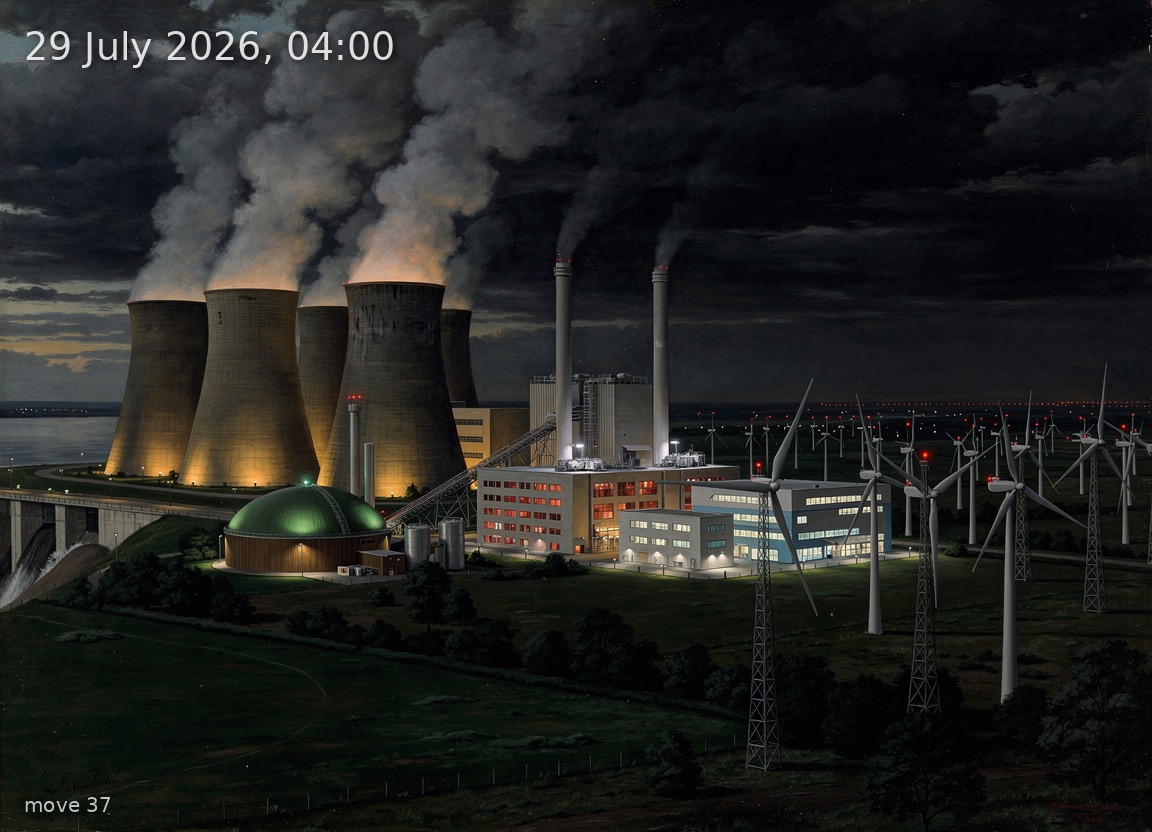
Brown coal, hard coal, gas, and wind share generation while 7.3 GW net imports cover overnight demand.
Generation mix
Wind onshore 27%
Wind offshore 6%
Biomass 11%
Hydro 3%
Natural gas 15%
Hard coal 14%
Brown coal 25%
46%
Renewable share
11.7 GW
Wind (on + offshore)
0.0 GW
Solar
35.7 GW
Total generation
7.3 GW
Net import
140.3 EUR/MWh
Day-ahead price
13.1°C / 1 km/h
Temp / Wind speed
Open-Meteo, Kassel (51.3°N 9.5°E) · surface estimate from 100 m wind
95.0% / 0.0 W/m²
Cloud cover / Radiation
380
gCO₂/kWh
Image prompt
Brown coal 8.8 GW dominates the left third of the scene as a cluster of massive hyperbolic cooling towers with thick white-grey steam plumes rising into a black overcast sky, their concrete surfaces lit by amber sodium floodlights; hard coal 5.0 GW appears just right of centre as a pair of large power stations with tall rectangular stacks and conveyor gantries, glowing red-orange from furnace light spilling through windows; natural gas 5.4 GW occupies the centre as two compact CCGT plants with slender single exhaust stacks emitting thin vapour, illuminated by harsh white industrial lighting; wind onshore 9.7 GW fills the right third as dozens of three-blade turbines on lattice and tubular towers receding into the dark distance, their red aviation warning lights blinking in staggered rhythms; wind offshore 2.0 GW is suggested at the far right horizon as a faint line of red blinking lights above an invisible sea; biomass 3.8 GW appears as a modest wood-clad biogas facility with a green-lit dome and small stack near the coal plants; hydro 1.0 GW is rendered as a concrete dam spillway visible at the far left edge, water catching floodlight reflections. The sky is completely dark, deep charcoal-black with heavy 95% cloud cover erasing any stars or moon, pressing down oppressively to reflect the high electricity price. The landscape is a flat northern German plain in midsummer, with lush dark-green grass and mature deciduous trees barely visible in silhouette. Ground-level air is dead still — no motion in grass or foliage, contrasting with the spinning turbine blades above driven by upper-level winds. Puddles on an industrial access road reflect the sodium-orange and white lights. Rendered as a highly detailed oil painting in the tradition of 19th-century German Romantic landscape painters — rich, dark palette with dramatic chiaroscuro, visible confident brushwork, atmospheric depth and sfumato in the steam plumes, meticulous engineering accuracy in every turbine nacelle, cooling tower curvature, and CCGT exhaust stack detail. The mood is solemn, industrial sublime. No text, no labels.