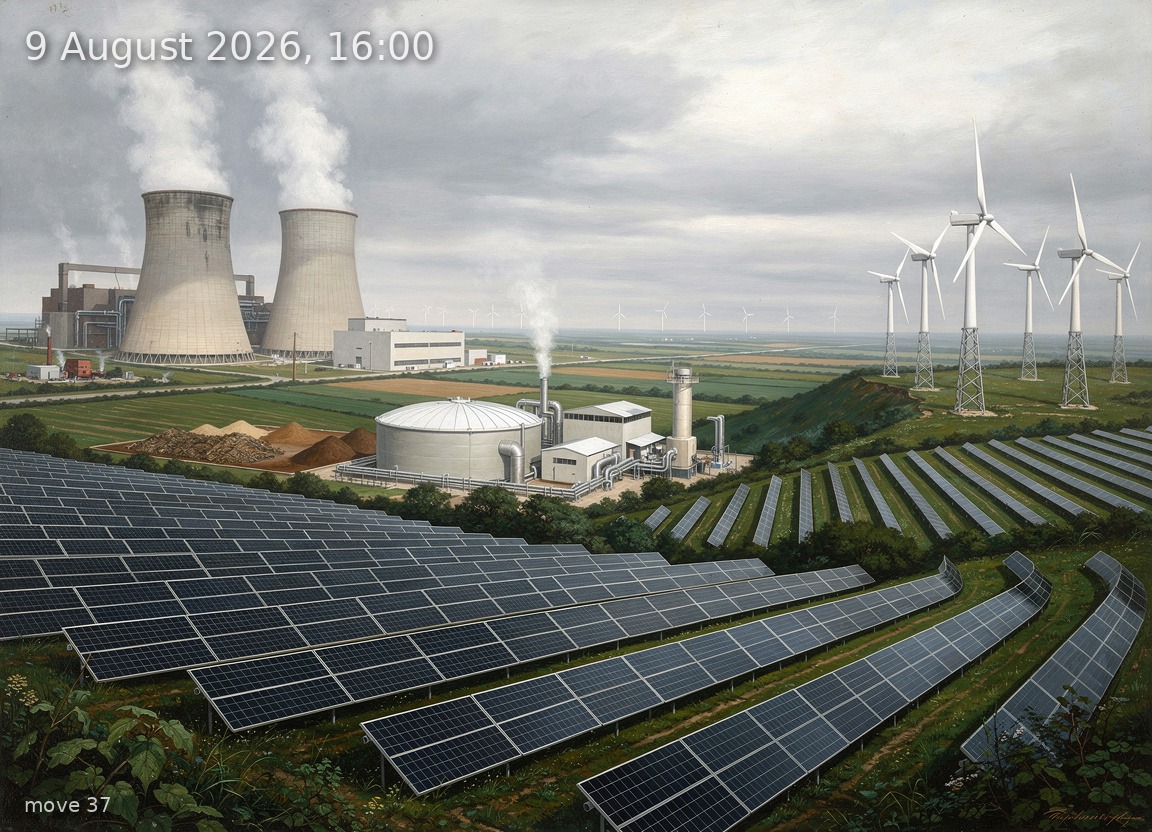
Solar at 35.1 GW drives 6.7 GW net exports and near-zero prices under heavy overcast.
Generation mix
Wind onshore 10%
Wind offshore 2%
Solar 69%
Biomass 7%
Hydro 2%
Natural gas 3%
Hard coal 1%
Brown coal 7%
90%
Renewable share
6.2 GW
Wind (on + offshore)
35.1 GW
Solar
51.1 GW
Total generation
+6.7 GW
Net export
3.8 EUR/MWh
Day-ahead price
32.3°C / 17 km/h
Temp / Wind speed
Open-Meteo, Kassel (51.3°N 9.5°E) · surface estimate from 100 m wind
95.0% / 171.0 W/m²
Cloud cover / Radiation
74
gCO₂/kWh
Image prompt
Solar 35.1 GW dominates the foreground and middle ground as vast fields of aluminium-framed crystalline silicon PV panels stretching across gently rolling farmland, their blue-black surfaces reflecting diffuse white light under a uniformly overcast sky. Wind onshore 5.3 GW appears as a cluster of modern three-blade turbines on lattice towers on a ridge to the right, blades turning gently in moderate breeze. Wind offshore 0.9 GW is suggested by a few distant turbines on the far horizon line. Brown coal 3.3 GW occupies the far left as two large hyperbolic cooling towers with lazy steam plumes drifting into the grey sky, connected to a blocky power station building. Biomass 3.5 GW appears as a compact industrial facility with a domed biogas digester and a low exhaust stack beside a woodchip storage area, positioned just left of centre behind the solar arrays. Natural gas 1.4 GW is a single CCGT unit with a slim exhaust stack and modest heat shimmer, tucked beside the biomass plant. Hard coal 0.5 GW is a small, aging plant with a single square chimney releasing a thin wisp, barely visible at the far left edge. Hydro 1.2 GW is a concrete run-of-river weir and small powerhouse visible along a river in the mid-ground. The time is 16:00 on a scorching August afternoon: full daylight but entirely diffused through dense, unbroken cloud cover — no shadows, a bright but flat silvery-white sky pressing down with humid summer heat. Vegetation is lush, deep green, slightly wilted from 32°C heat; the air feels heavy and still despite the moderate breeze turning the turbines. The low price creates a calm, expansive, open atmosphere — no tension, just quiet industrial abundance. Style: highly detailed oil painting in the tradition of 19th-century German Romantic landscape painters such as Caspar David Friedrich and Carl Blechen, with rich layered colour, visible confident brushwork, atmospheric aerial perspective, meticulous engineering detail on every technology — turbine nacelle housings, PV cell grid patterns, cooling tower concrete textures, pipe networks — rendered as a monumental panoramic masterwork of the modern industrial landscape. No text, no labels.