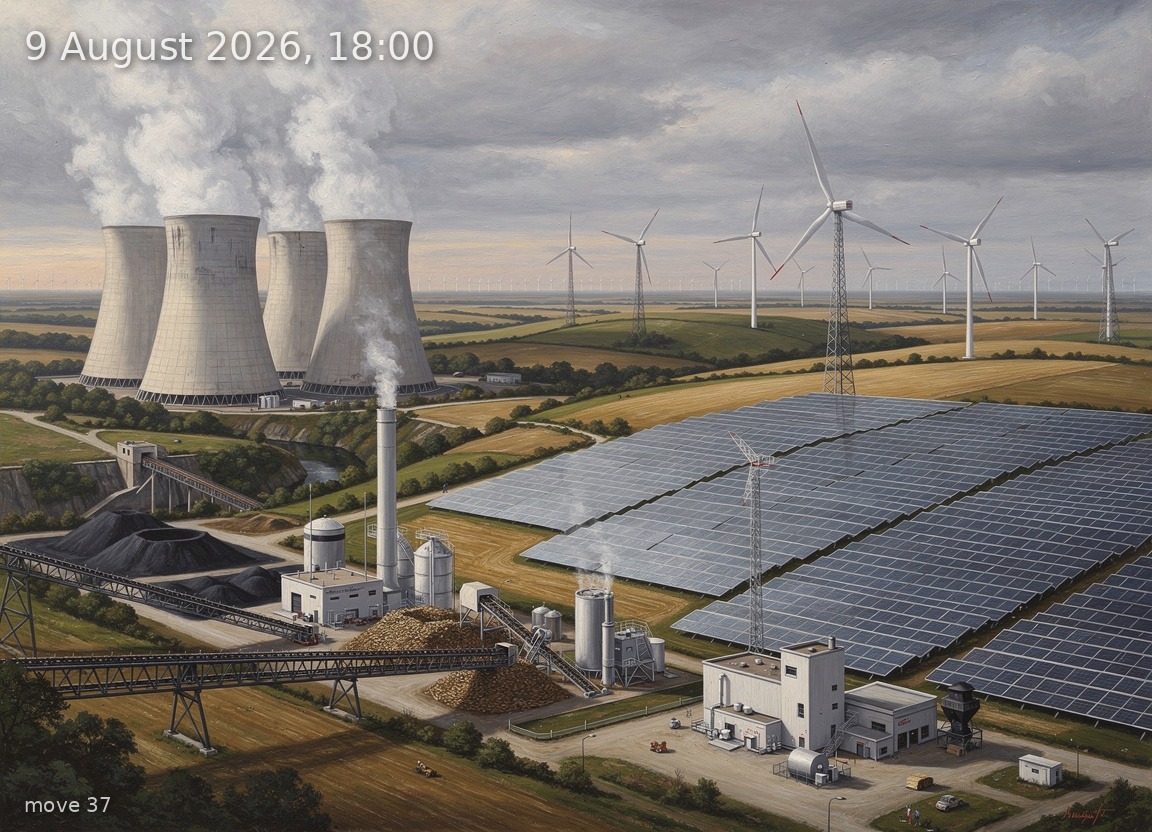
Solar leads at 14 GW under full overcast; brown coal and wind support as 12.3 GW net imports cover peak demand.
Generation mix
Wind onshore 18%
Wind offshore 3%
Solar 41%
Biomass 11%
Hydro 3%
Natural gas 5%
Hard coal 4%
Brown coal 15%
75%
Renewable share
7.1 GW
Wind (on + offshore)
14.0 GW
Solar
34.3 GW
Total generation
12.3 GW
Net import
151.2 EUR/MWh
Day-ahead price
31.4°C / 14 km/h
Temp / Wind speed
Open-Meteo, Kassel (51.3°N 9.5°E) · surface estimate from 100 m wind
100.0% / 81.0 W/m²
Cloud cover / Radiation
182
gCO₂/kWh
Image prompt
Solar 14.0 GW dominates the centre-right as vast fields of aluminium-framed crystalline silicon photovoltaic panels stretching across rolling farmland under a completely overcast, flat grey-white sky with no direct sun, diffuse light only. Brown coal 5.2 GW occupies the left foreground as a cluster of massive hyperbolic concrete cooling towers with thick white steam plumes rising into the heavy clouds, beside a sprawling lignite conveyor system. Wind onshore 6.0 GW fills the right background as dozens of tall three-blade turbines on lattice and tubular steel towers, rotors turning moderately in light wind across summer-parched golden-green hills. Biomass 3.7 GW appears as a mid-ground wood-chip-fed power station with a tall cylindrical smokestack and fuel storage silos. Natural gas 1.7 GW is rendered as a compact CCGT plant with a single clean exhaust stack and modest heat shimmer, tucked between the coal complex and solar fields. Hard coal 1.5 GW shows as a smaller conventional boiler house with a square chimney and visible coal bunker. Wind offshore 1.1 GW is glimpsed as a faint row of turbines along a distant hazy horizon line. Hydro 1.1 GW appears as a small dam and penstock structure nestled in a wooded valley at far left. Time is early dusk at 18:00 in August: the sun is still above the horizon but entirely hidden by the thick overcast, producing a flat, warm, oppressive grey light with no shadows; the lower horizon shows the faintest hint of amber warmth beginning. The atmosphere feels heavy and sultry — 31°C summer heat haze softens distant details, vegetation is lush but slightly wilted, fields of dry grass and mature crops. The mood is oppressive and tense, reflecting the 151 EUR/MWh price — a weighty, humid stillness. Style: highly detailed oil painting in the tradition of 19th-century German Romantic landscape masters such as Caspar David Friedrich and Carl Blechen, with rich impasto brushwork, atmospheric depth through layered glazes, dramatic tonal contrasts between the pale industrial steam and the brooding overcast sky, meticulous engineering accuracy in every turbine nacelle, every PV module frame, every cooling tower's parabolic curve. No text, no labels.