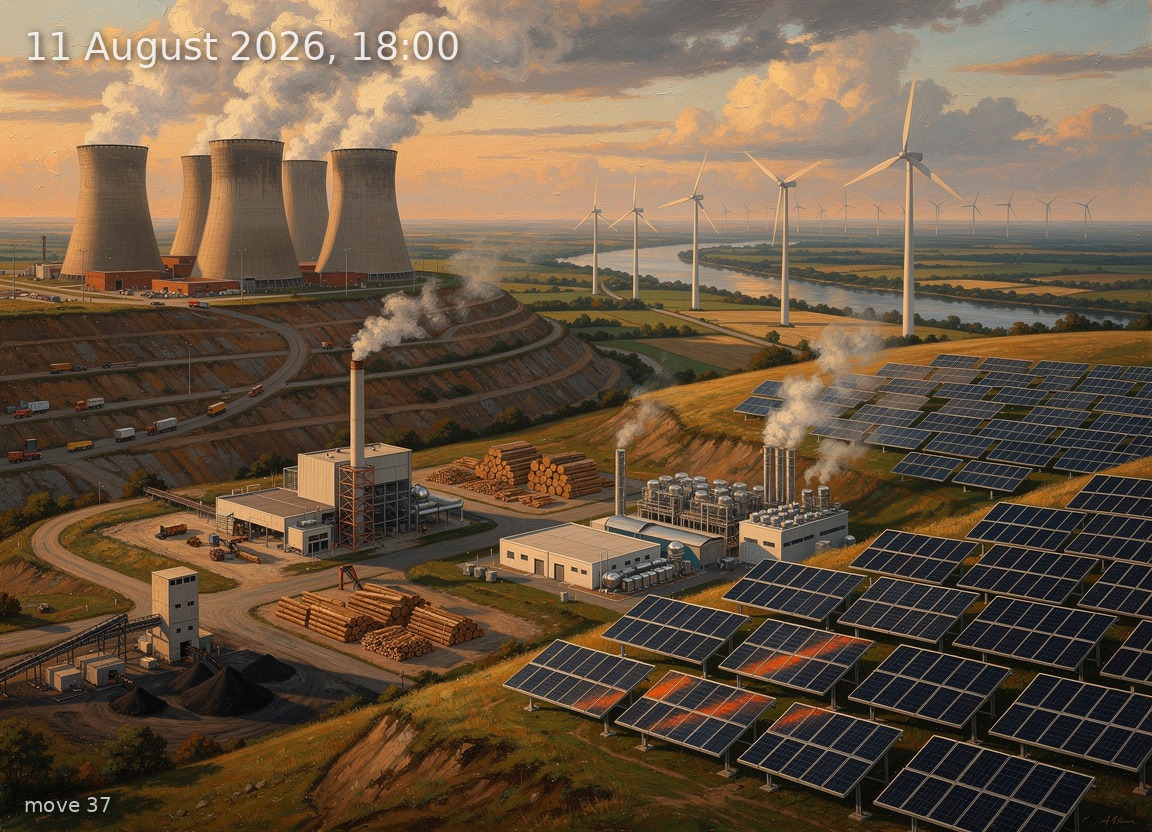
Solar leads at 17.4 GW with brown coal at 6.1 GW; 15.3 GW net imports drive elevated evening prices.
Generation mix
Wind onshore 17%
Wind offshore 3%
Solar 42%
Biomass 9%
Hydro 2%
Natural gas 6%
Hard coal 5%
Brown coal 15%
74%
Renewable share
8.2 GW
Wind (on + offshore)
17.4 GW
Solar
40.9 GW
Total generation
15.3 GW
Net import
146.5 EUR/MWh
Day-ahead price
23.3°C / 13 km/h
Temp / Wind speed
Open-Meteo, Kassel (51.3°N 9.5°E) · surface estimate from 100 m wind
62.0% / 354.0 W/m²
Cloud cover / Radiation
189
gCO₂/kWh
Image prompt
Solar 17.4 GW dominates the right half of the composition as vast fields of aluminium-framed crystalline silicon photovoltaic panels stretching across gently rolling farmland, angled toward a low western sun; brown coal 6.1 GW occupies the left quarter as a cluster of massive hyperbolic cooling towers with thick white-grey steam plumes rising into the sky, beside open-pit excavation terraces; wind onshore 7.1 GW appears as a line of tall three-blade turbines on ridgelines in the middle distance, rotors turning slowly in moderate breeze; wind offshore 1.1 GW is suggested by a faint row of turbines on a hazy horizon line beyond a distant river; biomass 3.8 GW is rendered as a medium-sized industrial plant with a timber yard and a single modest smokestack emitting thin white vapour; natural gas 2.6 GW appears as a compact CCGT facility with sleek exhaust stacks and a low heat shimmer; hard coal 2.0 GW is a smaller power station with a conveyor belt and a squat rectangular chimney; hydro 0.9 GW is a stone dam with water cascading in the far background. The lighting is dusk at 18:00 in August — a deep orange-red glow on the lower western horizon, the sky above transitioning from warm amber to darkening blue-violet, long dramatic shadows stretching eastward across the landscape. The atmosphere feels heavy and oppressive, with a hazy, humid quality reflecting the high electricity price — the air shimmers faintly with summer heat at 23°C, and 62% cloud cover creates broken cumulus formations lit from below in copper and rose. Green summer vegetation covers the hills, wheat fields golden and ripe. Highly detailed oil painting in the tradition of 19th-century German Romantic landscape painters such as Caspar David Friedrich and Carl Blechen — rich saturated colour, visible impasto brushwork, atmospheric depth and luminous sky treatment — but with meticulous engineering accuracy for each technology: correct turbine nacelle housings and lattice towers, realistic PV module framing, proper cooling tower proportions with natural-draft hyperbolic geometry. The scene feels monumental, a masterwork industrial landscape painting. No text, no labels.