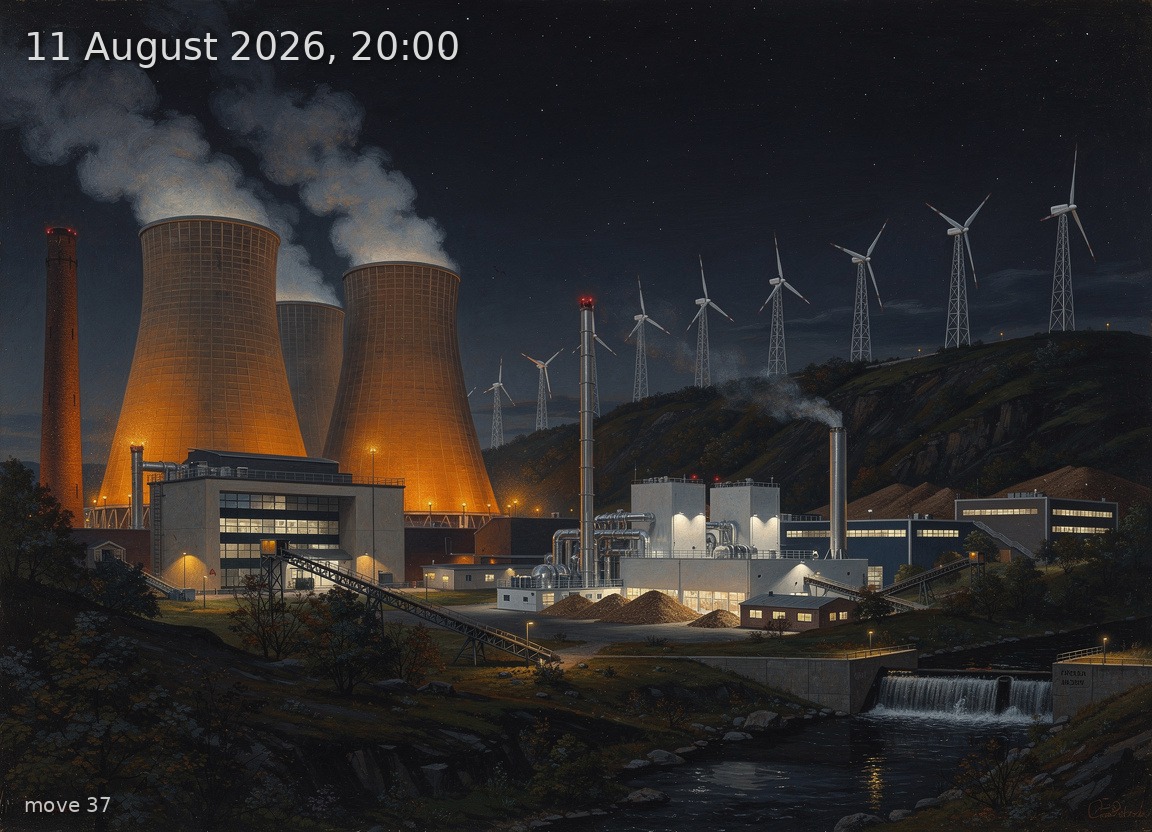
Brown coal, onshore wind, and gas anchor a 31.3 GW domestic supply requiring ~23 GW net imports at evening peak.
Generation mix
Wind onshore 23%
Wind offshore 3%
Solar 3%
Biomass 13%
Hydro 4%
Natural gas 18%
Hard coal 12%
Brown coal 25%
46%
Renewable share
8.2 GW
Wind (on + offshore)
0.8 GW
Solar
31.3 GW
Total generation
23.1 GW
Net import
199.0 EUR/MWh
Day-ahead price
21.7°C / 13 km/h
Temp / Wind speed
Open-Meteo, Kassel (51.3°N 9.5°E) · surface estimate from 100 m wind
0.0% / 84.0 W/m²
Cloud cover / Radiation
380
gCO₂/kWh
Image prompt
Brown coal 7.7 GW dominates the left quarter as a massive lignite power station with three hyperbolic cooling towers emitting thick white steam plumes, lit from below by orange sodium lamps; onshore wind 7.3 GW fills the centre-right as a long ridge of tall three-blade turbines with white lattice towers, their rotors turning steadily in moderate wind; natural gas 5.5 GW appears centre-left as two compact CCGT blocks with slender exhaust stacks venting thin heat shimmer; biomass 4.1 GW sits in the middle ground as a wood-chip-fed industrial plant with a single squat smokestack and conveyor belts; hard coal 3.9 GW occupies the far left as a classical coal plant with a large rectangular boiler house and a tall brick chimney; hydro 1.1 GW is a small concrete dam with spillway visible in the lower right valley; offshore wind 0.8 GW appears as faint turbine silhouettes on a distant dark horizon line; solar 0.8 GW is represented by a small field of aluminium-framed crystalline silicon panels catching the last faint glow, nearly dark. The sky is fully dark — deep navy to black, no twilight glow remaining — it is 20:00 in August in central Germany; stars faintly visible through perfectly clear skies, zero cloud cover. The warm 21.7°C summer night shows lush green deciduous trees and tall grass in full August foliage, barely visible in the artificial light. The atmosphere is heavy and oppressive, reflecting a 199 EUR/MWh price — a humid industrial haze clings to the valley, sodium-orange light pools around every facility, power transmission pylons with high-voltage lines stretch into the darkness connecting to unseen import sources. Highly detailed oil painting in the tradition of 19th-century German Romantic landscape painters — rich, deep colour palette of indigo, amber, ochre, and coal-black, visible impasto brushwork, atmospheric depth with layers of industrial haze, meticulous engineering accuracy on every turbine nacelle, cooling tower ribbing, and exhaust stack. The scene evokes Caspar David Friedrich's sense of sublime scale but applied to an industrial energy landscape. No text, no labels.