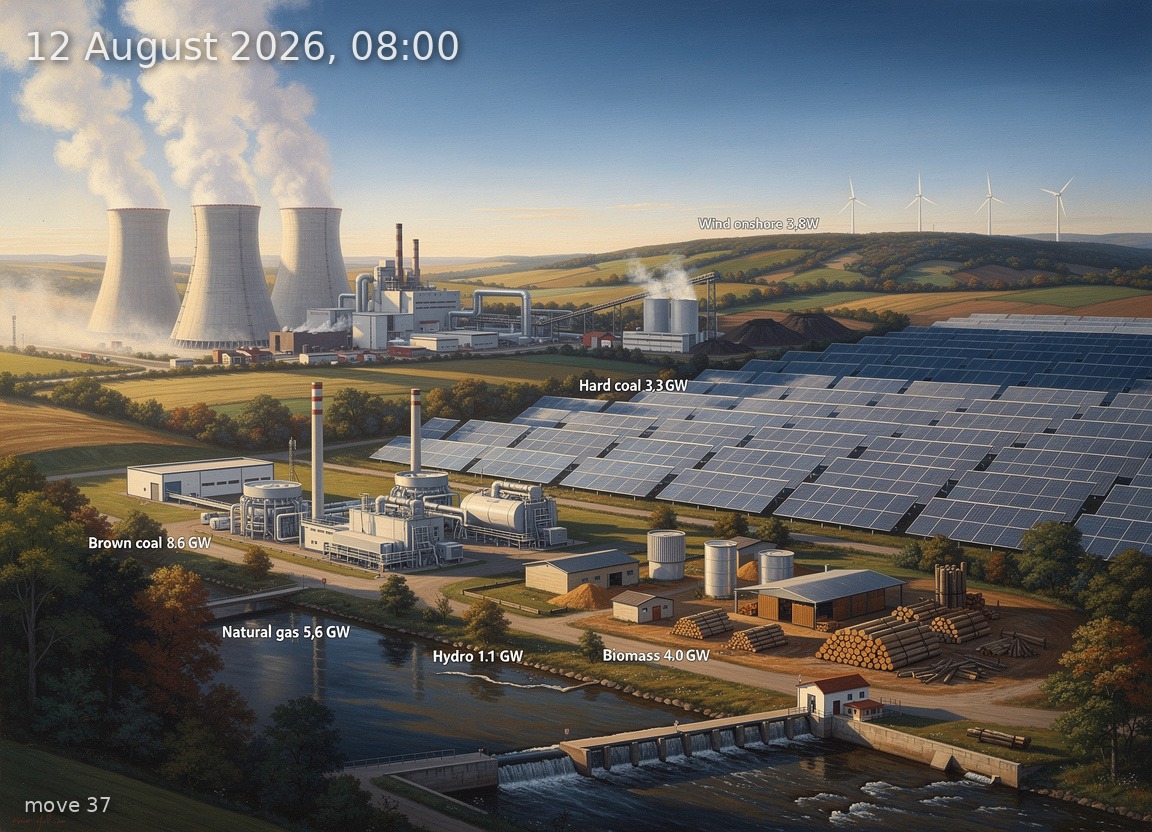
Strong solar and heavy coal generation meet morning demand, but 10 GW net imports are needed under calm winds.
Generation mix
Wind onshore 8%
Wind offshore 0%
Solar 45%
Biomass 8%
Hydro 2%
Natural gas 12%
Hard coal 7%
Brown coal 18%
64%
Renewable share
3.8 GW
Wind (on + offshore)
21.9 GW
Solar
48.3 GW
Total generation
10.0 GW
Net import
155.2 EUR/MWh
Day-ahead price
10.8°C / 5 km/h
Temp / Wind speed
Open-Meteo, Kassel (51.3°N 9.5°E) · surface estimate from 100 m wind
0.0% / 71.0 W/m²
Cloud cover / Radiation
254
gCO₂/kWh
Image prompt
Solar 21.9 GW dominates the right half of the scene as vast fields of aluminium-framed crystalline silicon photovoltaic panels stretching across rolling farmland, angled south and glinting under a clear morning sun low in the eastern sky. Brown coal 8.6 GW occupies the left quarter as a massive lignite power station complex with four hyperbolic concrete cooling towers emitting thick white steam plumes rising into the still air. Natural gas 5.6 GW appears as two compact CCGT power blocks with tall single exhaust stacks and heat-recovery units in the left-centre middle ground. Hard coal 3.3 GW is rendered as a smaller coal-fired station with rectangular mechanical draft cooling towers and a conveyor belt feeding a coal bunker, positioned behind the gas plant. Biomass 4.0 GW appears in the centre-right as a cluster of modest wood-chip fired CHP plants with low cylindrical stacks and timber storage yards. Wind onshore 3.8 GW is shown as a sparse row of six three-blade turbines on a distant ridge, their rotors barely turning in the near-calm air. Hydro 1.1 GW is a small run-of-river station with a weir visible along a river in the foreground valley. The sky is entirely cloudless, deep blue overhead shading to a pale warm haze near the eastern horizon where the August morning sun casts long golden shadows westward. The temperature is cool for summer — vegetation is lush green but with a slight dewy freshness. The atmosphere feels heavy and oppressive despite the clarity, with a faint yellowish industrial haze hanging near the thermal plants, reflecting the high electricity price. The landscape is gently undulating central German terrain with mixed deciduous forest edges, wheat stubble fields, and small villages. Rendered as a highly detailed oil painting in the tradition of 19th-century German Romantic landscape painters such as Caspar David Friedrich and Carl Blechen — rich saturated colour, visible confident brushwork, dramatic atmospheric depth and chiaroscuro, meticulous engineering detail on every turbine nacelle, panel frame, cooling tower shell, and exhaust stack. No text, no labels.