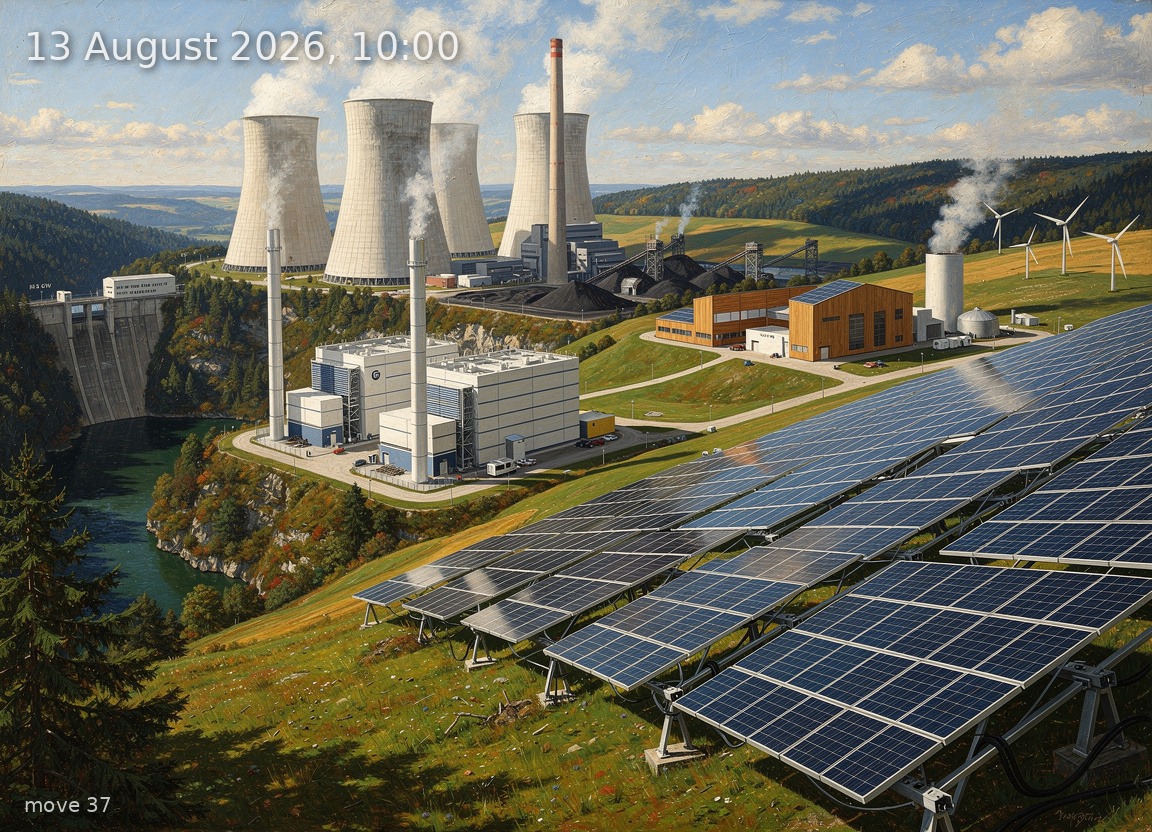
Solar at 46 GW drives 80% renewables; coal and gas persist as Germany exports nearly 10 GW at midday.
Generation mix
Wind onshore 4%
Wind offshore 1%
Solar 67%
Biomass 6%
Hydro 2%
Natural gas 7%
Hard coal 4%
Brown coal 9%
80%
Renewable share
3.4 GW
Wind (on + offshore)
46.1 GW
Solar
68.5 GW
Total generation
+9.9 GW
Net export
109.6 EUR/MWh
Day-ahead price
20.3°C / 2 km/h
Temp / Wind speed
Open-Meteo, Kassel (51.3°N 9.5°E) · surface estimate from 100 m wind
0.0% / 325.0 W/m²
Cloud cover / Radiation
141
gCO₂/kWh
Image prompt
Solar 46.1 GW dominates the entire right two-thirds of the scene as vast rolling fields of aluminium-framed crystalline silicon photovoltaic panels stretching to the horizon, their blue-black surfaces gleaming under fierce direct sunlight. Brown coal 6.4 GW occupies the left background as a cluster of massive hyperbolic cooling towers emitting thick white steam plumes rising into the still air. Natural gas 5.0 GW appears in the left-centre as two compact CCGT power blocks with tall single exhaust stacks venting thin heat shimmer. Hard coal 2.6 GW sits behind the gas units as a smaller conventional plant with a single square chimney and coal conveyors. Biomass 3.8 GW is represented in the mid-ground as a modest timber-clad biomass plant with a rounded silo and a low stack releasing pale vapour. Wind onshore 2.7 GW appears as a sparse line of four three-blade turbines on a distant ridge, their rotors barely turning in the dead-calm air. Wind offshore 0.7 GW is a faint suggestion of two turbines on the far hazy horizon. Hydro 1.2 GW is a small concrete dam and powerhouse nestled in a wooded valley at the far left edge. The sky is completely cloudless, an intense, deep summer blue, with the August sun at about 55 degrees elevation casting strong shadows to the northwest. The atmosphere feels oppressive and heavy—heat haze shimmers above the panels and over the coal plant yards, conveying the elevated electricity price. Vegetation is lush midsummer green but slightly parched. The landscape is gently undulating central German terrain. Style: highly detailed oil painting in the tradition of 19th-century German Romantic landscape painters such as Caspar David Friedrich and Carl Blechen, with rich saturated colour, visible textured brushwork, dramatic atmospheric depth and chiaroscuro, but rendered with meticulous engineering accuracy for every technology—correct turbine nacelle geometry, realistic PV module frames and wiring, authentic cooling tower proportions with natural-draft hyperboloid profiles, proper CCGT exhaust configurations. The painting should feel monumental and contemplative, an industrial sublime masterwork. No text, no labels.