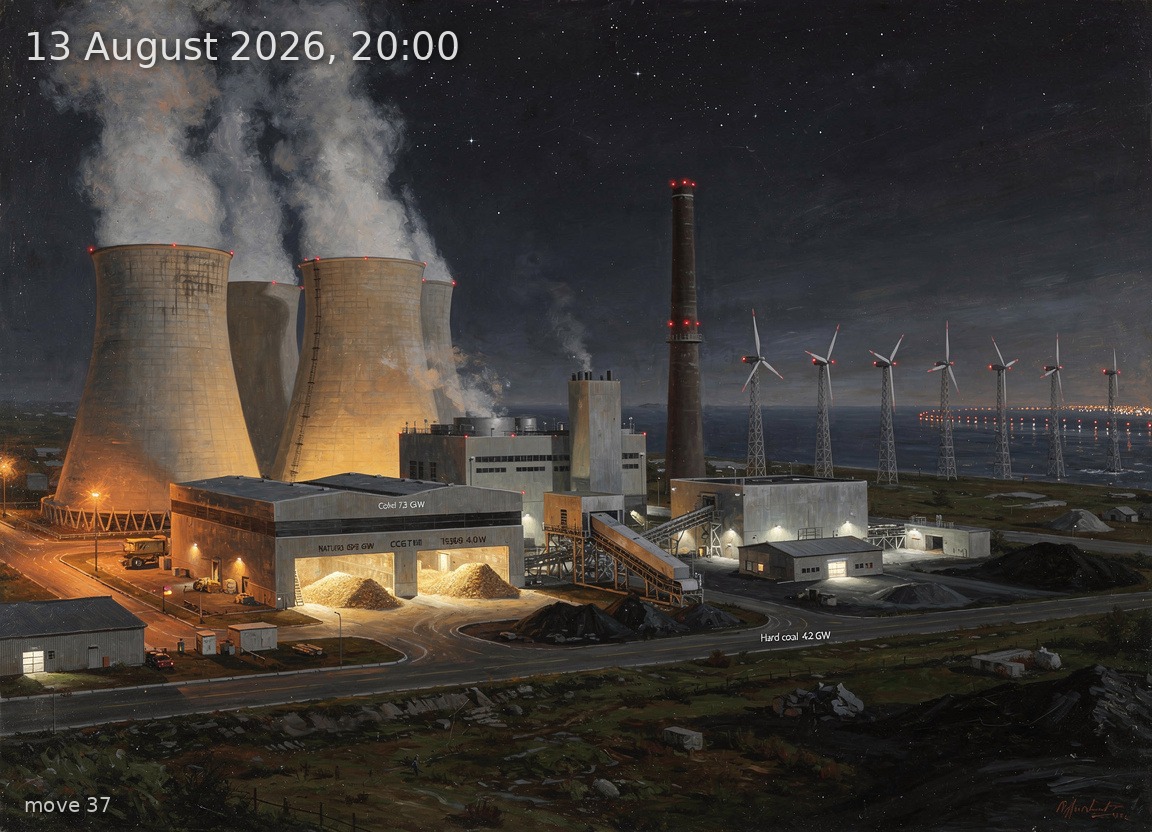
Coal and gas anchor evening generation while 18.8 GW of net imports fill the gap left by fading solar.
Generation mix
Wind onshore 26%
Wind offshore 5%
Solar 2%
Biomass 11%
Hydro 3%
Natural gas 21%
Hard coal 12%
Brown coal 21%
47%
Renewable share
10.5 GW
Wind (on + offshore)
0.7 GW
Solar
34.9 GW
Total generation
18.8 GW
Net import
338.9 EUR/MWh
Day-ahead price
28.2°C / 14 km/h
Temp / Wind speed
Open-Meteo, Kassel (51.3°N 9.5°E) · surface estimate from 100 m wind
0.0% / 81.0 W/m²
Cloud cover / Radiation
361
gCO₂/kWh
Image prompt
Brown coal 7.3 GW dominates the left quarter of the scene as a cluster of four massive hyperbolic cooling towers with thick white-grey steam plumes, lit from below by sodium-orange industrial floodlights against a fully dark night sky. Natural gas 7.2 GW occupies the centre-left as two compact CCGT power blocks with tall single exhaust stacks emitting thin heat shimmer, their metal cladding reflecting amber security lighting. Hard coal 4.2 GW appears centre-right as a smaller coal plant with a single large stack and conveyor belts, coal piles dimly visible under halogen lamps. Wind onshore 8.9 GW spans the right third as a long row of tall three-blade turbines on lattice towers stretching into darkness, red aviation warning lights blinking on each nacelle, blades turning at moderate speed in 14 km/h winds. Wind offshore 1.6 GW is suggested by a distant cluster of smaller turbine lights on the far-right horizon. Biomass 4.0 GW is rendered as a mid-sized wood-chip-fed generating station with a modest rectangular stack and a warm glow from open loading bays, positioned between the gas plant and the wind turbines. Hydro 1.0 GW appears as a small illuminated dam structure in the middle distance, water glinting under floodlights. Solar 0.7 GW is a barely visible field of dark crystalline silicon panels in the foreground, catching only faint reflected industrial light, clearly producing almost nothing. The sky is completely black with scattered stars, no twilight, no horizon glow—a deep August night at 20:00 in central Germany. The atmosphere is heavy and oppressive, a lingering 28 °C summer heat suggested by haze around the cooling towers and a slight shimmer above the asphalt. Vegetation is lush midsummer green but darkened, visible only where light spills from the plants. The painting style is a highly detailed oil painting in the tradition of 19th-century German Romantic landscape art—rich impasto brushwork, dramatic chiaroscuro between industrial light and enveloping darkness, atmospheric depth with layers of steam and haze, meticulous engineering accuracy on every turbine nacelle, cooling tower, and exhaust stack. No text, no labels.