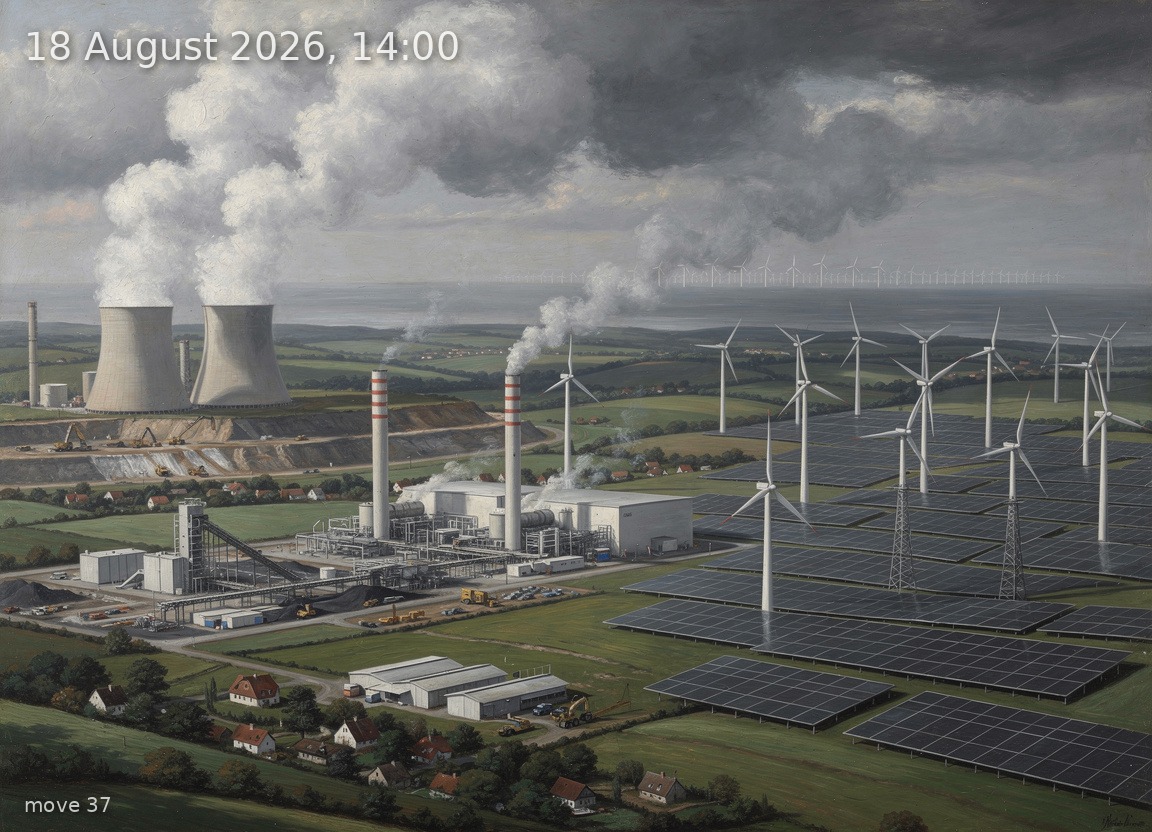
Overcast skies limit solar to diffuse output; onshore wind and thermal plants share the load, with 6.6 GW net imports filling the gap.
Generation mix
Wind onshore 25%
Wind offshore 4%
Solar 35%
Biomass 7%
Hydro 3%
Natural gas 10%
Hard coal 9%
Brown coal 7%
74%
Renewable share
14.2 GW
Wind (on + offshore)
17.6 GW
Solar
49.9 GW
Total generation
6.6 GW
Net import
130.5 EUR/MWh
Day-ahead price
16.0°C / 12 km/h
Temp / Wind speed
Open-Meteo, Kassel (51.3°N 9.5°E) · surface estimate from 100 m wind
100.0% / 5.0 W/m²
Cloud cover / Radiation
178
gCO₂/kWh
Image prompt
Solar 17.6 GW occupies the right third of the scene as vast fields of aluminium-framed crystalline silicon PV panels stretching across gentle rolling hills, their surfaces reflecting only the flat grey light of a completely overcast sky with no direct sunlight. Wind onshore 12.4 GW dominates the centre-right as dozens of tall three-blade turbines on lattice and tubular towers, rotors turning steadily in moderate wind across green farmland. Wind offshore 1.8 GW appears as a faint cluster of turbines on the distant horizon. Natural gas 4.7 GW sits centre-left as two compact CCGT plants with single tall exhaust stacks releasing thin heat plumes. Hard coal 4.7 GW appears to the left as a large coal-fired station with rectangular boiler houses, conveyor belts, and a cluster of tall chimneys trailing grey smoke. Brown coal 3.7 GW occupies the far left as a pair of massive hyperbolic cooling towers emitting thick white steam plumes against the grey sky, with open-pit mine terraces visible behind them. Biomass 3.6 GW is shown as a mid-sized industrial facility with a wood-chip storage dome and a single modest smokestack near centre. Hydro 1.3 GW appears as a small dam and reservoir nestled in a wooded valley in the background. The sky is entirely covered in a heavy, oppressive, uniform blanket of stratiform cloud — no blue sky, no sun disc visible — casting flat, shadowless, diffuse daylight consistent with 14:00 in August. The atmosphere feels heavy and pressured, reflecting the high electricity price. Vegetation is lush mid-summer green but muted under the overcast light, with cool-toned grass and leafy deciduous trees suggesting 16°C. The landscape is a broad panoramic German lowland-to-upland transition with fields, gentle hills, and scattered villages. Rendered as a highly detailed oil painting in the tradition of 19th-century German Romantic landscape painters such as Caspar David Friedrich and Carl Blechen — rich layered colour, visible impasto brushwork, atmospheric depth and haze, dramatic tonal contrasts between the pale industrial steam and the dark grey sky. Every piece of energy infrastructure is painted with meticulous engineering accuracy: three-blade rotor profiles, nacelle housings, cooling tower parabolic curves, substation transformers, high-voltage transmission lines crossing the scene. No text, no labels, no people in foreground.