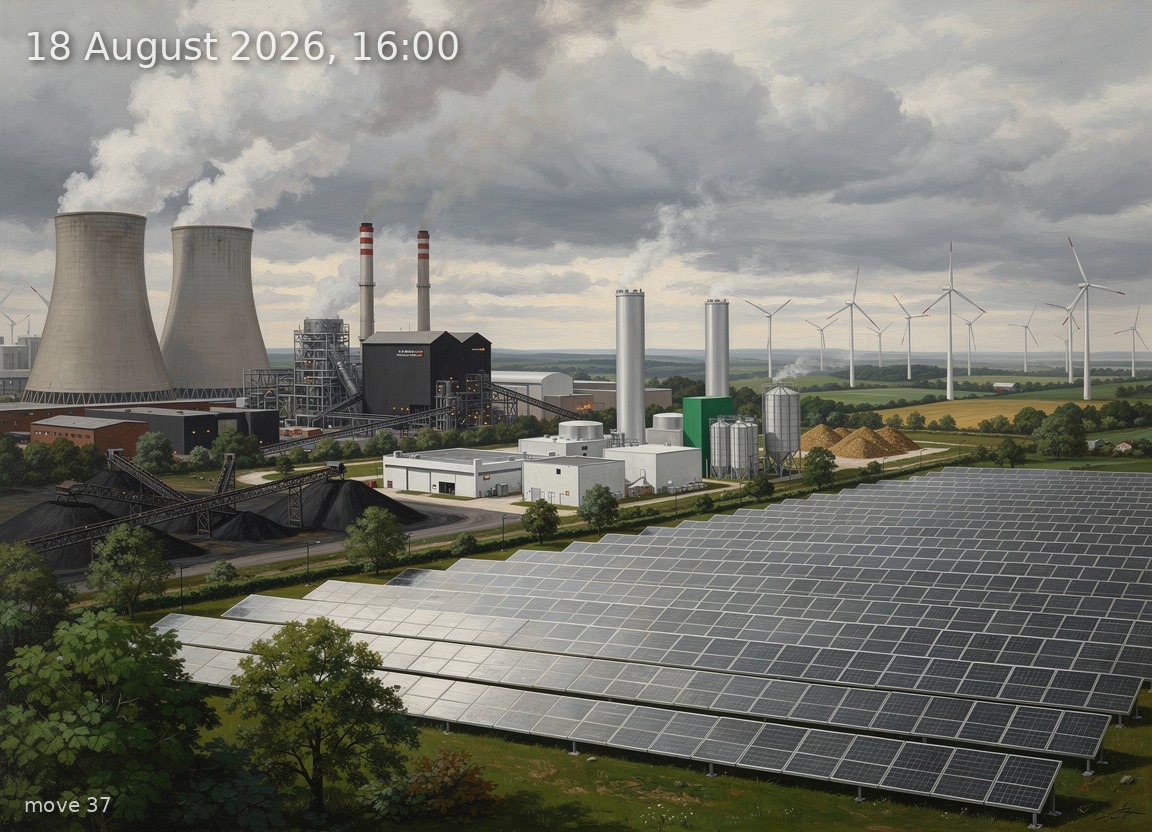
Wind and diffuse solar lead generation under full overcast, but 8 GW net imports fill the gap at elevated prices.
Generation mix
Wind onshore 29%
Wind offshore 4%
Solar 28%
Biomass 8%
Hydro 3%
Natural gas 11%
Hard coal 10%
Brown coal 8%
72%
Renewable share
15.7 GW
Wind (on + offshore)
13.3 GW
Solar
47.0 GW
Total generation
8.0 GW
Net import
138.9 EUR/MWh
Day-ahead price
16.8°C / 18 km/h
Temp / Wind speed
Open-Meteo, Kassel (51.3°N 9.5°E) · surface estimate from 100 m wind
100.0% / 1.0 W/m²
Cloud cover / Radiation
186
gCO₂/kWh
Image prompt
Wind onshore 13.7 GW dominates the right half of the canvas as dozens of three-blade turbines on lattice and tubular steel towers stretching across rolling green hills, blades turning briskly in moderate wind; solar 13.3 GW fills the centre-right foreground as vast fields of aluminium-framed crystalline silicon PV panels angled toward a sunless sky, their surfaces reflecting dull grey light; natural gas 4.9 GW appears centre-left as a cluster of compact CCGT plants with tall single exhaust stacks emitting thin heat shimmer; hard coal 4.5 GW sits left-of-centre as a large power station with rectangular boiler buildings, conveyor belts feeding dark coal, and a pair of tall chimneys with faint smoke; brown coal 3.5 GW occupies the far left as two hyperbolic cooling towers releasing thick white steam plumes into the heavy air; biomass 3.6 GW appears as a modest wood-chip-fed plant with a green-trimmed stack near the centre; wind offshore 2.0 GW is visible in the distant background as a faint line of turbines on the grey horizon beyond a coastal inlet; hydro 1.3 GW is a small dam and spillway tucked into a wooded valley at the far right edge. The sky is entirely overcast with dense, uniform, oppressive grey-white stratus clouds—no blue sky, no sun disc, no shadows on the ground—diffuse flat daylight of late afternoon at 16:00 in August. Direct solar radiation is essentially zero; lighting is even and muted. The atmosphere feels heavy and pressing, reflecting the high electricity price. Temperature is a mild 16.8 °C; vegetation is lush mid-summer green—full canopy deciduous trees, thick grass—but subdued under the grey pall. Style: highly detailed oil painting in the tradition of 19th-century German Romantic landscape painters such as Caspar David Friedrich and Carl Blechen—rich layered colour despite the overcast palette, visible confident brushwork, atmospheric depth with subtle aerial perspective fading the distant offshore turbines into haze. Each technology rendered with meticulous engineering accuracy: turbine nacelles with anemometers, three-blade rotors with correct pitch, PV panel cell grids visible up close, cooling tower parabolic profiles with condensation plumes, coal conveyor gantries. No text, no labels, no human figures prominent—an industrial landscape as sublime Romantic subject.