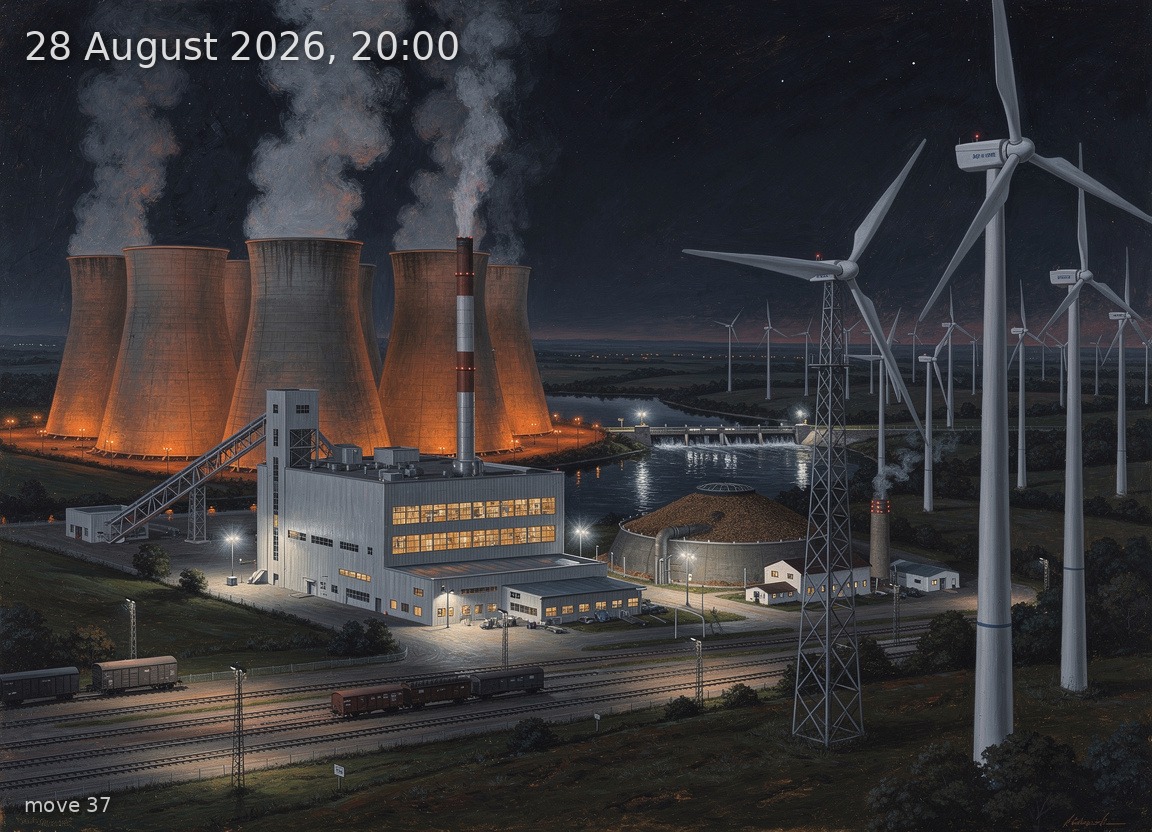
Wind leads at 20 GW but brown coal and net imports of 10.1 GW are needed to cover evening peak demand.
Generation mix
Wind onshore 37%
Wind offshore 11%
Solar 0%
Biomass 10%
Hydro 3%
Natural gas 9%
Hard coal 9%
Brown coal 21%
61%
Renewable share
20.0 GW
Wind (on + offshore)
0.0 GW
Solar
42.4 GW
Total generation
10.1 GW
Net import
176.8 EUR/MWh
Day-ahead price
21.0°C / 9 km/h
Temp / Wind speed
Open-Meteo, Kassel (51.3°N 9.5°E) · surface estimate from 100 m wind
70.0% / 10.0 W/m²
Cloud cover / Radiation
286
gCO₂/kWh
Image prompt
Brown coal 8.9 GW dominates the left quarter of the scene as a cluster of massive hyperbolic cooling towers with thick white-grey steam plumes rising into the night sky, their concrete forms lit from below by orange sodium lamps; wind onshore 15.5 GW fills the right half and recedes into the deep background as dozens of tall three-blade turbines on lattice and tubular towers, their red aircraft warning lights blinking in the darkness, rotors turning steadily; wind offshore 4.5 GW is suggested at the far right horizon by a faint row of turbine lights over a dark estuary; hard coal 3.8 GW appears as a rectangular power station with a tall smokestack and conveyor belt structure, glowing industrial windows, positioned center-left behind a rail yard; natural gas 3.9 GW sits at center as a compact combined-cycle gas turbine plant with a single tall exhaust stack emitting a thin heat shimmer, its metal cladding reflecting floodlight; biomass 4.4 GW is rendered as a mid-sized industrial facility with a woodchip storage dome and a modest chimney, positioned between the coal plants; hydro 1.3 GW appears as a small dam structure in the middle distance with water gleaming under floodlights. The sky is completely dark — deep navy to black, no twilight, no sunset glow — it is 20:00 in late August. Stars are mostly obscured by 70 percent cloud cover, thick clouds pressing down oppressively, reflecting the amber industrial glow from below, creating a heavy, brooding atmosphere suggesting high electricity prices. The landscape is a gentle central German rolling plain with late-summer green vegetation, deciduous trees in full leaf, temperature mild at 21°C. Ground-level wind is moderate, shown by gently swaying grass and tree movement. Power transmission lines with steel lattice pylons cross the scene, connecting the disparate generation sources. The entire composition is rendered as a highly detailed oil painting in the tradition of 19th-century German Romantic landscape painters — rich impasto brushwork, deep chiaroscuro contrasts between the glowing industrial facilities and the vast dark sky, atmospheric depth with haze and steam softening distant turbines, meticulous engineering accuracy on every nacelle, cooling tower, and exhaust stack. No text, no labels.