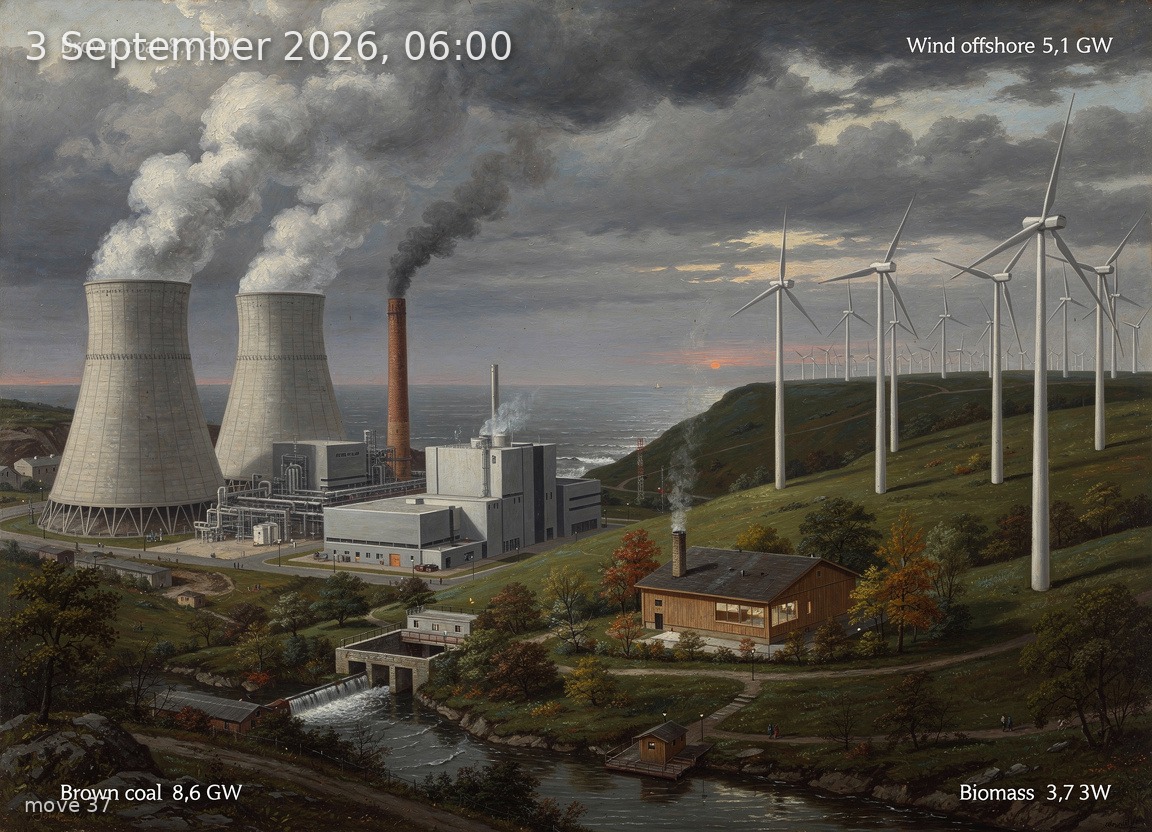
Strong wind leads generation but coal and gas fill gaps as overcast dawn and net imports drive prices to 174 EUR/MWh.
Generation mix
Wind onshore 43%
Wind offshore 12%
Solar 0%
Biomass 8%
Hydro 1%
Natural gas 7%
Hard coal 9%
Brown coal 20%
64%
Renewable share
23.6 GW
Wind (on + offshore)
0.2 GW
Solar
43.6 GW
Total generation
7.0 GW
Net import
174.4 EUR/MWh
Day-ahead price
13.4°C / 18 km/h
Temp / Wind speed
Open-Meteo, Kassel (51.3°N 9.5°E) · surface estimate from 100 m wind
100.0% / 0.0 W/m²
Cloud cover / Radiation
266
gCO₂/kWh
Image prompt
Wind onshore 18.6 GW dominates the right two-thirds of the composition as dozens of tall three-blade turbines with white tubular towers and nacelles stretching across rolling green hills, blades visibly turning in moderate wind. Wind offshore 5.1 GW appears in the far-right background as a cluster of turbines standing in a slate-grey North Sea glimpsed through a gap in the terrain. Brown coal 8.6 GW occupies the left foreground as a massive lignite power station with three hyperbolic concrete cooling towers emitting thick white-grey steam plumes that merge with the overcast sky. Hard coal 4.1 GW sits just to the right of the lignite plant as a smaller coal-fired station with rectangular boiler buildings and a tall brick chimney trailing dark smoke. Natural gas 3.1 GW appears as a compact CCGT facility with a single sleek exhaust stack and visible heat shimmer, positioned in the centre-left middle ground. Biomass 3.7 GW is rendered as a modest wood-clad biomass plant with a short stack and steam wisps, nestled among trees at the centre of the scene. Hydro 0.4 GW is barely visible as a small weir and turbine house beside a river running through the valley floor. The sky is entirely covered with heavy, low stratocumulus clouds in tones of slate, pewter, and charcoal — no blue sky visible — creating a dense, oppressive atmosphere reflecting the high electricity price. The lighting is early dawn at 06:00 in September: a pale, cold blue-grey pre-dawn glow diffusing through the cloud layer from the eastern horizon, no direct sunlight, no warm tones, just the faintest brightening along the horizon line. No solar panels anywhere. The landscape is early-autumn central German terrain with dark green meadows, some yellowing deciduous trees, and dew on the grass. The air feels cool at 13°C. Painted in the style of a highly detailed 19th-century German Romantic oil painting — rich impasto brushwork, atmospheric depth and haze, dramatic chiaroscuro between the glowing industrial facilities and the dark dawn sky — but with meticulous engineering accuracy on every turbine nacelle, cooling tower, and exhaust stack. No text, no labels.