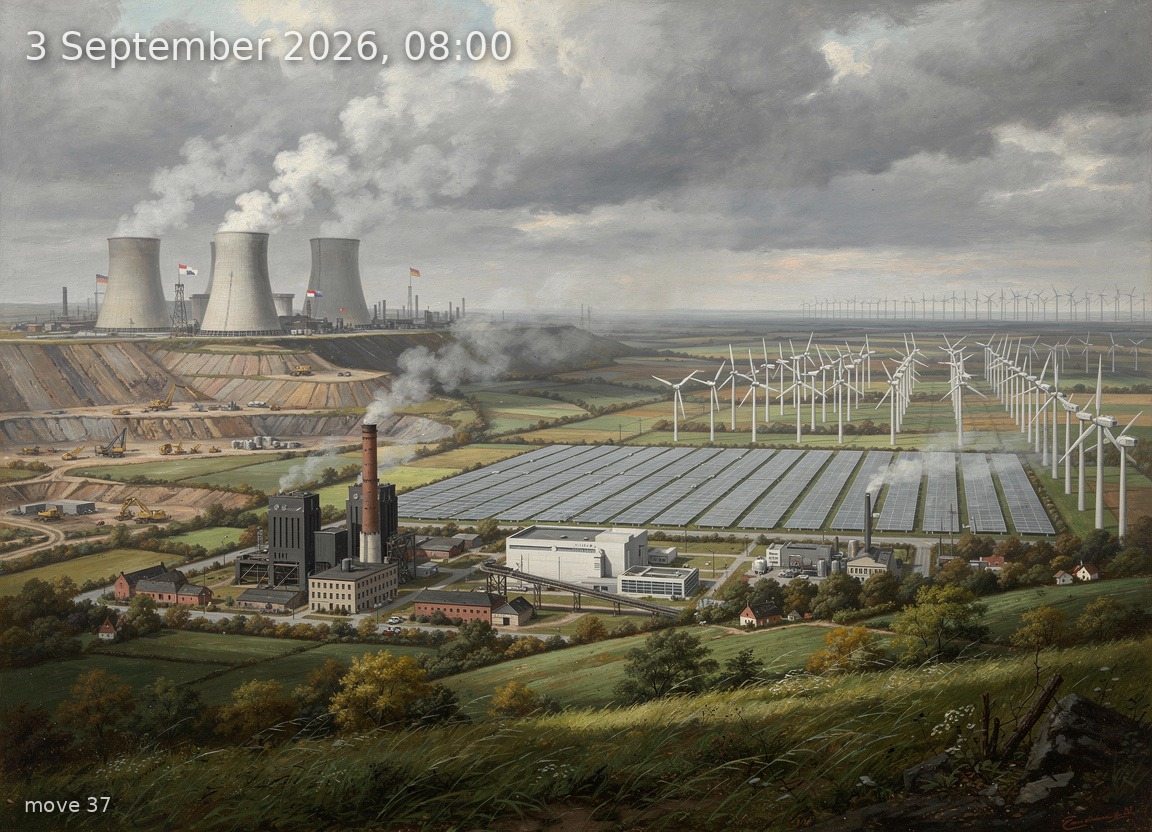
Strong onshore wind leads at 22 GW under full overcast, with brown coal and thermal plants firming a tight supply-demand balance.
Generation mix
Wind onshore 38%
Wind offshore 9%
Solar 17%
Biomass 7%
Hydro 1%
Natural gas 6%
Hard coal 7%
Brown coal 15%
72%
Renewable share
27.5 GW
Wind (on + offshore)
9.9 GW
Solar
57.8 GW
Total generation
1.2 GW
Net import
180.0 EUR/MWh
Day-ahead price
13.7°C / 22 km/h
Temp / Wind speed
Open-Meteo, Kassel (51.3°N 9.5°E) · surface estimate from 100 m wind
100.0% / 4.0 W/m²
Cloud cover / Radiation
203
gCO₂/kWh
Image prompt
Wind onshore 22.0 GW dominates the right two-thirds of the scene as vast ranks of three-blade turbines on lattice and tubular towers stretching across rolling central German farmland, rotors spinning briskly in strong wind; wind offshore 5.4 GW appears as a distant line of larger turbines on the far-right horizon above a faintly visible grey sea. Solar 9.9 GW occupies a modest mid-ground strip as fields of aluminium-framed crystalline silicon PV panels, their surfaces dull and reflectionless under the thick overcast, producing weakly. Brown coal 8.5 GW fills the left portion as massive hyperbolic cooling towers emitting heavy white-grey steam plumes that merge with the low cloud ceiling, beside open lignite pit mines with terraced earth. Hard coal 4.1 GW appears as a smaller coal-fired station with a tall brick chimney and conveyor belts, positioned left-centre. Natural gas 3.5 GW is rendered as a compact CCGT plant with a single sleek exhaust stack and modest heat shimmer, placed centre-left. Biomass 4.0 GW shows as a wood-chip-fed plant with a squat cylindrical silo and thin smoke, tucked between the coal and gas facilities. Hydro 0.4 GW is a small run-of-river weir barely visible in a stream in the foreground. The sky is entirely covered by a thick, oppressive, low stratus cloud layer — 100% cloud cover — casting flat diffuse daylight with no shadows and no visible sun; the light is cool and grey, consistent with 08:00 morning in early September. The atmosphere feels heavy and pressured, reflecting the high 180 EUR/MWh electricity price. Temperature is a cool 13.7°C: the vegetation is late-summer green beginning to hint at autumn yellowing, with dew on grass. Wind visibly bends the tall grass and whips flags on industrial buildings. Painted in the style of a highly detailed 19th-century German Romantic oil painting — rich, layered colour with visible confident brushwork, atmospheric depth receding into misty industrial horizons — yet every turbine nacelle, every cooling tower's parabolic profile, every PV cell grid is rendered with meticulous engineering accuracy. No text, no labels.