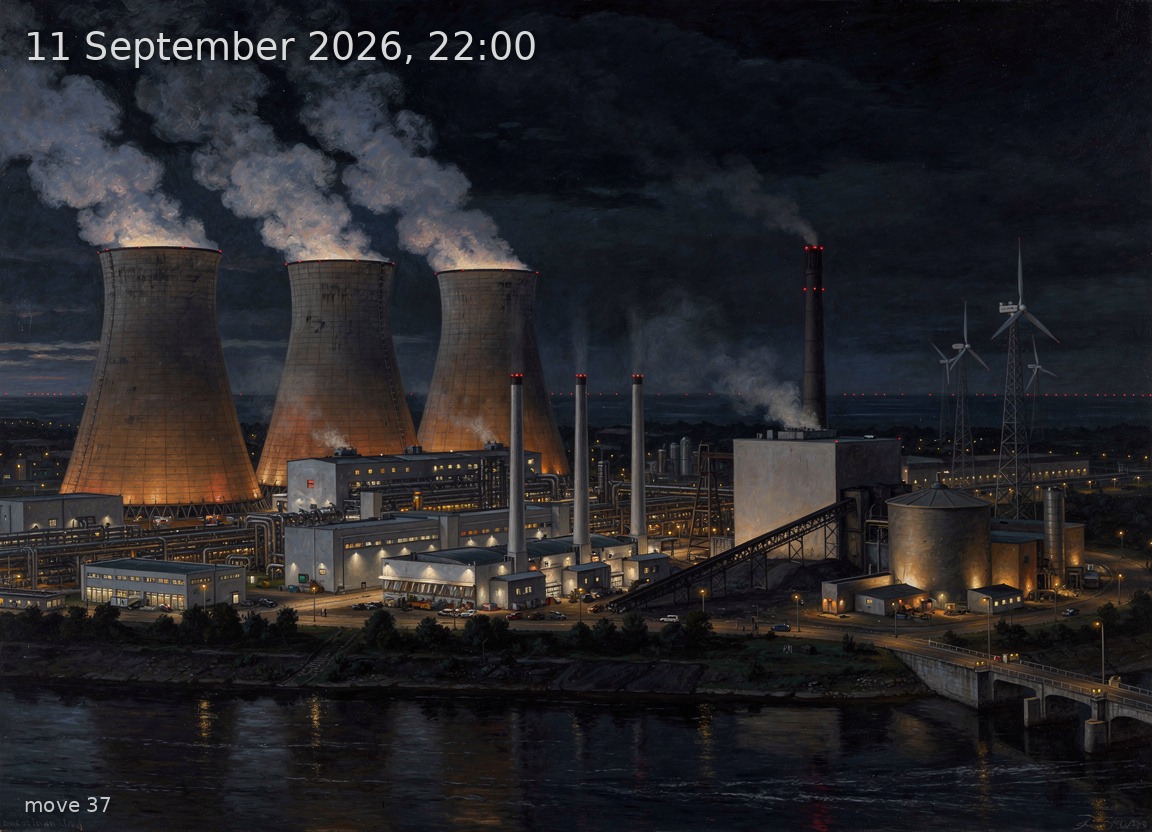
Brown coal, gas, and hard coal dominate a low-wind, post-sunset grid requiring 12 GW net imports.
Generation mix
Wind onshore 10%
Wind offshore 3%
Biomass 12%
Hydro 3%
Natural gas 23%
Hard coal 16%
Brown coal 34%
28%
Renewable share
4.7 GW
Wind (on + offshore)
0.0 GW
Solar
36.4 GW
Total generation
12.0 GW
Net import
225.0 EUR/MWh
Day-ahead price
17.1°C / 5 km/h
Temp / Wind speed
Open-Meteo, Kassel (51.3°N 9.5°E) · surface estimate from 100 m wind
65.0% / 0.0 W/m²
Cloud cover / Radiation
508
gCO₂/kWh
Image prompt
Brown coal 12.2 GW dominates the left third of the scene as a massive lignite power plant complex with four hyperbolic cooling towers releasing thick white steam plumes into the night sky; natural gas 8.4 GW occupies the centre-left as a row of compact CCGT plants with tall slender exhaust stacks emitting thin heat shimmer, lit by amber industrial floodlights; hard coal 5.8 GW sits at the centre-right as a large conventional coal station with rectangular boiler houses, conveyor belts, and a single large chimney with a red aviation warning light; biomass 4.2 GW appears as a modest wood-fired CHP plant with a rounded silo and short stack, warmly lit; wind onshore 3.7 GW is visible in the far right background as a small cluster of three-blade turbines on lattice towers, their rotors turning very slowly in light air, nacelle lights blinking red; wind offshore 1.0 GW is suggested by distant tiny red lights on the far horizon line; hydro 1.1 GW appears as a small concrete dam structure at the far right edge with spillway illuminated by a single floodlight. The sky is completely dark, deep navy-black with no twilight or glow on the horizon, 65% cloud cover visible as heavy dark clouds partially obscuring faint stars. The atmosphere is heavy, oppressive, and hazy—reflecting the extreme 225 EUR/MWh price—with industrial smoke and steam mingling in the still, warm September night air at 17°C, mild enough for green but darkened deciduous trees along a river in the foreground reflecting the orange sodium streetlights and industrial glow of the power stations. Highly detailed oil painting in the tradition of 19th-century German Romantic landscape painters such as Caspar David Friedrich and Carl Blechen, with rich deep colour, visible confident brushwork, atmospheric depth and chiaroscuro, meticulous engineering detail on every turbine nacelle, cooling tower, and exhaust stack, the scene feeling like a monumental masterwork painting of the nocturnal industrial landscape. No text, no labels.