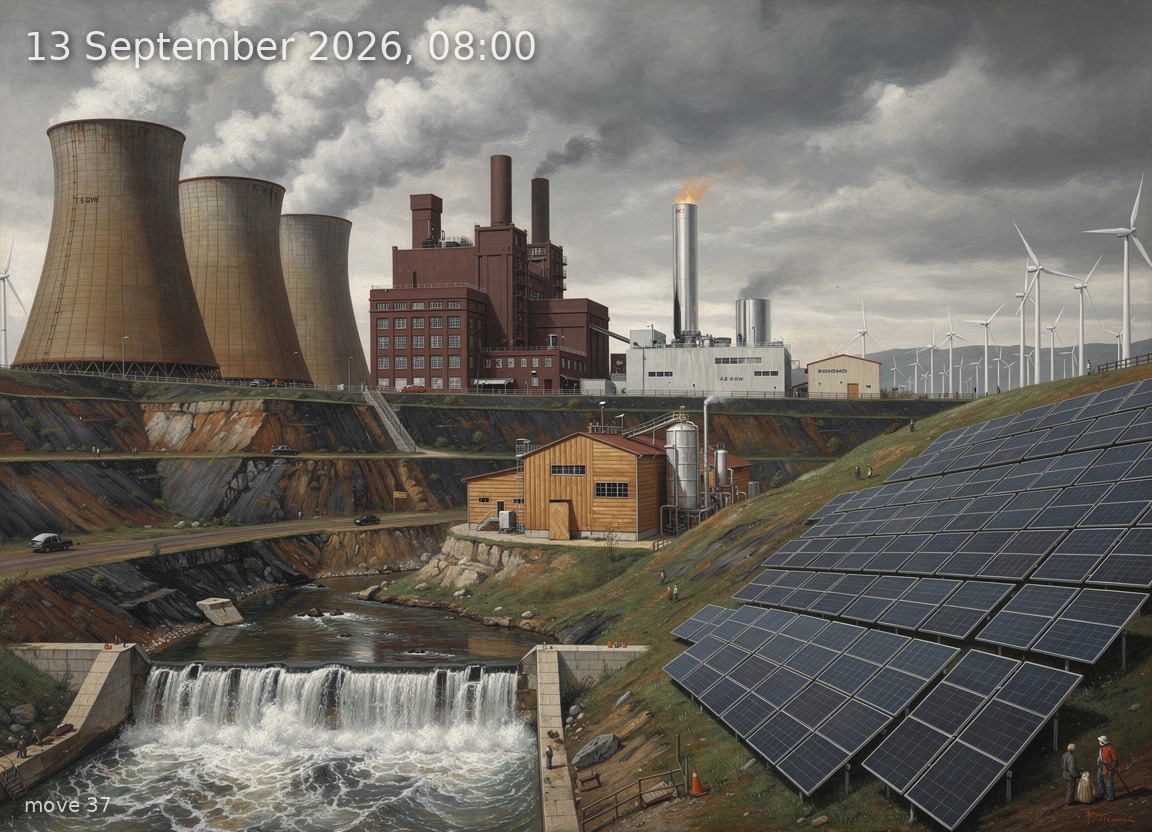
Wind leads at 13.7 GW combined, coal provides 11.4 GW baseload, and 8.2 GW net imports fill the gap at a zero clearing price.
Generation mix
Wind onshore 31%
Wind offshore 6%
Solar 14%
Biomass 11%
Hydro 2%
Natural gas 6%
Hard coal 11%
Brown coal 20%
64%
Renewable share
13.6 GW
Wind (on + offshore)
5.1 GW
Solar
37.3 GW
Total generation
8.2 GW
Net import
—
Day-ahead price
14.8°C / 14 km/h
Temp / Wind speed
Open-Meteo, Kassel (51.3°N 9.5°E) · surface estimate from 100 m wind
100.0% / 0.0 W/m²
Cloud cover / Radiation
271
gCO₂/kWh
Image prompt
Brown coal 7.5 GW dominates the left quarter as a cluster of massive hyperbolic cooling towers with thick white-grey steam plumes merging into the overcast sky, surrounded by open-pit lignite excavation terraces in ochre and rust tones; hard coal 3.9 GW appears just right of centre-left as a dark brick power station with twin rectangular stacks trailing thin smoke; natural gas 2.1 GW sits as a compact CCGT plant with a single polished exhaust stack and modest heat shimmer; wind onshore 11.4 GW spans the entire right half and background as dozens of tall three-blade turbines on lattice and tubular towers, rotors visibly canted by moderate wind, receding across rolling green-gold late-summer farmland with hints of early autumn; wind offshore 2.3 GW appears on the far-right horizon as a faint line of turbines standing in a grey North Sea sliver; solar 5.1 GW is shown as aluminium-framed crystalline silicon panels arrayed on a gentle hillside in the mid-ground, their surfaces dull and reflective under diffuse light only, no sunshine or glare; biomass 4.2 GW is a mid-sized wood-clad facility with a rounded silo and thin pale exhaust near the centre; hydro 0.9 GW is a small concrete run-of-river weir with white churning water in the foreground stream. The sky is entirely overcast at 100% cloud cover — a uniform blanket of grey-white stratus at 08:00 morning daylight, soft and even illumination with no shadows, no sun disk visible anywhere. Temperature 14.8°C gives cool early-autumn atmosphere: grass still green but tinged gold, some leaves beginning to turn, dew visible on metal surfaces. The zero electricity price evokes a calm, open, unoppressive atmosphere. Style: highly detailed oil painting in the tradition of 19th-century German Romantic landscape painters — Caspar David Friedrich meets industrial sublime — rich colour palette of slate greys, muted greens, warm browns, visible confident brushwork, atmospheric aerial perspective with distant turbines fading into mist, meticulous engineering accuracy on every nacelle, rotor blade, cooling tower rib, and panel frame. No text, no labels, no human figures prominent.