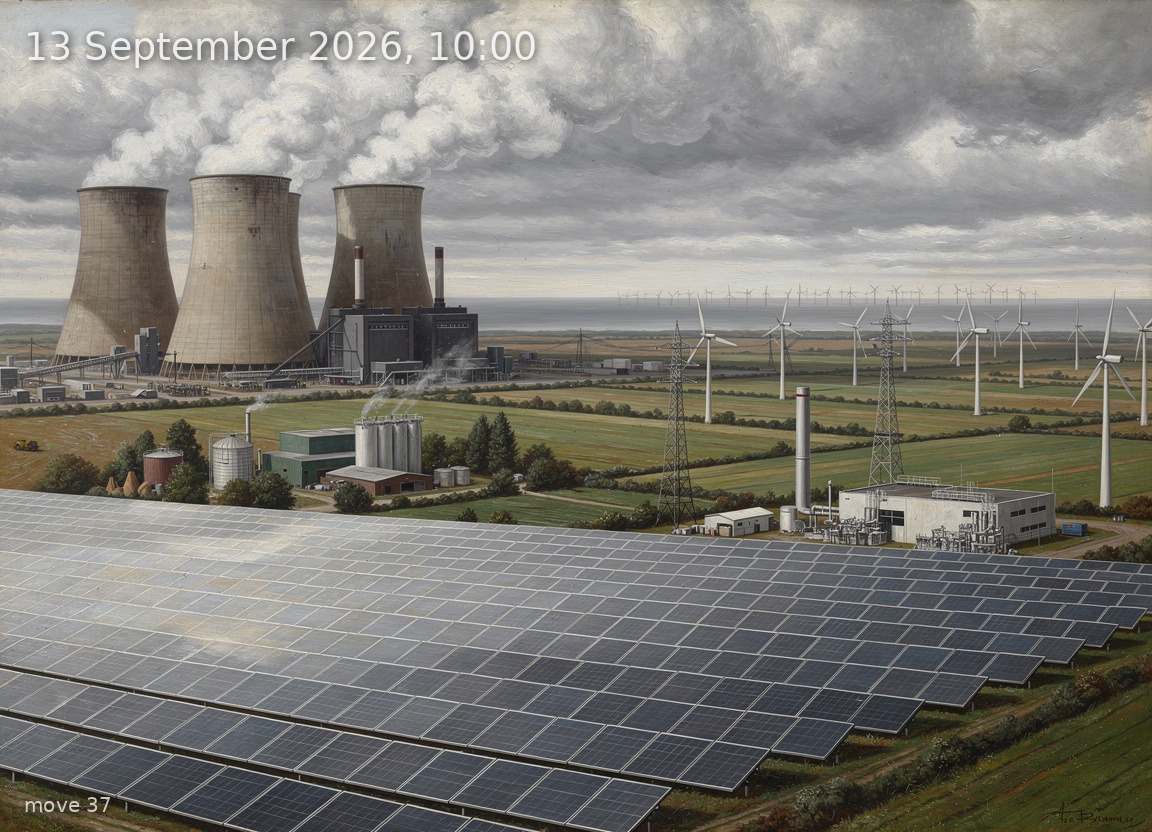
Solar leads at 14.7 GW under full overcast, backed by wind and lignite, with net imports bridging 4.3 GW of shortfall at zero price.
Generation mix
Wind onshore 22%
Wind offshore 4%
Solar 33%
Biomass 9%
Hydro 2%
Natural gas 4%
Hard coal 9%
Brown coal 17%
71%
Renewable share
11.6 GW
Wind (on + offshore)
14.7 GW
Solar
44.4 GW
Total generation
4.4 GW
Net import
—
Day-ahead price
15.7°C / 12 km/h
Temp / Wind speed
Open-Meteo, Kassel (51.3°N 9.5°E) · surface estimate from 100 m wind
100.0% / 5.0 W/m²
Cloud cover / Radiation
221
gCO₂/kWh
Image prompt
Solar 14.7 GW dominates the foreground as an expansive field of aluminium-framed crystalline silicon PV panels stretching across gently rolling farmland, their surfaces reflecting only flat grey light under dense overcast; brown coal 7.4 GW occupies the left quarter as a massive lignite power station with four hyperbolic cooling towers emitting thick white steam plumes that merge into the low cloud base; wind onshore 9.7 GW fills the right third as dozens of three-blade turbines on lattice and tubular steel towers spread across green late-summer fields, rotors slowly turning; hard coal 3.9 GW appears as a coal-fired plant with tall rectangular boiler houses and twin chimneys trailing grey exhaust, positioned behind the solar field at mid-distance; biomass 4.1 GW is rendered as a cluster of smaller industrial buildings with cylindrical wood-pellet silos and modest stacks emitting faint vapour, set among trees at the centre-left; wind offshore 1.8 GW is suggested by a sliver of grey North Sea visible on the far horizon with a row of offshore turbines barely distinguishable in the haze; natural gas 1.7 GW appears as a compact CCGT unit with a single slim exhaust stack and low rectangular heat-recovery building, tucked beside the coal plant; hydro 1.0 GW is a small dam and spillway visible at the far right edge where forested hills begin. The sky is entirely overcast — a uniform blanket of pale grey stratus with no blue or sun visible, lit by diffuse mid-morning daylight at 10:00, casting soft shadowless illumination. Vegetation is late-summer green beginning to show hints of early autumn yellowing, temperature around 16°C giving a cool dampness to the air. The atmosphere is calm and muted — no oppressive weight, reflecting the zero-euro price. Painted in the style of a highly detailed 19th-century German Romantic oil painting — rich layered colour, visible confident brushwork, atmospheric depth and aerial perspective, technically precise engineering details on every installation, the grandeur of Caspar David Friedrich meeting industrial realism. No text, no labels, no people prominent.